




Until recently, naming Kay Fisker in an international architectural conversation would have drawn little more than a polite pause. Since his death in 1965, his work has been well known within Danish architectural culture – the subject of monographs, exhibitions, and sustained professional attention – yet his representative role on the international stage has remained largely in the shadow of a few other canonised Danish names, primarily Arne Jacobsen and Jørn Utzon. This issue of Magasin for Bygningskunst og Kultur sets out to redress that imbalance. It does not seek to simply add Fisker to an existing canon, but rather to open up the very terms on which his work is read, discussed, and used – in history, in practice, and in the classroom.
The timing of this publication is not incidental. Over the past decade, international research on Fisker has matured rapidly. His subdued, large-scale housing estates such as Hornbækhus (1920–1922) and Vestersøhus (1935–1939), his public buildings for the educational and health programmes of the Danish welfare state, and his role as professor and writer at the Royal Danish Academy have all attracted growing scholarly attention. At the same time, decanonisation processes are already emerging – nowhere more productively than around a project such as Det Danske Institut i Rom (1960–1967), which the contributions to this issue approach from multiple and sometimes contradictory angles. The issue is published in continuation of the international Kay Fisker Symposium: Appraisals and Reappraisals, which took place at the Royal Danish Academy on 29–30 November 2023 and brought together researchers, practitioners, and educators from across Europe and beyond to reconsider Fisker’s legacy in its full complexity.
The eighteen contributions gathered here – seven peer-reviewed academic articles, two artistic research contributions, and nine essays – reflect the breadth of that complexity. They are organised around four thematic strands: Fisker at school; by Fisker; Fisker reread; and cross-cultural Fisker. Rather than enforcing strict boundaries between these strands, the issue allows them to overlap, as Fisker’s work itself tends to do – moving between the domestic and the monumental, the local and the transnational, the historical and the urgently contemporary.
FISKER AT SCHOOL
The first three contributions address the pedagogical dimensions of Fisker’s legacy – both his own teaching practice and the contemporary uses of his buildings in architectural education. Chiara Monterumisi traces Fisker’s pedagogical practice at the Royal Danish Academy over nearly four decades, reconstructing from archival fragments – including study trip itineraries, design assignment briefs, and lantern-slide registers – a remarkably coherent educational project. Students were not passive recipients but active participants in knowledge production, and the generations shaped by Fisker’s teaching were equipped with a transferable mode of reasoning rather than a personal style to imitate.
Paul Kuitenbrouwer describes how, over more than a decade, Fisker’s housing blocks have become a cornerstone of comparative plan analysis in TU Delft’s bachelor curriculum. The article traces the specific ways in which students learn to read, dissect, and ultimately design with historical awareness by working through Fisker’s buildings – from Hornbækhus to Dronningegården. In a pedagogical experiment, here presented and reflected on by Fabio Gigone, American architecture students at DIS Copenhagen are asked to reinterpret Fisker’s housing blocks through the lens of social sustainability, using drawing as both a critical instrument and a design method. The course challenges the dominance of monographic narratives and proposes collective authorship as an alternative.
BY FISKER
The next four contributions focus directly on Fisker’s architectural production, examining specific buildings or project types through close formal, material, or historical analysis. Erik Tonning Jensen traces the journey of a small grey folder containing ten sets of drawings for the Gudhjemsbanen railway stations on Bornholm, signed by Fisker and Aage Rafn in 1915–1916, rescued from a wastepaper bin in Copenhagen in 1983 and kept in a drawer in Norway for decades. The essay reflects on what it means to read, preserve, and pass on a drawing – and on the life of architectural documents beyond the archive. Bruce Peter traces Fisker’s ship interiors, a largely overlooked dimension of his practice: between the mid-1930s and the mid-1950s, Fisker’s office designed the passenger accommodation for a series of Danish vessels, pioneering a functionalist approach to shipboard design that influenced Nordic maritime interiors for decades. The article follows this lineage from the Hammershus (1935) through to the final DSB ferries of the 1990s.
Fisker’s final work, the Ansgar Church in Flensburg, is examined by Samuel Quagliotto through a study of the project’s drawings and sketches. It traces how Fisker rooted his design in the architectural traditions of the place – from Bornholm’s medieval churches to Swedish rural buildings – and reinterpreted them with a quiet, modern sensibility, arriving at a domestic atmosphere in a public building. Riccardo Petrella explores how Fisker in another late work, Det Danske Institut i Rom, wove the terraces, shadows, and spatial sequences of Rome into an architecture that remains unmistakably Nordic – achieving not a clash of identities but an intimate and carefully calibrated conversation between North and South.
FISKER REREAD
Five contributions examine how Fisker’s architecture and thinking have been taken up, translated, and reinterpreted – in his own lifetime and by later practitioners, researchers, and educators. Andreas Vold’s contribution is an experiment in which a language model was trained on Fisker’s own archival texts – lecture notes, essays, articles – and then asked to respond to questions about modernism, anonymity, and the housing crisis. The essay reflects critically on what such synthetic knowledge production reveals about the archive, its silences, and the structures that shape historical understanding.
A phenomenological reading of nine Copenhagen housing buildings is offered by Nicolai Bo Andersen who argues that Fisker’s work presents a viable alternative to contemporary object fetishism. Through a systematic first-person analysis of material vocabulary, the article proposes the concept of quiet attunement to characterise a mode of architecture that is modest in its means and rich in its effects – and that may serve as a model for sustainable building culture in a biophysically constrained world. Guia Baratelli examines how Fisker and Povl Baumann, through Vestersøhus and Storgården respectively, arrived at two complementary responses to the challenge of the modern Danish façade – shaping the image of Copenhagen housing for decades to come and establishing a shared functional tradition. In his artistic research contribution, Frans Drewniak approaches the question of architectural quality through a close reading of Fisker’s brick buildings, drawing an unexpected parallel with the American painter Agnes Martin to articulate the subtle vibrant effects produced by brickwork, jointing, and window proportion that make Fisker’s façades anything but flat.
Rebecca Carrai repositions the celebrated furniture designer Finn Juhl as Fisker’s most consequential pupil, tracing how Fisker’s typological thinking and democratic understanding of housing were translated – at a smaller scale and with a more personal touch – into Juhl’s vision of the home as a dynamic and intimate space. The article recovers a lineage that disciplinary boundaries have tended to obscure.
CROSS-CULTURAL FISKER
The final six contributions examine Fisker’s work in relation to broader international architectural movements and cultural exchanges, situating Danish modernism within a decisively polycentric world. Lovisa Lorén situates a formative early encounter – the young Fisker seeing Sigurd Lewerentz’s work for the first time – within the Baltic Exhibition’s (1914) utopian ambitions and catastrophic ending and reflects on what it means to be a young architect today, standing in the same park more than a century later. Five decades of intellectual exchange between the same two architects – Fisker and Lewerentz – is reconstructed by Martin Søberg through Fisker’s published and unpublished writings, tracing what united them – a shared conviction that architecture is a significant art – and what separated them, as Lewerentz’s intensely personal sensibility remained difficult to translate into a Danish context. In another Danish-Swedish meeting, Max Gerthel recounts how a 1921 house in Löderups Strandbad, Sweden – built by a Swedish ironmonger from Fisker’s winning entry for a Politiken competition – was quietly obscured over decades of extensions and alterations, and how a recent renovation restored Fisker’s original spatial logic as the heart of the house.
In her contribution, Carmen García Sánchez argues that long before biophilic design had a name, Fisker was advocating for an architecture that dissolved the boundary between interior and nature. Her essay traces how his teachings, travels, and international connections – from Swedish functionalism to Japanese spatial ideas – quietly seeded the nature-connecting domestic architecture that would make postwar Denmark famous. Also linking Fisker to East Asia, Sean Yuxiang Li argues that the East Asian objects in Fisker’s office signal more than private taste. Following Fisker’s travels to China and Japan, the article situates his lifelong argument for an anonymous, collective architecture within a polycentric world of images and itineraries, positioning Danish functionalism as formed not only in dialogue with Germany, England, and Sweden but also through East Asian translation.
In this issue’s final contribution, Angela Gigliotti offers an alternative historiography of Det Danske Institut i Rom centred on labour, transnational production, and the contributions of largely unheard workers and collaborators. Drawing on a newly digitised construction archive, she demonstrates that the building’s celebrated Danish identity – embodied in its thousands of yellow bricks – was in fact achieved through Italian concrete, locally produced cladding, and a complex negotiation between Danish design intentions and Italian building culture. What has long been read as an outpost of Danish modernism turns out to be a genuinely hybrid object.
Together, these contributions make the case that Fisker’s work repays sustained attention not despite but because of its apparent quietness. In a discipline that has long rewarded the spectacular and the singular, his insistence on the anonymous, the relational, and the socially grounded offers a productive counterpoint – and a set of questions that remain urgent. We hope this issue provides a foundation for the broader reappraisal that Fisker’s work deserves.
–
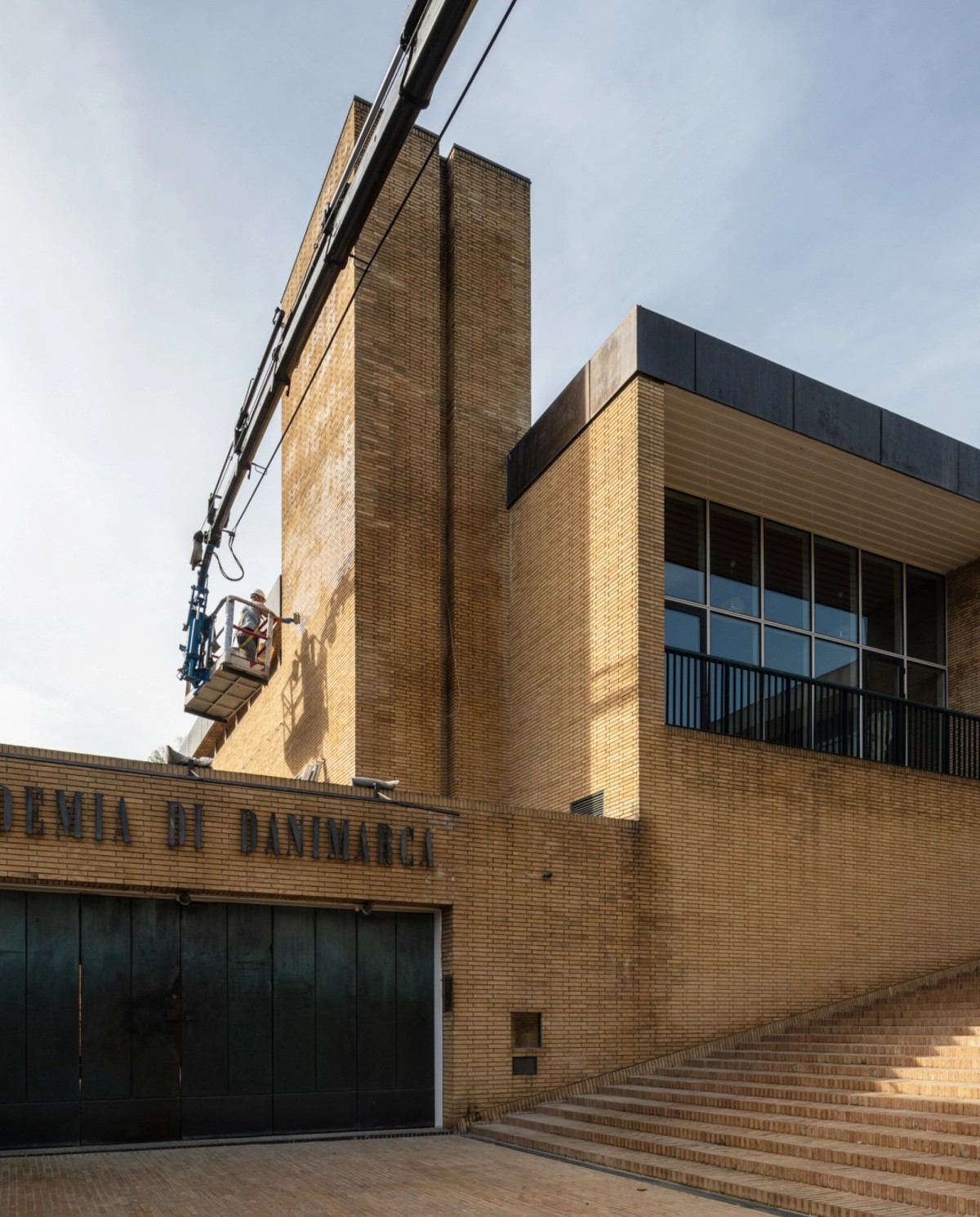
Magasin for Bygningskunst og Kultur no. 11 with the theme “Kay Fisker” is edited by Angela Gigliotti, Postdoctoral Fellow at Eastern Switzerland University of Applied Sciences, Academic Guest at gta/ETH Zürich and Adjunct Faculty at Syracuse University and Martin Søberg, Associate Professor at the Institute of Architecture and Culture, Royal Danish Academy – Architecture, Design, Conservation. Graphic design by Studio Hanna Bergman. Cover image taken at the Danish Academy in Rome during maintenance work by Luca Chiaudano in September 2022. Permission to reproduce the work of Kay Fisker has kindly been granted by Johan Fisker.
Næste: Kay Fisker and Techniques of Knowledge Transmission Across Generations