




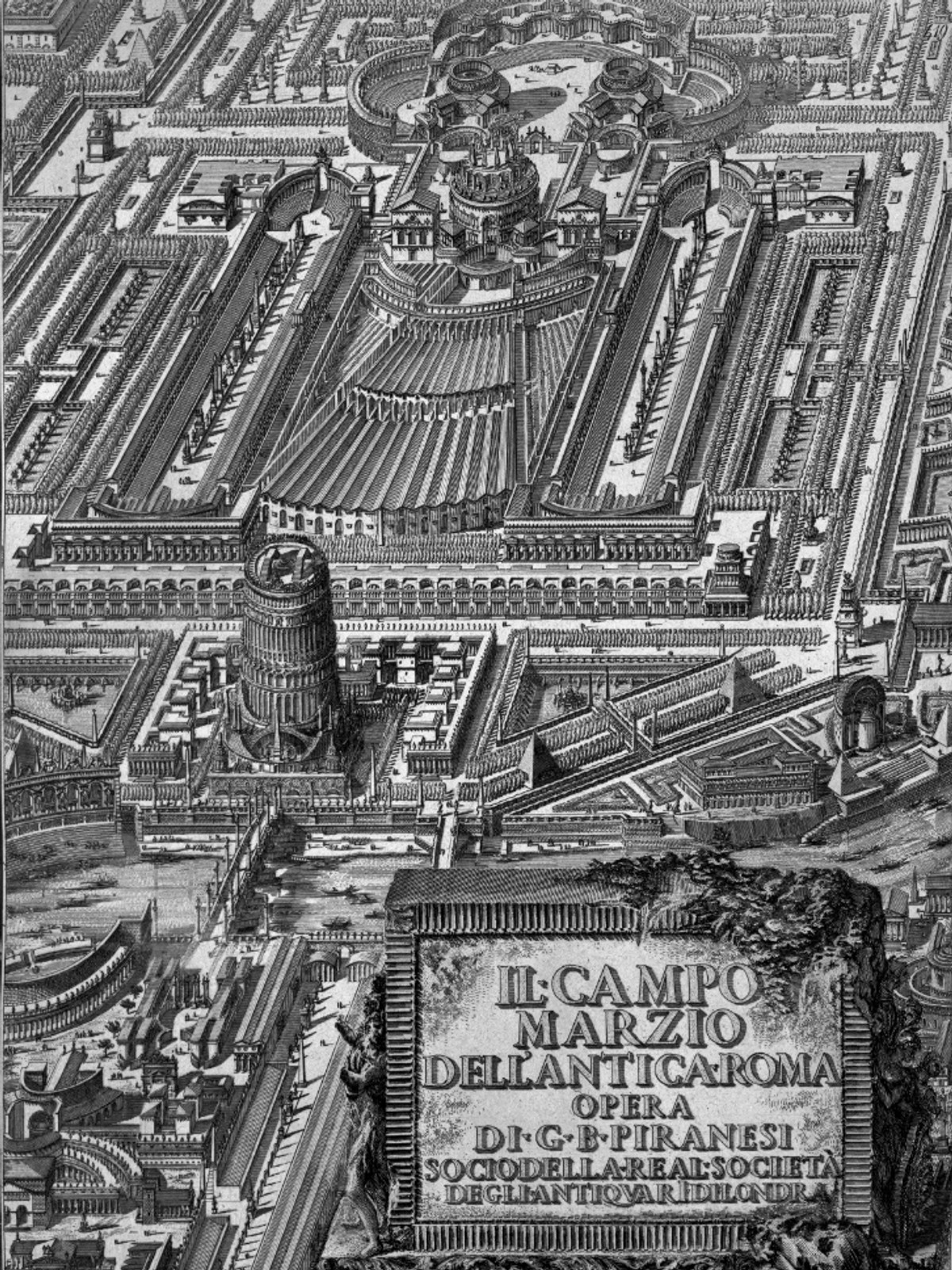
Ill. 1. Giovanni Battista Piranesi, Il Campo Marzio dell’Antica Roma, frontispiece, 1762.
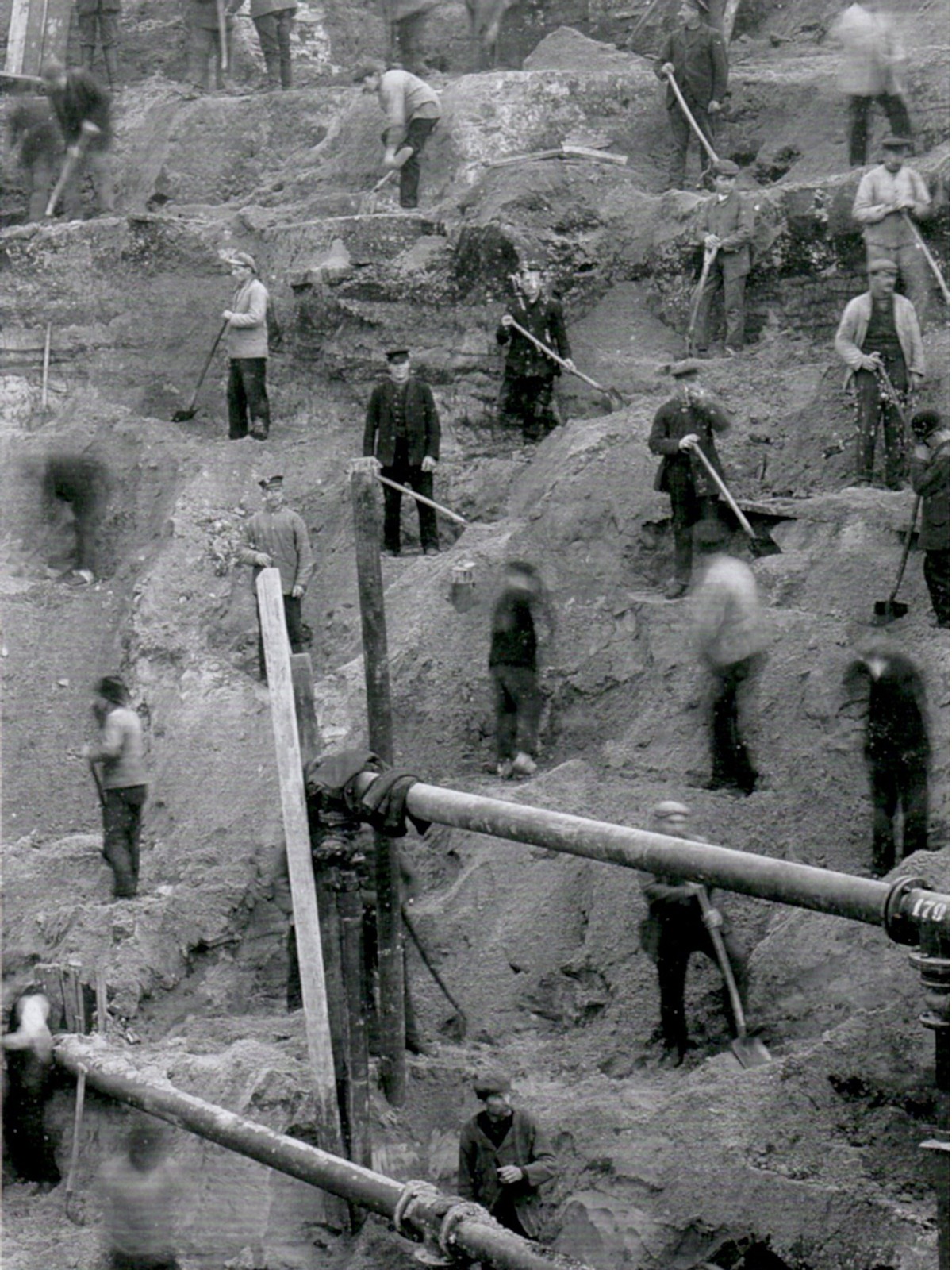
Ill. 2. Construction at Museum Island, Berlin, 1911. Photograph of excavation works.
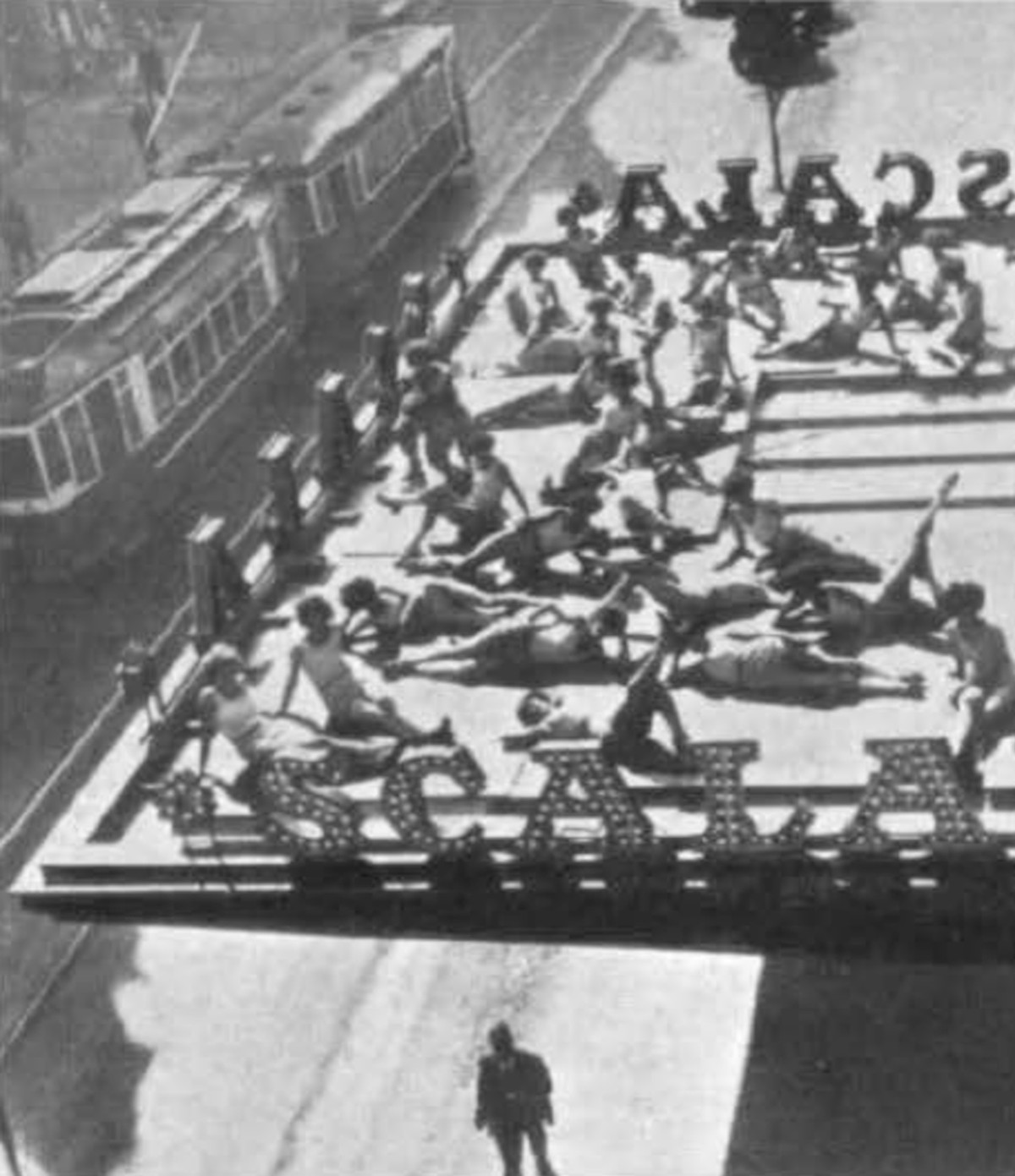
Ill. 3. “Cantilevered roof for sunbathing,” in László Moholy-Nagy, Von Material zu Architektur (1929), 224. Photograph shows the appropriation of the entry canopy of the Scala Theater in Berlin as a raised terrace for performers to relax, just above the city’s traffic, c. 1925.
FORMLESS
Essentially it is the struggle between architecture and the city, between the demand for order and the will to formlessness, that assumes epic tone in Piranesi’s Campo Marzio.
– Manfredo Tafuri, Architecture and Utopia, 1973.
Architecture, the so-called ordering element, was, according to Manfredo Tafuri, hopelessly overwhelmed by the urban environment that Piranesi rendered. While the accumulation and clashing of architectural forms negate the possibility of singularity, the form of the city disappears as well. Divided and structured only through the Tiber River, Piranesi’s invented view of ancient Rome shows architectural forms intersecting with one another and creating a heterogeneous field of difference. In the end, any effort by architecture to preserve a sense of totality was for Tafuri “nullified by the assemblage of architectural pieces in the city,” the place where “these fragments are pitilessly absorbed and deprived of any autonomy.” And, this situation was only exacerbated by the industrial metropolis of the coming century, where the gulf between architectural form and urban formlessness widened as urbanization became more invasive.
In the nineteenth century, industrial cities were predominantly criticized as discontinuous, chaotic, irregular and overwhelming. The term formless was frequently used to describe the city’s lack of form, but it also articulated a certain ungraspable nature of the big city that could no longer be pinned down. In 1845, Friedrich Engels describes the city as an “urban mess … and the result of a gigantic accident” and a century later Lewis Mumford speaks of the “gigantism of the metropolis,” “where its form is defined by its formlessness … and its aim is defined by its aimlessness.” This rhetoric gives us a taste of the linguistic gymnastics that these figures performed in order to articulate a territory that was beyond comprehension. While the concept of the formless city surfaced frequently in the architectural discourse of the last century, often appearing as part of a critique of cities without form and the urban jungle, its impact has been largely overlooked and its possible productiveness for architecture has not been considered. Instead, the established historiography reinforces an image of modern architecture as opposition to urbanization and focuses primarily on moments when architects have attempted to counteract the uncontrolled conditions of the city.
Yet the forces of urbanization also served as a stimulant for architecture’s spatial, programmatic and material imagination, which might prompt us to expand on Tafuri’s assertion on the battle between architecture and the city. In fact, the struggle was often productive and even accelerating. Here, architectural intelligences were discovered in the city without form. Simultaneously enthralled and traumatized by the turmoil of the metropolis, some architects and urbanists began to focus on the disordered, disjunctive, and anarchic moments of the modern city in an attempt to formulate an understanding of the discontinuities they found dominating. The term formless city was utilized early in the German architectural discourse on the modern Großstadt during the end of the nineteenth and the beginning of the twentieth century in publications such as Die Schönheit der großen Stadt (The beauty of the metropolis) by the architect August Endell (1908), or Die Architektur der Großstadt (The architecture of the metropolis) by the art historian and critic Karl Scheffler (1913). In these texts, the concept was used to gain access to the city. Endell, for example, entirely reversed the negativities associated with contemporary urbanization and instead detected a new beauty within it, while Scheffler employed the formless as a strategic device to reveal potentials of the metropolis. In all these works, the existing urban condition crystallized into an operative concept that, in turn, penetrated the architectural discourse.
BERLIN
What is astonishing is that the metropolis, despite all its ugly buildings, despite its noise, despite everything that one can criticize, is, for those who want to see, a wonder of beauty and poetry.
– August Endell, Die Schönheit der großen Stadt, 1908.
The city of Berlin was at the centre of attention in these texts. Influenced by modern psychology, empathy theory, impressionist ideas, contemporary sociology and various literary circles, Endell reports on whatever the city had to offer in addition to what it was lacking. While the familiar form of the city had vanished, its new formlessness became for him the driver of an alternative urban imagination – an argument, counter to the anti-urbanist tendencies of the early twentieth century. His thesis surprised most readers: the city’s centre, he argued, lay in its marginal sites, and its lasting identity was captured in its fleeting moments. As such, the book is an early example of subverting the existing architecture and planning discourses and attempting to recalibrate attitudes toward the contemporary metropolis. Seemingly naïve declarations like, the city is beautiful! would offer an alternative position that emphasized the capacities rather than the failures of the metropolis.
Indeed, Berlin’s malfunctions were well documented. With one of the most rapid population increases in modern history, it witnessed unprecedented densities and aggressive territorial negotiations. While in the 1820s, the city housed around 200,000 inhabitants, the number rose over the next sixty years to 1.3 million. In 1871, Berlin became the capital of the German Empire and would acquire a more central position in cultural, intellectual and social life. And, by 1910, sixty percent of Germany’s population lived in cities, of which Berlin was by far the largest with a population of over two million. Its growth had emerged from a unique combination of circumstances: Advanced industrial activities, enormous building efforts and a complex web of town councils, rural municipalities and estates. This assemblage of multiple territories and constituencies, which were not unified until the Greater Berlin Act of 1920, inhibited town planning efforts across the entire territory. It is, therefore, no coincidence that the lack of planning, absence of a coherent urban form, and randomness of urban implementation were recognized by many authors who were based in Berlin at the time.
What Endell had identified as a city without form reappeared in Siegfried Kracauer’s descriptions of undesigned urban territory in a metropolis where “the distinct interests of masses of stone and streetscapes collide…[locations that] doze through time unconcerned about their image.” Associating the metropolis with terminology such as casual, coincidental and temporal, suggested an urbanity that was unplanned, undesigned and unfinished, a “formless” conglomerate created by dispersed forces. In contrast to the traditional idealizations of the city, these writings speculated on the productivities of the formless, and its possibilities to articulate a new urban, fragmented and all-encompassing condition that, otherwise, eluded comprehension. The formless metropolis (or what Vidler called the “formal disintegration” of the city) became simultaneously a challenge and a motivation for architecture. A challenge because it stood in utter contrast to the formal ambitions of architecture, and a motivation because it provided a terrain of infinite multiplicities for architecture to sample and test. While Berlin reflected a specific constellation of influences, its exceptional commitment to metropolitan forces often provoked architects and planners to see the city as an indication of larger trends still ahead of other cities (with very different histories). Some channeled Berlin’s lack of form toward the invention of a metropolitan architecture.
SPIELRAUM
… urban formlessness created Spielraum (room to maneuver) for unlimited possibilities.
– Karl Scheffler, Berlin – City Destiny, 1910.
The unplanned, tumultuous, and ever-changing metropolis was not only propelled by modernization, but also served as the source of a new kind of architecture. In fact, for Karl Scheffler, architectural inventiveness occurred not despite the formless metropolis, but because of the city’s tumultuous conditions that could become springboards for spatial and organizational imaginings. Just as Walter Benjamin would later find that the “decay of the aura in works of art is matched by a huge gain in the scope for play [Spiel-raum],” so, too, did Scheffler hope to find new possibilities in the metropolis. Associating the term formlessness with Spielraum (the latter literally translating as room for play but also understood as leeway, margin, scope, elbow room or room to move) opened new possibilities in the terrain of the modern city.
Already by the end of the nineteenth century, art historians such as August Schmarsow and Heinrich Wölfflin had made use of the term to stress the importance of bodily experience for the sense of space in architecture. In 1912, Adolf Loos and the journalist and playwright Karl Kraus expanded on the term by calling for the recognition of a difference between art and utilitarian objects, saying that “it is this distinction above all that provides culture with Spielraum.” According to Kraus, their practice was entirely devoted to identifying this alternative space. For them, Spielraum was an essential component of urban and architectural culture, without which the environment would be swallowed by either the artistry of Jugendstil or the rationalism of the Werkbund. Faced with Germany’s increasing militarization and rationalization of urban life, critics sought to counter these tendencies, troubled by the demands for predictability and order. For the poet Karl Wolfskehl, an early acquaintance of Endell, room needed to be given to possibilities and accidents in an ever more rational world. Wolfskehl wrote: “The elimination of chance … [and] the creation of order … destroys the true Spielraum. No, no, it is certain: without a trace of the unexpected, life cannot exist.”
What all of these uses of Spielraum have in common is the implication that it could challenge and liberate traditional thinking and movement (or the lack thereof), suggesting the possibility of discoveries within a newly gained space. Therefore, the introduction of the concept of Spielraum into urban theory comes as no surprise. It designated a realm in which to account for new forms of metropolitan space. The unplanned, inarticulate and varied sites of the city became the zone in which alternative conditions could develop and where architectural paradigms could emerge. As much as the formless city was viewed as problematic, relating it with an expansion in Spielraum made the metropolis the very source for a new kind of architecture – one that developed in the latitudes of the modern city. Here, the crisis of urban form enabled architecture’s reevaluation through an intentional shift in attitude that sought to discover potentials in the existing metropolis. The idea of the city swung from negative to prospective, and engagement with the city moved from oppositional to opportunistic. Forces of the metropolis, previously seen only as frightening, now held the possibility for an architecture sparked by its provocations.
—
Alexander Eisenschmidt visited the Royal Danish Academy for the international lecture series The Art of Analysis on November 28th, 2019.
Manfredo Tafuri, Architecture and Utopia: Design and Capitalist Development (1973; Cambridge, MA: MIT Press,1976), 14.
Friedrich Engels, Die Lage der arbeitenden Klasse in England (Leipzig: Otto Wigand, 1845), 48 and Lewis Mumford, The City in History: Its Origins, Its Transformations, and Its Prospects (1961; San Diego: Harcourt Brace & Co., 1989), 544.
Siegfried Kracauer, “Berliner Landschaft” (1931), republished as “Aus dem Fenster gesehen,” in Straßen in Berlin und anderswo (Frankfurt am Main: Suhrkamp, 1964), 50.
Anthony Vidler, “The Third Typology,” Oppositions, no. 7 (Winter 1976). Here cited from Oppositions Reader: Selected Readings from a Journal for Ideas and Criticism in Architecture 1973–1984, ed. K. Michael Hays (New York: Princeton Architectural Press, 1998), 15–16.
Walter Benjamin, “Das Kunstwerk im Zeitalter seiner technischen Reproduzierbarkeit” (1936). Here cited from the revised and expanded version of the first essay, where Benjamin elaborated on the notion of “Spielraum,” translated in Walter Benjamin: Selected Writings, 1935–1938, vol. 3, trans. Livingstone (Cambridge, MA: Belknap Press, 1996), 127.
August Schmarsow, Das Wesen der architektonischen Schöpfung (Leipzig: Karl W. Hiersemann, 1894); and Heinrich Wölfflin, Prolegomena zu einer Psychologie der Architektur (Munich: Kgl. Hof- & Universitäts-Buchdruckerei, 1886).
Karl Kraus, Die Fackel (December 1912): 37. For further references, see Carl E. Schorske, “From Public Scene to Private Space: Architecture as Culture Criticism,” in Thinking with History (Princeton: Princeton University Press, 1998). More recently, Hal Foster and Anthony Vidler have investigated the term “Spielraum” in Hal Foster, Design and Crime: And Other Diatribes (London; New York: Verso, 2002), 15–17; and Anthony Vidler, Warped Space: Art, Architecture, and Anxiety in Modern Culture (Cambridge, MA: MIT Press, 2000), 3–5, 84–86.
Karl Wolfskehl, “Spielraum” (1926), in Gesammelte Werke (Hamburg: Claassen, 1960), 431–432.
Næste: Culture of Transformation
Ill. 1. Giovanni Battista Piranesi, Il Campo Marzio dell’Antica Roma, frontispiece, 1762.
Ill. 2. Construction at Museum Island, Berlin, 1911. Photograph of excavation works.
Ill. 3. “Cantilevered roof for sunbathing,” in László Moholy-Nagy, Von Material zu Architektur (1929), 224. Photograph shows the appropriation of the entry canopy of the Scala Theater in Berlin as a raised terrace for performers to relax, just above the city’s traffic, c. 1925.