




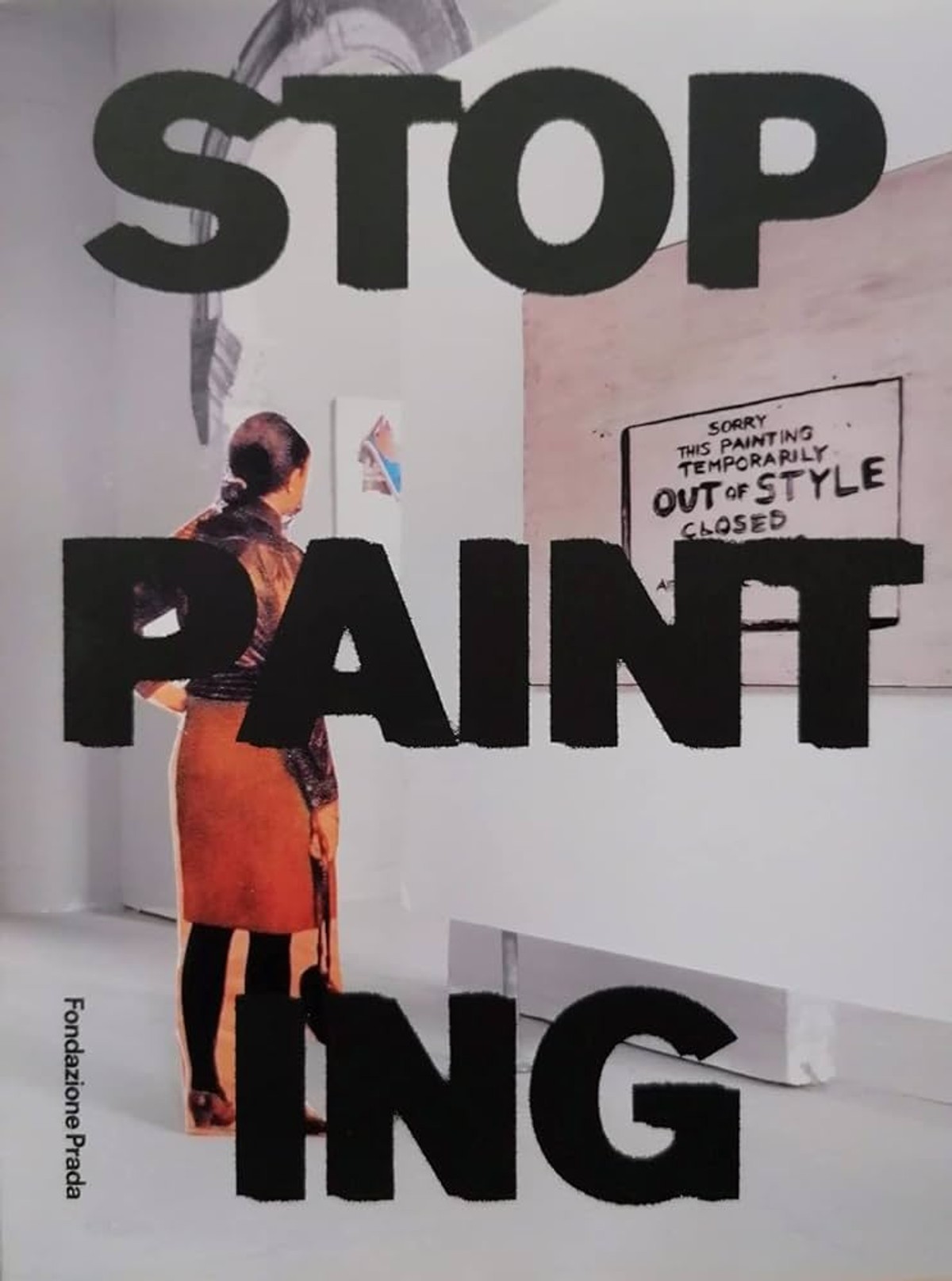
Ill.1. Peter Fischli, Stop Painting 2021. Credit: Fondazione Prada
Ill.2. Asger Jorn, Ainsi on 's' Ensor (Out of this World after Ensor 1962)
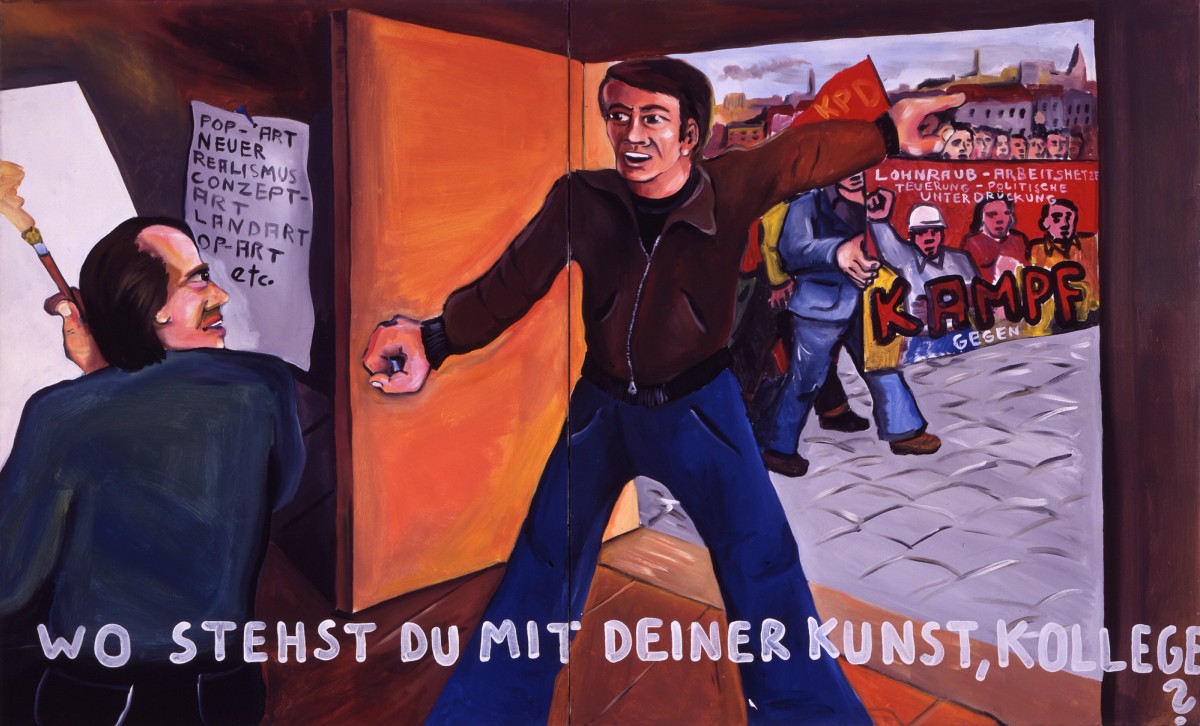
Ill.3: Jörg Immendorff, Wo stehst du mit deiner Kunst, Kollege?“, 1973, Acryl auf Leinwand, © Estate of Jörg Immendorff, Courtesy Galerie Michael Werner Märkisch Wilmersdorf, Köln & New York
A spectre is haunting the contemporary world — the spectre of crisis.
In the realms of art and architecture, this spectre manifests as stagnation, a blind adherence to economic imperatives and technological determinism. Artists and architects once considered vanguards of progress, find themselves trapped in a cycle of repetition, churning out commodities for the market instead of questioning the very foundations of their practices. Stop Painting, Stop Building is not a call for silence, but a potent manifesto urging a return to the root of creativity, a radical reimagining of the role of art and architecture, in an age grappling with ecological collapse and societal upheaval.
From Peter Fischli's Stop Painting exhibition [Ill. 1] to the architects' Stop Building slogan, there is a demand to shake off the shackles of convention and address the crises brewing within art and architecture. But unlike the cyclical relationship between painting and Stop Painting, there exists a life-and-death connection between architecture as a field and the Stop Building slogan. This article aims to explore this fictional and phantom connection between architecture and building. It contrasts this connection with painting, a medium that continuously dies and is reborn, providing meaning for the new world and itself. This contrast offers a joyful requiem for the majority of contemporary architects and architecture.
Stop building. Let us imagine that the death of contemporary architectural practice can wash away our sins, just like Jesus Christ. Stop building. Let us together write an elegy for architecture, tracing the corruption of ideals from the post-war era until today, along with our cynicism and the Ivory Tower syndrome. Stop building. Let us find comrades and traitors in this grand funeral, and together, reimagine the future of architecture.
PAINTING DIED FIVE TIMES, BUT ALWAYS COMES BACK
Was the recurring ghost telling the story of the end of painting a phantom problem? And if yes, can phantoms be real?
Peter Fischli
Stop Painting was an exhibition curated by artist Peter Fischli, displayed at the historic Ca’ Corner della Regina, the Venetian venue of Fondazione Prada. In the Die Hard, Stirb Langsam, Duri a morire section, the work Ainsi on s’Ensor (Out of this World—after Ensor), by Danish artist Asger Jorn [Ill. 2] was also exhibited, expressing a nostalgic sympathy for the painting medium. Jorn's classic, and always amusing exclamation, added a footnote to this theme; "If you have old paintings, do not despair. Retain your memories but detour them so that they correspond with your era. Why reject the old, if one can modernize it?”
In this exhibition, Peter Fischli identified five radical ruptures caused by technological and social changes that marked artistic paradigm shifts through the rejection and reinvention of painting. The tale of deaths, denials, and rebirths.
The first rupture was triggered by the widespread use of photography. As Rosalind Krauss emphasizes: "Photography calls into question the whole concept of the uniqueness of the art object, the originality of the author… and the individuality of so-called self-expression.” This led painter Paul Delaroche to famously declare around 1840: "From today, painting is dead." The painting was compelled to abandon its mimetic function to survive. The second crisis is represented by the invention of the readymade collage, which pushed painting to "extend itself and move beside itself in space through objects” as noted by David Joselit. The third rupture was provoked by the questioning of the idea of authorship, or as defined by Roland Barthes in 1968; "the death of the author." The fourth crisis can be identified with the critique of painting as a commodity in the late 1960s. The fifth rupture focuses on the crisis of criticism in the so-called late capitalist society, as formulated in studies by Luc Boltanski and Eve Chiapello: "Since the 1980s, the idea of an avant-garde became obsolete and dissolved, and, again, the end of a critical position in painting was proclaimed.”
Later, he described the exhibitions as a “kaleidoscope of repudiated gestures, including the critique of those repudiated gestures.” This suggests, as is seen in the exhibition, that it is by no means an epic exhibition towering over art history, and under the banner of embracing technological progressivism, the so-called purification and evolution of art. On the contrary, it is a somewhat naive perspective that reexamines the historical narrative of art history; an intuitive strategic vandalism of art history. The exhibition is also not presented in chronological order, abandoning all implications of artistic progressivism. As seen in the review, the exhibition produces a kind of vertigo – a rational belief and an emotional disbelief in the linear, even a Marxist materialist historical narrative of art (as mentioned earlier in the article's five deaths). This vertigo itself presented an emerging discourse, which may underscore the notion that the show is not primarily concerned with painting itself but rather with discourse: the manner in which we narrate stories about art and artists, how paintings serve as a form of language, and how these narratives are conveyed and reflected through the art once more.
Behind the bold slogan of Stop Painting lies a deep-seated affection and reverence for painting. The artist's contemplation and appreciation of how painting intersects with politics and public life after each revival of the art form are evident. [Ill. 3] However, the artist does not offer a clear solution for these rebirths. Instead, the refusal to provide a definitive answer is subtly embedded in the selected paintings of their deceased bodies; the paintings themselves.
This perspective, which transcends the (un)traditional view of art history, can also be applied to architecture. It prompts a reconsideration of the relationship between architects and architecture, the connection between architecture and structures, and the interplay between contemporary architecture and history. It also invites reflection on the relationship between architects and financial considerations, rationally, publicly, and intuitively.
As Derrida once said: “It is only from the possibility of its death that art can be interrogated,” and this applies equally to the field of architecture.
ARCHITECTURE SHOULD BE DEAD MANY TIMES: A MANIFESTO
The notion of architecture facing death or crisis isn't new. Early voices like Giedion and Banham warned of its decline in the face of technology and standardization. Postmodernism, with figures like Jencks challenged modernist dominance, seeking meaning and playfulness beyond functionality. Today, concerns include commodification as stated by Frampton, and political implications according to Weizman, but architecture survived.
Modern architecture is dead, postmodern architecture is dead, decoration is dead, the mathematical logic of Renaissance architecture is dead, East Asian wooden architecture tradition is dead, and indigenous architecture is dead.
The Avatar of architecture has died many times. Architecture is still alive.
Architecture should die. Architecture should die many times. Architecture should be dead many times.
Painting is the body of the painter, as well as the will of the painter and the painter's imagination. Along with the presentation in the public domain, together they constitute their trinity soul. Similarly, the same analogy may hold in the field of architecture. The building is the body of the trinity soul of the architect, the sponsors, and the scanty public will.
Stopping building is to declare the death of architecture's physical body, allowing the soul to ascend, while those deserving of damnation shall redeem themselves in hell.
It is only from the possibility of its death, that architecture can be interrogated.
Stop building boring, phallic, neoliberal, greenwashing, mediocre, selfish, hypocritical, pretentious, self-indulgent, pandering, well-intentioned, self-proclaimed beautiful, colonial, techno-fetishistic, old wine in new bottles, semiological propaganda, pretentious, capitalist slavery, unpaid intern, toxic work environment, patricide, Oedipus complex, unequal, pretending to be equal, utilitarian, orientalist, self-orientalist, cute, amnesiac, atemporal, hegemonic, authoritarian, dictatorial, toxic masculinity, flattering, romanticizing, capitalist, communist, ideological, bourgeois, anthropocentric, and therefore, almost all buildings.
Stop building. It is no longer a story of a boy slaying dragons, no longer a story of the Odyssey, no longer a story of patricide and matricide.
Stop Building is about asking new stories. It’s about the story after Nora Helmer leaves, it is about the story of the baron in the tree, it is about leaving a gaslight relationship, it is about escaping a cult, a story of overcoming addiction, anorexia, a story of a lizard breaking its tail to survive, a cicada shedding its shell, a story of #freebritney, a story of Taylor Swift's 1989, it is about exploring inwardly and seeking a new world outwardly.
RE-BIRTH OF ARCHITECTURE AS DISOBEDIENCE THROUGH A KALEIDOSCOPE OF REPUDIATED GESTURES
While the evocative slogan Stop Building may ignite a powerful call for change within the architectural landscape, the recent artistic and architectural resurgence isn't a surrender to the absence of the built environment, but rather a reimagining of architecture as action itself. This transformation transcends the act of mere construction and embraces a kaleidoscope of rebellious gestures that disrupt established norms and challenge the status quo.
DAAR (Decolonizing Architecture Art Research) exemplifies this trend, using Swedish Art Fund resources to purchase a summer house and distribute keys to 12 immigrants. In a powerful act of spatial defiance, Danish architect Gitte Juul guided first-year students in continuous drawing at Stejlepladsen before its demolition. Susanne Ussing channeled her anger into a provocative diary drawing of a phallic nuclear plant, while François Roche explored future cities through hypnotic performances. Architects Declare continued to grow its movement against the climate crisis, mirroring the rise of new squatter movements fighting the housing shortage.
Resistance even surfaced within the profession, with protests against unpaid internships at Ishigami's office, and student labour scandals at SCI-Arc. Self-deprecating architectural memes on Instagram added a layer of critical humour to this rebellious atmosphere. Organizations like Building Diversity and Building Green in Denmark further solidified this transformative momentum. Copenhagen's 2023 giant greenwashing machine was a striking symbol. Forensic architecture, architectural ethnography, Extrastatecraft, Aktion Arkiv, and the Floating University all play vital roles in dismantling traditional paradigms within architecture.
This architectural rebirth transcends the mere cessation of construction. It signifies a paradigm shift that compels architects to undergo critical self-reflection, embracing their role as activists tackling contemporary societal challenges. This expanded scope reaches beyond traditional building practices, incorporating advocacy, research, and artistic expression into their toolkit. Ultimately, this radical imagination redefines architecture's potential to be a powerful force for addressing urgent social and environmental issues.
By embracing disobedience, questioning conventional practices, and actively engaging with diverse stakeholders beyond the building site, architecture can truly transcend the act of building. This collaborative spirit fosters a just and sustainable future, where architects contribute not just through bricks and mortar, but through activism and imagination.
Architecture is agonistic.
Architecture is political.
Architecture disobeys.
We must do this; we must do that. We must go this way; we must follow that path. I believe that the world's greatest minds and podcasts have already informed us of countless methods, solutions, and answers for moving into the future.
Here, it's not about how we do it, but about doing, stopping, going, following, daring, disobeying. It is about action.
The call to Stop Building is not, ironically, a call for inaction. It is a powerful demand to break free from uncritical practice and engage in deep self-reflection. It is a call for a diverse chorus of voices and constructive dissent. We need to challenge the status quo and reimagine the role of architecture in a world facing complex challenges.
Stop painting, stop building.
Rest in peace, painting.
Rest in peace, architecture.
No rest for the wicked.
–
Sean Yuxiang Li, MAA, is an architect, who works as a researcher assistant at the Royal Danish Academy and a guest researcher fellow at the INTERSECT research hub located the University of Copenhagen. He holds a Master of Arts in Political Architecture. He currently works with the intersection of alternative urban space, androgynous spatiality and diasporic domesticity. Architecture disobeys.
‘‘Ivory Tower’. In Wikipedia, 2 September 2023.https://en.wikipedia.org/w/index.php?title=Ivory_tower&oldid=1173517175.’.
Project Native Informant. ‘Stop Painting’. Accessed 8 April 2024.https://www.projectnativeinformant.com/exhibitions/stop-painting.
Asger Jorn, On His Détournements, Modifications of Old, Existing Paintings, in the Foreword to the Catalogue of His Exhibition Modifications (1959), n.d., n.d.
Rosalind Krauss, ‘A Note on Photography and the Simulacral’, October 31 (1984): 49–68, https://doi.org/10.2307/778356.
Smyth, Patricia. Paul Delaroche: Painting and Popular Spectacle. Liverpool University Press, 2022. https://doi.org/10.3828/liverpool/9781802070217.001.0001.
David Joselit, ‘Reassembling Painting’, accessed 22 February 2024, https://www.academia.edu/22693005/Reassembling_Painting.
Barthes, Roland. Image, Music, Text. Fontana Press, 1977.
Luc Boltanski and Eve Chiapello, ‘The New Spirit of Capitalism’, International Journal of Politics, Culture, and Society 18, no. 3/4 (2005): 161–88.
‘“Stop Painting” at Ca’ Corner Della Regina, Fondazione Prada, Venice — Mousse Magazine and Publishing’, 4 October 2021. https://www.moussemagazine.it/magazine/stop-painting-fondazione-prada-pablo-larios-2021.
Jacques Derrida, The Truth in Painting, trans. Geoffrey Bennington and Ian McLeod (Chicago, IL: University of Chicago Press, 2017), https://press.uchicago.edu/ucp/books/book/chicago/T/bo27619982.html.
Sigfried Giedion, Space, Time and Architecture: The Growth of a New Tradition, Fifth Revised and Enlarged Edition (Harvard University Press, 1982), https://doi.org/10.2307/j.ctv1bzfnzf.
Reyner Banham, Theory and Design in the First Machine Age (MIT Press, 1980).
Charles Jencks, The Language of Post-Modern Architecture (Academy Editions, 1984).
‘Towards an Agonistic Architecture’, accessed 23 February 2024, https://www.domusweb.it/en/opinion/2013/10/03/_towards_an_agonistic_architecture.html.
On Barak, review of Review of HOLLOW LAND: ISRAEL’S ARCHITECTURE OF OCCUPATION, by Eyal Weizman, The Arab Studies Journal 18, no. 1 (2010): 402–6.
‘The Doll’s House – Google Books’, accessed 26 February 2024, https://www.google.dk/books/edition/The_Doll_s_House/yX4MDEViHHgC?hl=en&gbpv=0.
‘Stavsnäs, Sweden (2023)’, DAAR, accessed 26 February 2024, https://www.decolonizing.ps/site/stavsnas-sweden-2023/.
‘Angående Stejlepladsen – Blok 1: Bosætning’, accessed 27 December 2021, https://angaaende-stejlepladsen.kadk.dk/content.html.
Svava Riesto, ‘Creating Alternatives: Stories about Participation, Collaboration and Gender in Architecture, the 1960s and 70s’, The Journal of Architecture 28, no. 3 (3 April 2023): 354–82, https://doi.org/10.1080/13602365.2023.2199310.
Manon Schaefle, ‘À quoi ressembleront les villes du futur ? Rencontre avec l’artiste-architecte François Roche’, Fisheye Immersive, 30 August 2023, https://fisheyeimmersive.com/article/a-quoi-ressembleront-les-villes-du-futur-rencontre-avec-lartiste-architecte-francois-roche/.
‘UK Architects Declare Climate and Biodiversity Emergency’, UK Architects Declare Climate and Biodiversity Emergency, accessed 24 February 2024, https://www.architectsdeclare.com/.
Jason Rodrigues, ‘Squatting Is on the Rise Again in Britain – and in This Vicious Housing Crisis, Is Anyone Surprised?’, The Guardian, 28 December 2023, sec. Opinion, https://www.theguardian.com/commentisfree/2023/dec/28/squatting-rise-housing-crisis-uk-vacant-properties.
Jonathan Hilburg, ‘Junya Ishigami ordered to pay interns after Serpentine uproar, as Elemental ends internships’, The Architect’s Newspaper (blog), 28 March 2019, https://www.archpaper.com/2019/03/junya-ishigami-ordered-pay-interns-serpentine-uproar-elemental-internships/.
Basecamp: How to Be in an Office, 2022, https://www.youtube.com/watch?v=iszdoZCdWZE.
‘Why the World Needs More Architecture Memes’, ArchDaily, 27 May 2018, https://www.archdaily.com/894378/why-the-world-needs-more-architecture-memes.
‘Building Diversity – Promoting Diversity and Equality in the Architectural Field’, 28 March 2023, https://buildingdiversity.dk/.
‘Building Green English’, Building Green, accessed 26 February 2024, https://buildinggreen.eu/en/.
‘unPAVILION’, OBEL AWARD (blog), accessed 26 February 2024, https://obelaward.org/initiatives/unpavilion/.
‘Investigations ← Forensic Architecture’, accessed 26 February 2024, https://forensic-architecture.org/.
‘Architectural Ethnography’, Sternberg Press (blog), accessed 20 October 2023, https://www.sternberg-press.com/product/architectural-ethnography/.
‘Keller Easterling — Zone: The Spatial Softwares of Extrastatecraft’, accessed 26 February 2024, https://www.kellereasterling.com/articles/zone-the-spatial-softwares-of-extrastatecraft.
‘Aktionarkiv.Org’, accessed 26 February 2024, https://aktionarkiv.org/.
‘News • FLOATING BERLIN’, FLOATING BERLIN, accessed 26 February 2024, https://floating-berlin.org/.
Ill.1. Peter Fischli, Stop Painting 2021. Credit: Fondazione Prada
Ill.2. Asger Jorn, Ainsi on 's' Ensor (Out of this World after Ensor 1962)
Ill.3: Jörg Immendorff, Wo stehst du mit deiner Kunst, Kollege?“, 1973, Acryl auf Leinwand, © Estate of Jörg Immendorff, Courtesy Galerie Michael Werner Märkisch Wilmersdorf, Köln & New York