





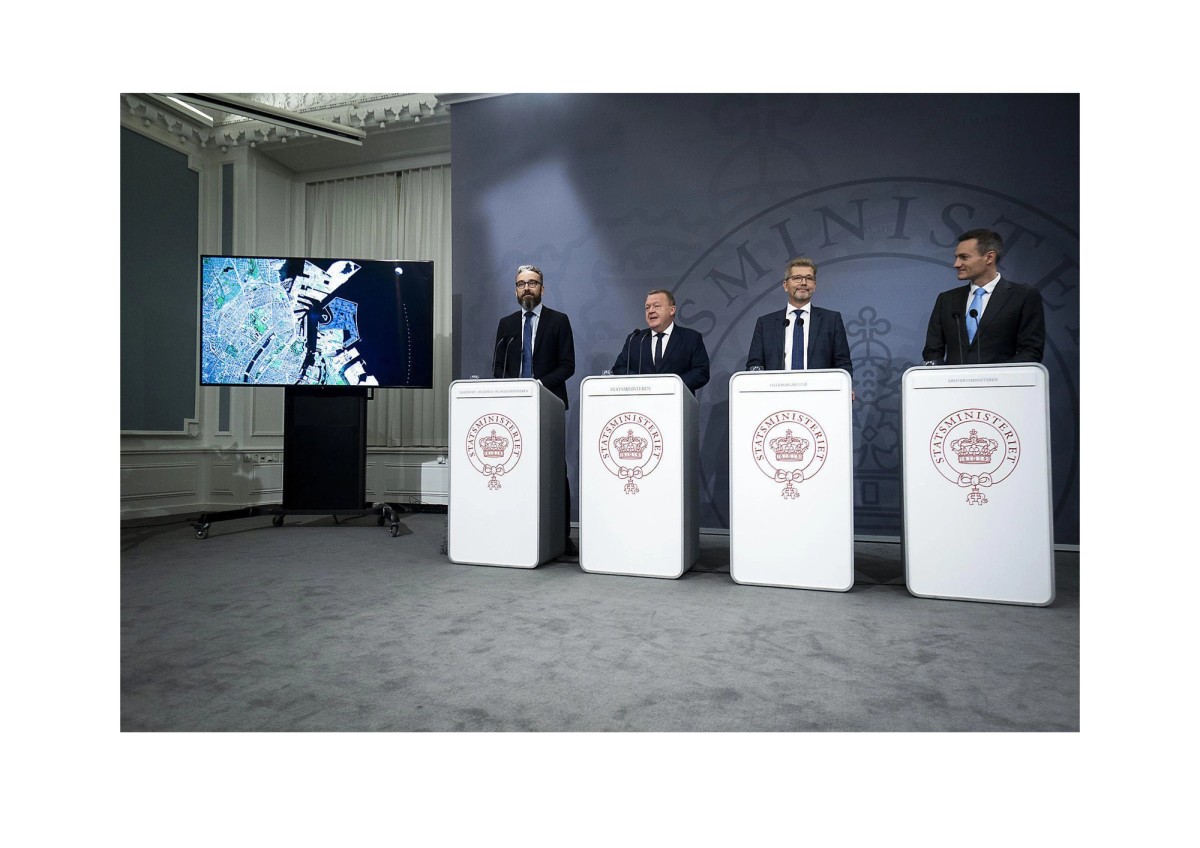
Ill. 1. Press conference 5 November 2018 with Prime Minister Lars Løkke (second left), Copenhagen’s Lord Mayor Frank Jensen (second right), as well as Minister of Transportation Ole Birk Olesen, (left) and Minister of Industry, Business and Financial Affairs Rasmus Jarlov (right). Photo: Jacob Aban Kjerumgaard.
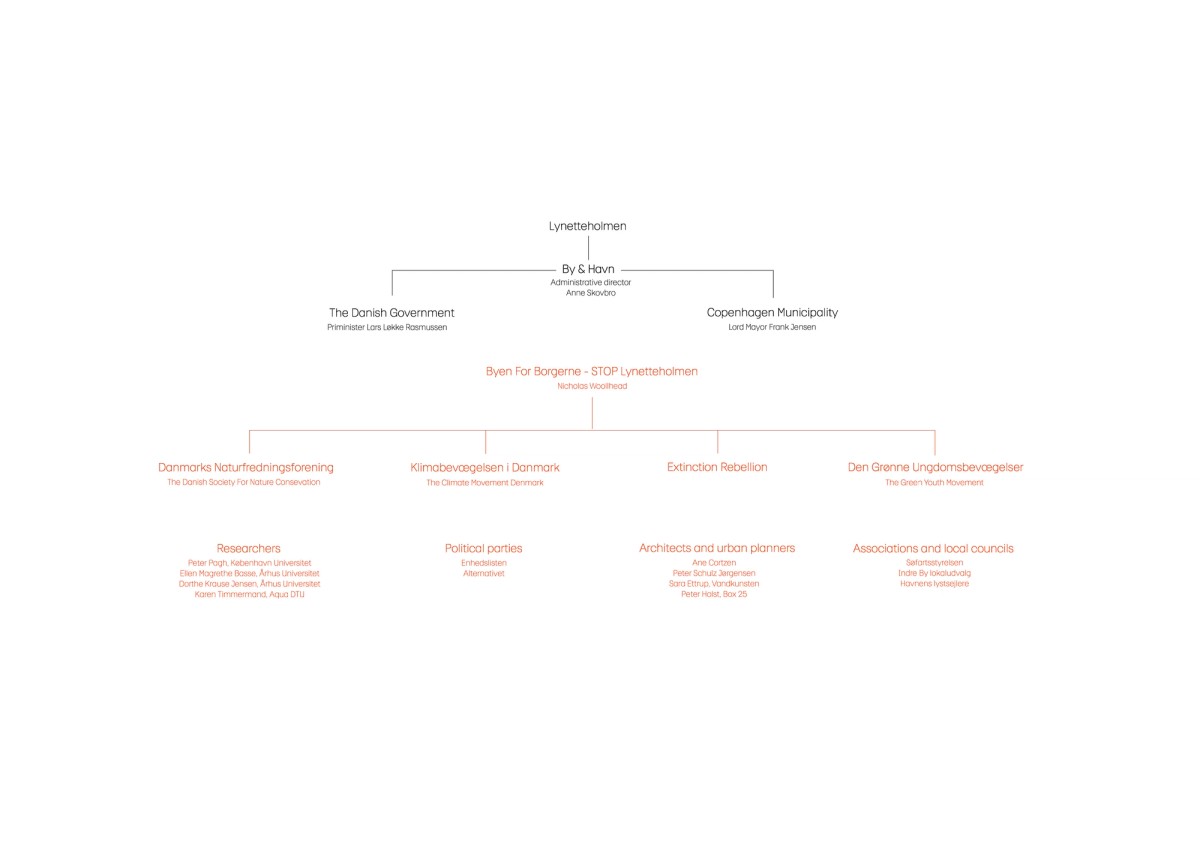
Ill. 2. Mapping of different stakeholders in the case study. Mapping is based preliminary desktop research of the case study. Illustration: Carina Thornval.
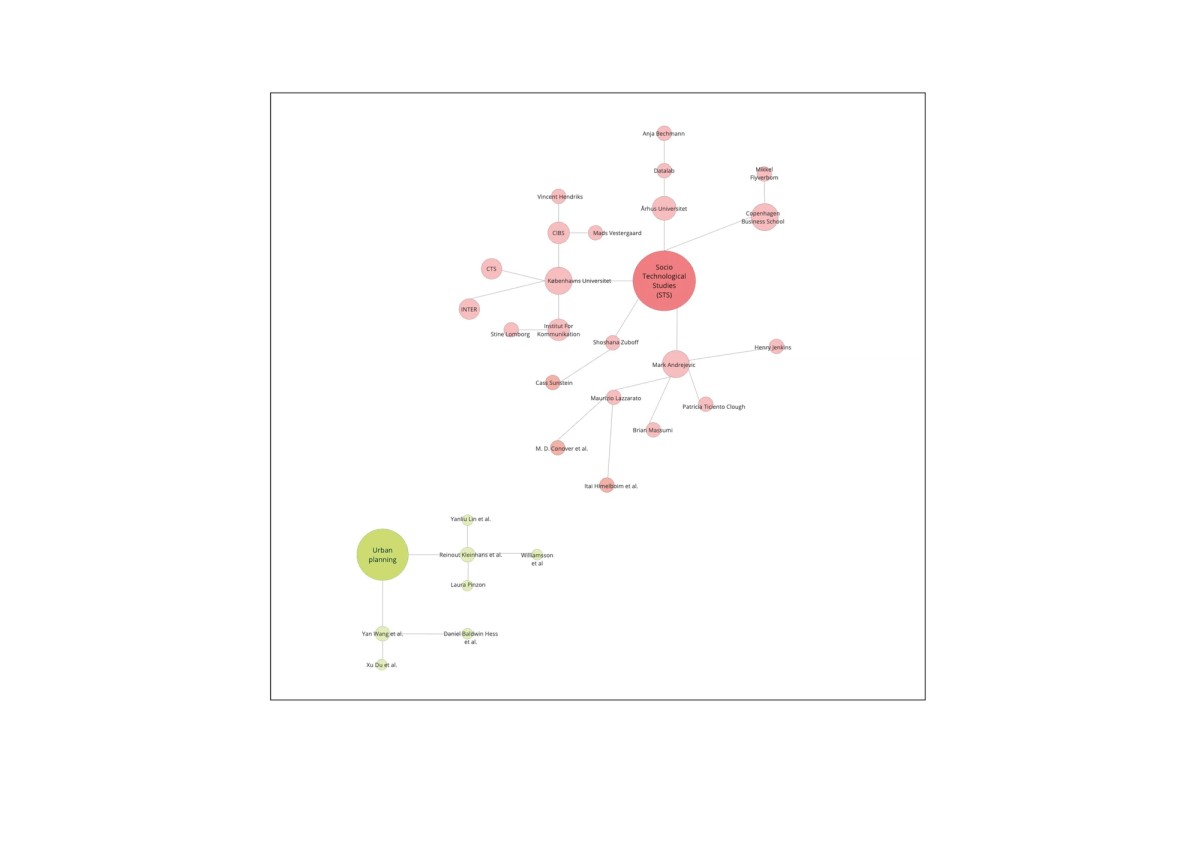
Ill. 3. State-of-the-art mapping between socio-technical studies (STS) and urban planning. Illustration: Carina Thornval.
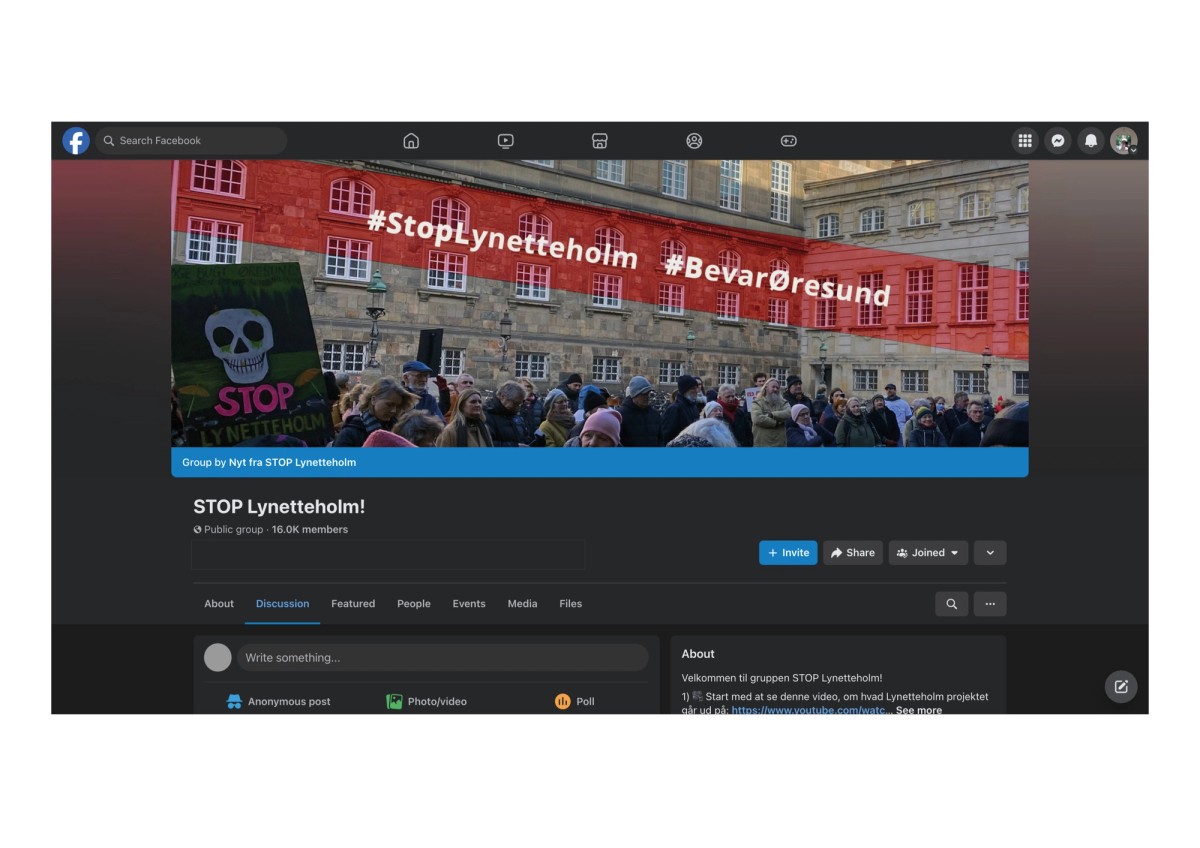
Ill. 4. Social media accounts ofthe organisation Byen for Borgerne (The City for Citizens). Illustration: Carina Thornval.

Ill. 5. Mapping using digital ethnographic methods. Illustration: Carina Thornval.
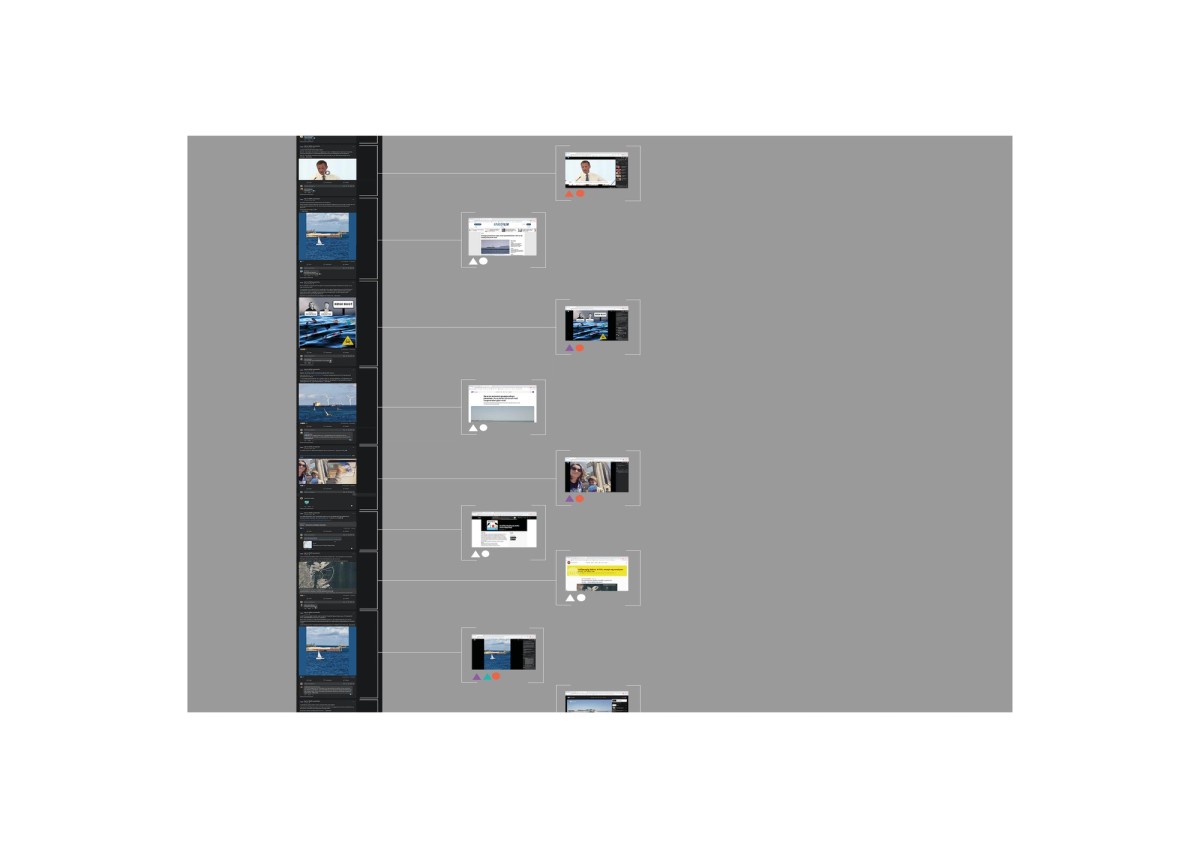
Ill. 6. Zoom-in of mapping. Illustration: Carina Thornval.
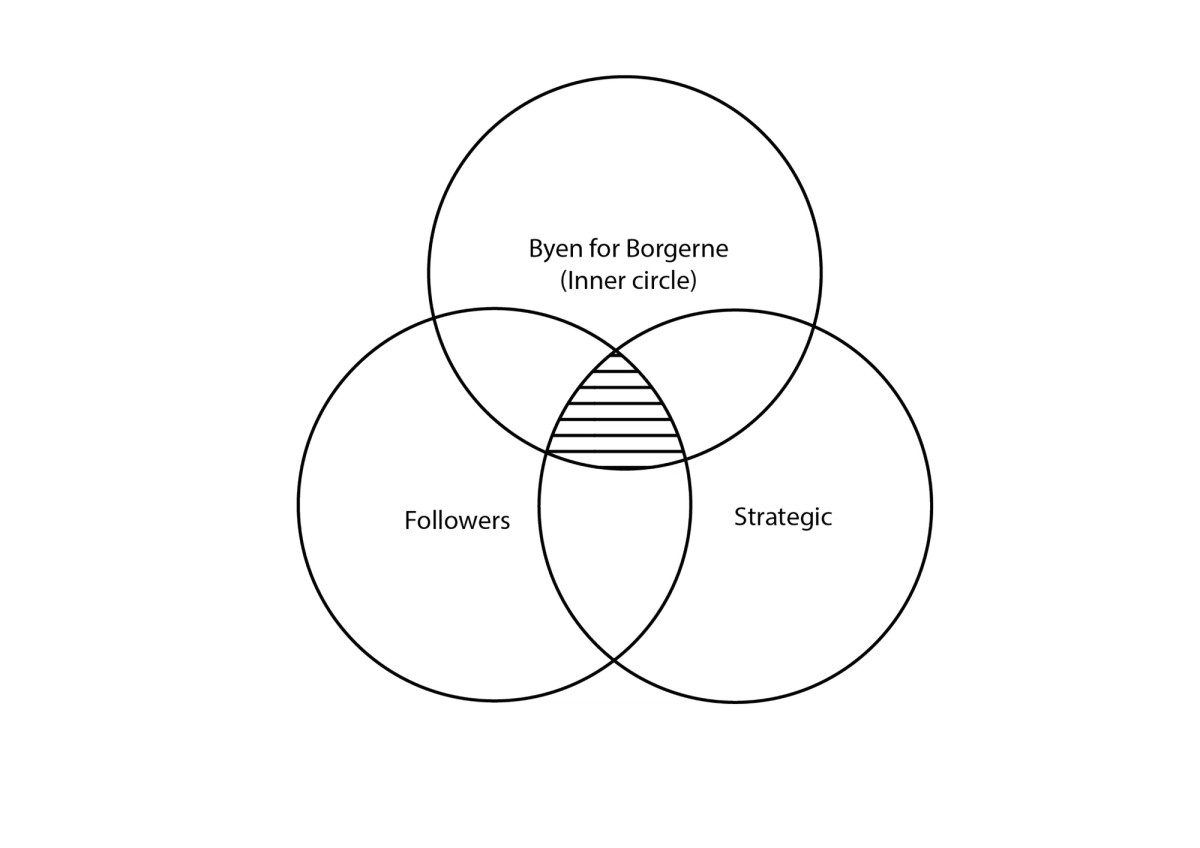
Ill. 7. Mock-up of Nicholas’ Venn diagram. Illustration: Carina Thornval.
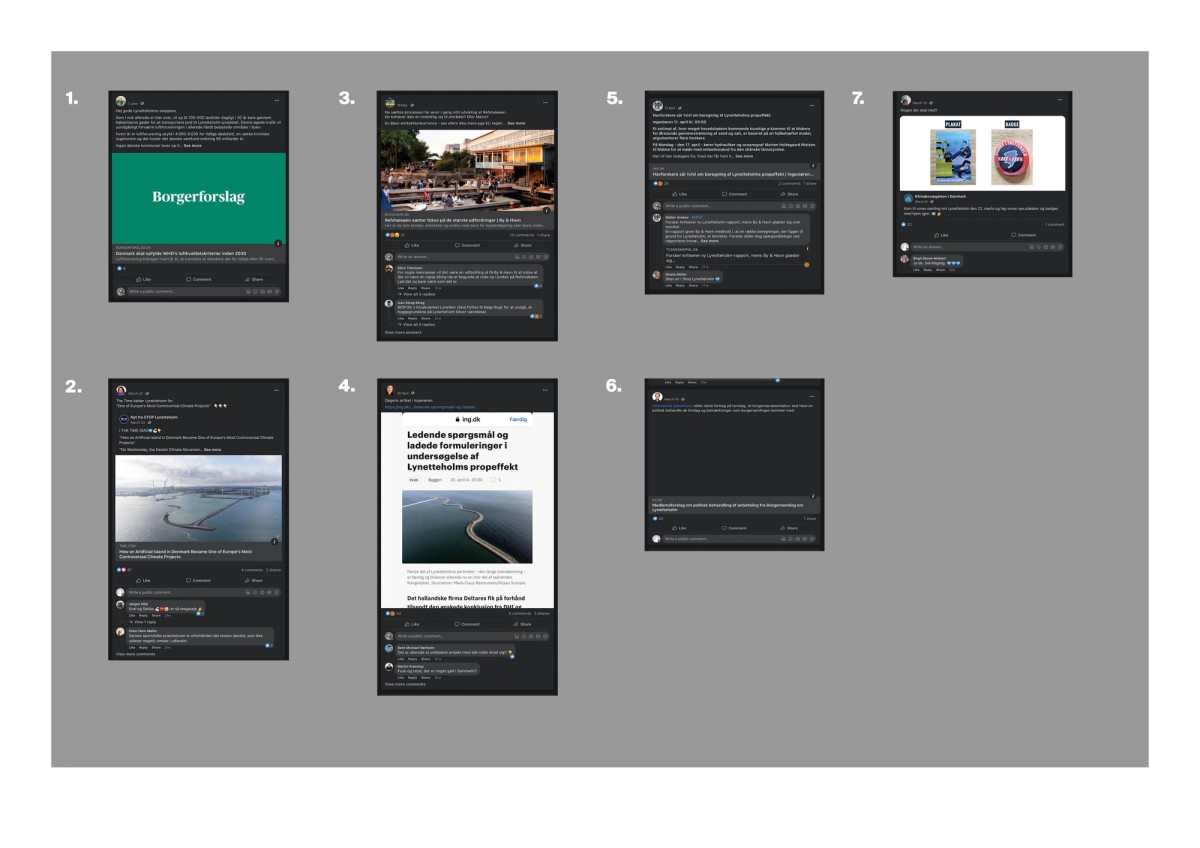
Ill. 8. Excerpt of seven randomised piece of content from the Facebook group. Illustration: Carina Thornval.
Traditionally, urban planning, including questions pertaining to housing, has been a field that has evoked strong resistance and protest from citizens, and throughout time citizens have had different channels at their disposal, through which they expressed opposition to projects. Among these are citizen conferences, various kinds of participatory processes, filing complaints to the municipality, organising demonstrations, and submitting consultation responses. However, since social media technology has become widespread in societies worldwide, citizens’ ability to exercise their democratic right and express resistance is no longer confined to these channels. Instead, they are now accompanied by social media platforms – a channel that supersedes all former channels in the velocity and the breadth with which it allows for information to be disseminated. In this way social media has equipped individual citizens with an unprecedented tool for circulating information about projects, as well as for expressing their own critical opinions about them.
The mass adoption of social media as a communication technology in societies worldwide raises urgent questions about how they mediate, and maybe even warp, the public debate and public opinion about urban planning. Throughout the last decade, the debate in Copenhagen, Denmark, concerning urban planning has playedout on social media, while at the same time high-profile projects have been subjected to interference from citizen-initiated protests. In some instance, changes have been made to the construction plans pertaining to these projects. An example of this is the case of Amager Fælled (Amager Common) in 2017, where the municipality had made plans to construct housing properties; however, these plans were put on pause indefinitely after ongoing protests from citizens.
Since social media is built on algorithmic personalisation of content, it remains opaque which narratives in the debate are given visibility on the platforms and why. At the same time, these narratives shape how users make sense of societal phenomena when logging off. This also extends to how citizens view city planning and where housing projects are being erected. The business model that the corporations behind the social media platforms employ exerts influence on public opinion about urban planning projects and housing politics and thereby also exerts influence on the democratic support of certain projects. In this way, social media has become an indirect, invisible, and yet unexplored factor in the processes that shape political decisions around housing politics and urban planning projects in general.
LYNETTEHOLMEN AND “BYEN FOR BORGERNE”
In Copenhagen, a high-profile urban planning project by the name of Lynetteholmen is currently under construction. Lynetteholmen is a man-made peninsula in Øresund, erected through land reclamation. In its finished state, Lynetteholmen is planned to span 275 hectares, providing housing for 35,000 citizens. The project was made public during a press conference on 4 October 2018 [ill. 1]. During the press conference, the Danish government alongside Frank Jensen, then Lord Mayor of Copenhagen, presented Lynetteholmen as an ambitious high-profile project, targeting four pressing issues facing the city; 1) protection against rising sea levels; 2) utilisation of soil accumulating in landfills north of the city; 3) improvement of the overall traffic infrastructure; and lastly 4) as a way of creating more housing to alleviate the pressure in a competitive housing market. From the announcement of Lynetteholmen as a project, until the peninsula would be completed, an estimated fifty years would pass.
After being made public, Lynetteholmen as a project has been met with fierce criticism and resistance from groups of citizens as well as from other segments of the Danish population: political parties, academics, architects and planners, climate activist organisations, and local associations [ill. 2]. These groups have expressed their resistance through demonstrations, filing lawsuits, forming unions, publishing critical articles and books, and more. The most prominent organisation exercising resistance against Lynetteholmen is the volunteer-run activist organisation called Byen for Borgerne (The City for Citizens). Throughout this article I will refer to them as BFB.
The way that high-profile urban planning projects and the critical debate about them on social media have emerged in relation to one another, prompts different questions. One of them is whether social media technologies, when deliberately leveraged by some actors and not by others in the context of urban planning, can disrupt power dynamics that were established from before social media became widespread as a communication technology. At the same time, my state-of-the-art mapping reveals a lack of research about social media’s impact in the context of urban planning [ill. 3] with researchers such as Wayne Willams and Kristian Rumings writing: “To date, social media has been largely absent from research looking at attempts to resist post-political planning efforts and research looking at the role of social media in planning participation has not investigated the post-political condition.”
Furthermore, it prompts the question of what this appropriation of social by some actors in the context of urban planning, such as grassroot and bottom-up movements, but not by others such as municipalities and developers, could ultimately mean for the way housing politics and urban planning are carried out. In this article, I explore answers to the question: How does the activist organisation BFB appropriate social media as a way of influencing public opinion and gaining exposure and support in the case of the urban planning project Lynetteholmen?
UNOBTRUSIVE RESEARCH AND QUALITATIVE INTERVIEWS
Looking at Lynetteholmen as a critical and theory-testing case study, I am using using digital ethnographic methods, specifically unobtrusive research methods as well as semi-structured interviews with Nicholas Woollhead, the front figure from BFB, and Enel Selvig, moderator in the Facebook group STOP Lynetteholmen! The data produced have been analysed using qualitative content analysis. I approach my data collection with actor-network theory (ANT) as an epistemological lens, as I look to understand relationships between human and non-human actors, for which ANT is suitable.
Unobtrusive methods is a research method within digital ethnography, where the researcher collects observational data about groups online in a non-intrusive and non-reactive way. I chose to focus my data collection on the account that had the most followers, which was STOP Lynetteholmen! with 16,100 followers [ill. 4]. To gain an in-depth understanding of what was happening on the social media accounts, I decided to map out the activities that played out on the different social media accounts over a period of three months from March 2023 to the beginning of June 2023. I wanted to focus on a timeframe that was long enough to allow for a diverse span of content to be posted in the group, while at the same time working with a timeframe, where the quantity of data would still be feasible to the process. In my mapping I reassembled the feeds, where all the content in the timeframe was chronologically and vertically unfolded [ill. 5-6]. This mapping served the purpose of making it possible to identify patterns in behaviour from both members of BFB, moderators, and followers. In analysing my mappings, I adopted a descriptive and categorising approach, where I analysed the data inductively through data-coding, allowing for patterns and themes to emerge from the data itself.
After carrying out this data collection, it quickly became evident that I needed to collect empirical data through other qualitative methods to obtain a thick description of BFB as an organisation and the role social media plays in their practice. I decided that carrying out semi-structured interviews with two members from BFB was the best way for me to proceed. For both interviews, I put together an interview guide before the interviews. After the interviews were conducted, I transcribed them and coded them using coding software. Lastly, after having coded and analysed the interviews, I translated the quotations from Enel and Nicholas from Danish to English.
The Facebook group STOP Lynetteholmen! is a public group that every user on Facebook can join and follow. This also means that everyone can see what is being posted in the group and by whom. According to Facebook’s settings page “Basic Privacy and Settings Tool,” which is available to all users, when they choose to post in a public group, that piece of content or comment is always going to be publicly available for every user. Regardless, some users still may not understand the implications of navigating public social media groups. For these reasons, I have made sure to remove – or obscure – any identifiable information about users in the data that I have collected from Facebook through unobtrusive methods. In my interviews with Enel and Nicholas I have placed a strong emphasis on preserving control and maintaining informed consent from my interviewees. Beyond sharing the interview guide this also meant that Enel and Nicholas have been informed about the way that the interviews were documented, which was through screen and audio recordings. Finally, it also meant that they were given the possibility of revoking their citations from the article.
IMMATERIAL LABOUR, MODULATION, AFFECTIVE FACT, AND ACTOR-NETWORK
The theoretical framework employed in this article draws from media theory with concepts such as immaterial labour, modulation,and affective fact to shed light on BFB’s social media presence. Furthermore, I am using concepts from ANT such as human actors and non-human actors, assemblages, obligatory point of passage and tokens. Immaterial labour, as conceptualised by the sociologist Maurizio Lazzarato, is defined as a series of activities that are not usually recognised as work, but that nonetheless “produces the cultural content of the commodity”. In that way immaterial labour is actions aimed at producing and preserving a meaning attached to a phenomenon, whether it is an object, a commodity, an event, a topic – or even public opinion. The media theorist Mark Andrejevic reiterates this by writing that immaterial labour in the realm of social media can be regarded as being “activities such as online social networking, Tweeting, blogging,”and that these are “not the manufacture of material products, but rather the production of networks of sociability, tastes and communication”. The sociologist Patricia Clough uses the concept of modulation to describe what happens when human emotion – or affect – is captured with the aim of serving as a strategy for management and control. In other words, it is information about people’s sentiments and emotions, obtained to influence them in a desired direction. In the context of social media, modulation occurs when sentiment data from users – that is, data disclosing user’s personally held opinions, emotions, thoughts, and viewpoints – is collected “not merely to record sentiment as a given, but to modulate it as a variable”.
The philosopher and social theorist Brian Massumi talks about the affective fact as what transpires when information is no longer treated as something to be processed and relied upon in deliberation to arrive at a more representational view of the world. Instead, affective facts rely on a “tautological logic,” which is a self-referential logic instead of logic referring outwards to an evidentiary description of reality. In that way,affective facts are facts that are presented to feel convincing in a given context. Andrejevic reiterates this by saying, “In the era of affective fact, power relies not on the attempt to control and monopolize the realm of empirical facts, but upon channelling this tautological logic: monitoring and modulating the ambient feeling tone, that endows non-facts with their “truthiness”. ANT is both a methodological and a theoretical approach articulated by the sociologist Bruno Latour, and it is often used to understand relationships between humans and technology. ANT distinguishes between human and non-human actors who come together in heterogeneous networks. The way that actors come together in networks is through translations in networks, which is also referred to as them forming assemblages. In ANT, the obligatory points of passage are a particular type of networks. The education scholars Tara Fenwick and Richard Edwards describe these by writing that, “These are central assemblages through which all relations in the network must flow at some time.”
ANALYSIS OF DIGITAL ETNOGRAPHIC DATA AND SEMI-STRUCTURED INTERVIEWS
In my pursuit of achieving a contextual understanding and a thick description of BFB and its relationship to social media, I found it necessary to understand BFB’s origin. During my interview with Nicholas, he explained to me that he decided to make a template for a consultation response. He then uploaded this template to Facebook with a short text encouraging other users to use it and to submit their own consultation response during the notice period. This catapulted Nicholas into a lot of exposure on Facebook and in his own words “to go viral,” which prompted other Facebook users who shared the same feelings of indignation to reach out to him:
Then I was contacted by a guy by the name of Poul Levin, who had a tiny Facebook group at the time with a couple of hundred members, all sailors, by the name of STOP Lynetteholmen!, that you would probably know.
He continued:
He wrote me and said, “I also feel angry about that Lynetteholmen thing, how about you share that post in our group?” And then that’s what I did, and then I was contacted by some more people, some who lived on Margretheholmen and so on, and some other people, and then after having been writing back and forth for a little while, we sat down in a zoom meeting and decided to make an association.
BFB was established in January 2021. In this way, Nicholas explained to me how the Facebook group STOP Lynetteholmen! was a crucial part of the conception of BFB, as it enabled people to locate each other in the first place – each of them with their own background and motivations – but all with the same feeling of indignation. Looking at this through the lens of ANT, Facebook is from the beginning a central non-human actor, not only in being a determining factor in how BFB would go on to carry out their practices, but also in how it instigates the process of how different human actors come together in the first place.
One significant development was when BFB in September 2021 was contacted by Lynetteholmen Arbejdsgruppe (Lynetteholmen Working Party) through Facebook. In this article, I will be referring to them as LWP. Nicholas went on to explain how the party reached out to BFB, proposing to enter into a mutually beneficial collaboration with one another, since BFB had already gained a social media following and they had professional competence and networks. After having stepped into this new partnership with LWP, Nicholas explains how BFB’s strategy changed character and adopted a more “strategic character”where BFB started looking to create maximum impact through minimal effort through their activities. When looking at these events through ANT, by entering into this collaboration BFB has successfully enrolled LWP, which is a huge professional resource, into the network that they have already established around the Facebook group STOP Lynetteholmen! andthereby further stabilised the assemblage.
AFFECTIVE FACTS AS AN INSTRUMENT
As a result of how BFB’s practice changed, Nicholas described how they worked to deliberately find ways of pushing Lynetteholmen to become more expensive, with the goal that it would end up becoming too expensive to be carried out altogether.
Another thing is the small ways, that things become more expensive. I mean that’s an obstacle when it comes to going through with Lynetteholmen. Every way that the project becomes more expensive reduces the chances of building in the Baltic Sea, create Østlig Ringvej, the metro line, and so on.
Not only is BFB doing this, it is also pushing for stories about these unforeseen expenses to get covered by the media. Nicholas referred to this strategy as “death-by-a-thousand-cuts.” In the interview, I asked him whether this strategy is about exposing every deviation in the construction plans, in a step-by-step manner, to which he answered:
Yes, or like, you know, every time there is a new decision about it, there’s also a new media round, you know, that presents a new opportunity, besides the fact that we can spread the message about the zero solution, then the headline isn’t going to be that Lynetteholmen will be, you know billions more expensive – the headline is going to be that Lynetteholmen is 35 billions in deficit or something like that, right?
In this way, Nicholas demonstrated a calculated awareness of how certain information will come across to an audience when presented through the news media in an accumulative way. Thereby, he also showed that he understands how to employ affective facts in the practice of BFB, because in making these calculations he is in fact monitoring and modulatingexactly when a certain piece of information will feel convincing to a specific audience.
THE MODULATION OF FOLLOWERS’ AFFECTS
I asked Nicholas about what things they take into consideration in BFB when they make day-to-day decisions about what activities to participate in and what initiatives to embark upon. In response, Nicholas started to sketch a Venn diagram on a piece of paper [ill. 7] representing BFB, the followers, and the strategic impact. Nicholas went on to explain how BFB closely considers each of these aspects, and how they relate to one another when deciding which activities to undertake, and that they aim to find themselves in the middle of the diagram.
Let’s say that we need to write an article. I like writing articles, so that’s also an activity that’s over here, our followers love to read these articles, because it looks like activity, looks important, and stuff like that. And in some cases, if it is the right article at the right time, it is also strategically the most optimal thing to do.
Nicholas revealed that an awareness of the impact of making sure to appeal to the emotions of their community can also be a tool to bolster more support to their political cause. A way of doing this is through demonstrations:
I hyped myself ahead of the climate march, right? Like, it achieves nothing politically. But it’s a good place for people who are upset about the same thing to show up and commit to their anger, right? To commit to the community, over their shared indignation, right? And in that way, there is a political purpose with a social purpose.
In this way, BFB is deploying tactics of modulation as they look at the innate emotional susceptibilities in their audience – in this instance the desire for a sense of community and shared identity – and chooses to target them for effect.
BFB’S SOCIAL MEDIA STRATEGY
In the interview I conducted with Nicholas, I asked about the strategy and the daily operations behind BFB’s presence on social media platforms. Nicholas revealed that he possesses a detailed insight into the algorithmic processes that govern the platforms by explaining that BFB focused more on the quantity than the quality of content:
We try to share something daily; that’s the goal in general. If it’s something we have written ourselves or if it is an article or a piece of writing for a debate or a video or whatever. That’s all the same to us as long as it gets shared, right?[…]The algorithms prefer that you are a “regular poster.” Like, you get boosted more by the algorithms if you post regularly, you know? So like, we don’t really care what it is about exactly on that particular day.
BFB’s willingness to adopt unorthodox approaches in their social media strategy was revealed when Nicholas explained to me how BFB took inspiration from fringe online communities such as anti-vaxxers, when they were building their social media presence. Nicholas went on to explain how this decision manifested in a specific strategy, where BFB gave their followers instructions to “bombard” the comment section on social media posts from politicians, civil servant, or similar, and link back to the Facebook group STOP Lynetteholmen!
So therefore, for a long time what we did was that we every time a politician would say something that was just remotely related to Lynetteholmen, every time someone from SF (the Green Left political party, ed.) said they wanted a green Copenhagen or something, or whatever, right? Then we linked their post into our Facebook group and instructed our followers to go in and bombard their commentary track, to in that way stay visible every time they poked out their head, right? And so, because of this, we have experienced being blocked numerous times. But it worked amazingly.
In the interview Nicholas also explained how BFB takes advantage of some of the inherent affordances of the social media platforms to automate processes around maintaining the accounts:
But now we have linked them together because META owns both, so everything that’s posted from STOP Lynetteholmen! on Facebook automatically gets shared to Instagram.
In this way, Nicholas revealed several layers of strategic thinking and practices aimed at upholding and growing BFB’s online presence: from accommodating to algorithmic calculations, to adopting controversial strategies to maximising visibility by automating processes of maintenance on the accounts. Altogether, this reveals an acute awareness on Nicholas’ part of social media as an asset, where online support can be converted into real-world support. These are all activities aimed at spreading their message and thereby count as different types of immaterial labour.
Taking these insights about BFB’s and the Facebook group STOP Lynetteholmen! I became very interested in understanding how these translated practically. I reached out to Enel Selvig, who works as with social media marketing in her professional life. In both groups, a large variety of content appears, so when asked about how content gets sourced and circulated. Enel described how LWPplayed a big role:
No, most of the time, that’s something I discover myself. But also, I’m a member of the Lynetteholm Working Party, a very competent group, the heavy ones, the ones that are really […] I mean, it’s like politicians, it’s, you know, engineers, all kinds of professions in it. They share as well, and so whenever they share in there, then I’ll share myself. In that way, we are several, who discover it, I would say.
Accordingly, it turns out, that the moderators and LWP are collaborating about sourcing and circulating content. These are orchestrated practices revolving around sustaining the group – and thereby, carry out another layer of immaterial labour to be able to continuously and ongoingly imbue Lynetteholmen with a specific meaning. Enel explained to me, what the role of moderator entailed on a day-to-day basis, and what kinds of content to allow on the pages and in the group. On this matter, Enel explained that in fact there were very few rules in place:
I try to take the stance that things posted concerns Lynetteholmen and then of course, that there’s a respectful tone. It’s not like we are sitting and trashing politicians, and if we do, it’s with humour, you could say, but beyond this, there are no guidelines at all.
Enel described a very unrestrained approach to moderating the accounts, where everyone was largely allowed to post what they wanted, thereby granting the followers free reign to take up as much space as they want. This unrestrained approach was also reflected in the mapping, that I carried out using unobtrusive methods. The mapping demonstrated that the different types of content that surfaced in the group is very diverse. When extracting a random selection of twenty pieces of content, it encompassed posts about different citizens’ proposals, reposts from international news outlets, critical post about the development company By & Havn (City & Port) who is responsible for constructing Lynetteholmen, satirical posts, posts about BFB’s events, post accusing By & Havn of misinformation, repost from Danish media outlets, posts about the flow of saltwater in Øresund, to repost from political parties and invitations to events from other climate activist groups [ill. 8]. This scope demonstrates the breadth and diversity of content posted in the group as well as of its active users.
Seen through the lens of ANT, this means that the Facebook group is a non-human actor: a piece of technology that binds together dispersed human actors including the followers, the moderators, BFB, and LWP. Each of these human actors log into Facebook from different places but convene in the group. The group has come to act as an obligatory point of passage, and it has become a link enabling these different groups of people to connect. Finally, the group has become a defining factor in how these groups organise themselves and how they act.
The span of diverse types of posts makes the unrestricted nature of BFB’s approach to social media more evident. What is posted in the group is determined by an improvised co-creation process between the BFB, LWP, and the moderators on one side and the followers on the other side. Both equally shape the overall flow of content in the group without any real sense of hierarchy. In this way the followers end up carrying out immaterial labour on behalf of BFB since BFB has managed to engage followers in the Facebook group as much as – or maybe even more than – in BFB itself. The followers end up furthering the type of work that BFB instigated. This makes BFB’s critical message about Lynetteholmen into a token that is passed throughout the network, with the group as the obligatory point of passage. The more followers that join the group, each with their own personal interpretation of the token as well as their own motivation for joining the group in the first place, the more solid the network becomes. Regardless of each of their backgrounds and motivations, the Facebook group remains the place where they convene around the same message.
FACEBOOK GROUP AS ONLINE GATHERING POINT
Through processing and analysing my data, I learned that it was the Facebook group STOP Lynetteholmen! that enabled BFB to be formed as an association – it was not until after this that it was appropriated by BFB as their primary online presence. Subsequently, BFB focused on growing their social media following, partly through taking inspiration from fringe online communities.
As the LWP was later enrolled in BFB’s work and practice, the Facebook group also became a place where a network of professionals would systematically distribute critical content about Lynetteholmen. Furthermore, as BFB’s overall strategy changed over time, the Facebook group too reflected those changes; an example of this is when BFB started adopting a strategy where they focused on exposing deviations and unforeseen expenses in the plans around Lynetteholmen. Similarly to how the content in the group promoted events and activities with the aim that these would directly or indirectly further their political cause as these served as real-world opportunities to cater to their followers’ feelings. But perhaps most importantly, the Facebook group is a place where the followers largely have free reign to post, circulate, and comment on content as they want. In that way, BFB have successfully managed to turn their followers into active and engaged co-creators of content, carrying out a lot of the work needed to sustain and maintain the accounts on BFB’s behalf.
Altogether these insights portray the group as an online gathering point, whilst BFB’s online and offline efforts to gain support and draw in followers have played out in parallel. The group has at the same time been a place, that posed as BFB’s online presence for the public to recognise them by, and a place, that promoted and highlighted the very kind of activities and the kind of stories meant to furthering their political cause and draw people in around their message in an accumulative way.
In the end, this made the group into a forum, where BFB’s narrative about Lynetteholmen was something that different people convened around to reproduce, build on and sustain. This is a narrative which works to systematically challenge the one presented by the Danish government, Copenhagen Municipality, and By & Havn. As social media enables individual citizens to disseminate a message with another breadth and speed than ever before, this also creates a lot more instances and opportunities for a counter-narrative to seep into the consciousness of users and influence the process of forming their opinion on the matter.
As social media allows for another limitlessness than other media both in terms of who can disseminate a message as well as the speed with which a given message can be disseminated, it means that such a counter-narrative about Lynetteholmen to the one publicly presented from institutions, would be able to reach a lot more people, which would otherwise not have been possible. A lot more users on social media are equipped with this counter-narrative to individually juxtapose against the dominant narrative presented by public institutions. Furthermore, if the counter-narrative revolves around a topic that feels urgent to the daily lives of the citizens, such as high-profile projects in the cities where they live, social media provide optimal conditions for a message to spread rapidly. This development raises questions about what new conditions for public debate, deliberation and citizen participation these communication technologies bring with them and what these conditions would be in the context of urban planning and housing politics.
HOW SOCIAL MEDIA FACTOR INTO HOUSING POLITICS AND URBAN PLANNING
In building their social media presences, BFB have focussed on growth, visibility, and automation. But most significantly, BFB have managed to activate followers in such a way that they end up sustaining the accounts. BFB demonstrates how they have managed to leverage social media to spread their critical message about Lynetteholmen and in that way exert influence on the public opinion about Lynetteholmen. These efforts are further supported by their offline actives which are aimed at archiving political impact and drawing more people in around their message, while their Facebook group STOP Lynetteholmen! poses as an online public gathering point around which supports convene in an accumulative way.
Altogether these insights shed light on how social media can be leveraged by bottom-up actors in urban planning projects in a way that mobilises resistance against projects in the population against the dominant discourse presented by institutional stakeholders in urban planning projects and housing politics. In this way, the article contributes to a growing field of literature focusing on the influence of social media in urban planning and housing politics, specifically doing so by shedding light on how the strategic targeting of affect and sentiment in users can inform public opinion, and how this is a mechanism that can be leveraged by certain actors to resist planning projects as well as post-political efforts.
_
Carina Thornval is an industrial PhD student at the Royal Danish Academy – Architecture, Design, Conservation and the Danish Architecture Center. She has a background in graphic design from Gerrit Rietveld Academie in Amsterdam and in design and anthropology from the Royal Danish Academy – Architecture, Design, Conservation. In her PhD project “Communication Technology and Public Opinion in Urban Planning,” she is exploring the implication of social media in the context of urban planning.
Micheal Dear, “Understanding and Overcoming the NIMBY Syndrome,” Journal of the American Planning Association 58, no. 3 (2007): 288–300,
Arne Post, Byplanhåndbogen (Copenhagen: Dansk Byplanlaboratorium, 2009), 21-22.
“Number of social media users in Central and Eastern European (CEE) countries in 2024 and 2030,” Statista Research Department, accessed 27 November, 2024. https://www.statista.com/statistics/1134033/social-network-users-in-cee-region/; “News Media in Western Europe: Populist Views Divide Public Opinion,” Pew Research Center, May 2018,https://www.rcmediafreedom.eu/Resources/Reports-and-papers/News-Media-in-Western-Europe-Populist-Views-Divide-Public-Opinion.
Mark Andrejevic, Infoglut: How Too Much Information Is Changing the Way We Think and Know (New York: Routledge, 2013) 1-18.
Cass Sunstein, Republic: Divided Democracy in the Age of Social Media (New Jersey: Princeton University Press, 2018), 1-31.
Jesper Pagh, “On the Battle of Amager Common: A Power Play of Housing Politics in Copenhagen,” in Architectures of Dismantling and Restructuring: Spaces of Danish Welfare 1970-Present, ed. Kirsten Marie Raahauge, Katrine Lotz, Deane Simpson, and Martin Søberg (Zurich: Lars Müllers Publishers, 2022), 432-435.
Shoshana Zuboff, The Age of Surveillance Capitalism: The Fight for a Human Future at the New Frontier of Power (London: Public Affairs, 2019), 292-327.
“Om Lynetteholmen, ”Copenhagen Municipality, accessed 17 November 2024, https://lynetteholm.kk.dk/om-lynetteholm.
“Regeringen og Københavns Kommune vil bygge en helt ny bydel,” Transportministeriet, accessed 3 April 2025, https://www.trm.dk/nyheder/2018/regeringen-og-koebenhavns-kommune-vil-bygge-en-helt-ny-bydel.
“Pressemøde den 5. oktober 2018,” Statsministeriet, accessed 3 October 2018, https://www.stm.dk/presse/pressemoedearkiv/pressemoede-den-5-oktober-2018/.
Wayne Williamson and Kristian Ruming, “Urban Renewal and Public Participation in Sydney: Unpacking Social Media Strategies and Use for Contesting Consensus,” Urban Policy and Research 37, issue 3 (2019). 350-366. This sentiment has furthermore been reiterated by researchers such as Yanliu Lin and Stan Geertman as well as Reinout Kleinhans, Maarten Van Ham, and Jennifer Evans-Cowley.
Robert K. Yin, Case Study Research, Design and Methods (Los Angeles: SAGE Publications, 1989).
Margrit Schreier, Qualitative Content Analysis in Practice (London: SAGE Publications, 2012), 80-107.
Christine Hine, Ethnography for the Internet: Embedded, Embodied and Everyday (New York: Routledge, 2020), 27-29.
Schreier, Qualitative Content Analysis in Practise, 80-107.
Hine, Ethnography for the Internet, 27-29.
Silje Friis, Co-Creation Cards (Sorø: U Press, 2015).
Friis, Co-Creation Cards.
“Master Your research project With The Power of AI,” Atlas.ti, accessed 6 April 2025, https://atlasti.com/
“Basic Privacy and Settings Tool,” Facebook, accessed 6 April 2025, https://www.facebook.com/help/325807937506242.
Steinarr Kvale and Svend Brinkmann, Interview: Det Kvalitative Forskningsinterview Som Håndværk, 3rd ed. (Copenhagen: Hans Reitzels Forlag, 2015), 1-55.
Bruno Latour, “The Powers of Association,” The Sociological Review 32, issue 1 (1984): 264-278.
Maurizio Lazzarato, “Immaterial Labor,” in Radical Thought in Italy: A Potential Politics 7 (Minnesota: University of Minnesota Press, 1996), 130-150.
Lazzarato, “Immaterial Labor,” 133-148.
Mark Andrejevic, Infoglut: How Too Much Information Is Changing the Way We Think and Know (Routledge, 2013).44.
Patricia T. Clough, “The Affective Turn: Political Economy, Biomedia and Bodies,” Theory, Culture & Society 25, no. 1 (January 2008): .1-22.
Andrejevic, Infoglut, 46.
Brian Massumi, Ontopower: War, Powers, and the State of Perception (Durham: Duke University Press, 2015), 52-55.
Andrejevic, Infoglut: How Too Much Information Is Changing the Way We Think and Know. 47.
Andrejevic, Infoglut, 47.
Latour, “The Powers of Association,” 264-278.
Tara Fenwick and Richard Edwards, Actor-Network Theory in Education (Routledge, 2010), 18.
Hine, Ethnography for the Internet,27-29.
Post, Byplanhåndbogen,21-22.
The timeframe for notice period is in Copenhagen usually four weeks. “Lokalplaner i København,” Københavns Kommune, https://www.kk.dk/politik/politikker-og-indsatser/bolig-byggeri-og-byliv/lokalplaner-i-koebenhavn.
Nicholas Woollhead, interview by the author, 19 June 2023.
Woollhead, interview. Margretheholmen is a residential area in Copenhagen near Lynetteholmen.
Woollhead, interview.
Woollhead, interview; “Faktaark: Østlig Ringvej (1. etape),” Transportministeriet and Finansministeriet, 28 March 2025, accessed 6 April 2025, https://fm.dk/media/53eikgbj/faktaark_oestlig-ringvej-1-etape.pdf.
Interview with Nicholas Woollhead 19-6-23. Zero-solution (DA: nulløsning) refers to suggestions to carry out compensational digging in Øresund seabed, with the construction of Lynetteholmen to preserve the inflow of saltwater in Øresund.
Massumi, Ontopower, 52-55.
Woollhead, interview.
Woollhead, interview.
Woollhead, interview.
Woollhead, interview.
Woollhead, interview.
Enel Selvig, interview by the author, 31 October 2024.
Selvig, interview.
Reinout Kleinhans, Maarteen van Ham, and Jennifer Evans-Cowley, “Using Social Media and Mobile Technologies to Foster Engagement and Self-Organization in Participatory Urban Planning and Neighbourhood Governance,” Planning, Practise and Research 30, no. 4 (May 2015): 237–247, https://doi.org/10.1080/02697459.2015.1051320; Wayne Williamson and Kristian Ruming, “Urban Renewal and Public Participation in Sydney: Unpacking Social Media Strategies and Use for Contesting Consensus,”Urban Policy and Research 37, issue 3 (2019): 1-15.
Næste: Reimagining cities as child-friendly spaces
Ill. 1. Press conference 5 November 2018 with Prime Minister Lars Løkke (second left), Copenhagen’s Lord Mayor Frank Jensen (second right), as well as Minister of Transportation Ole Birk Olesen, (left) and Minister of Industry, Business and Financial Affairs Rasmus Jarlov (right). Photo: Jacob Aban Kjerumgaard.
Ill. 2. Mapping of different stakeholders in the case study. Mapping is based preliminary desktop research of the case study. Illustration: Carina Thornval.
Ill. 3. State-of-the-art mapping between socio-technical studies (STS) and urban planning. Illustration: Carina Thornval.
Ill. 4. Social media accounts ofthe organisation Byen for Borgerne (The City for Citizens). Illustration: Carina Thornval.
Ill. 5. Mapping using digital ethnographic methods. Illustration: Carina Thornval.
Ill. 6. Zoom-in of mapping. Illustration: Carina Thornval.
Ill. 7. Mock-up of Nicholas’ Venn diagram. Illustration: Carina Thornval.
Ill. 8. Excerpt of seven randomised piece of content from the Facebook group. Illustration: Carina Thornval.