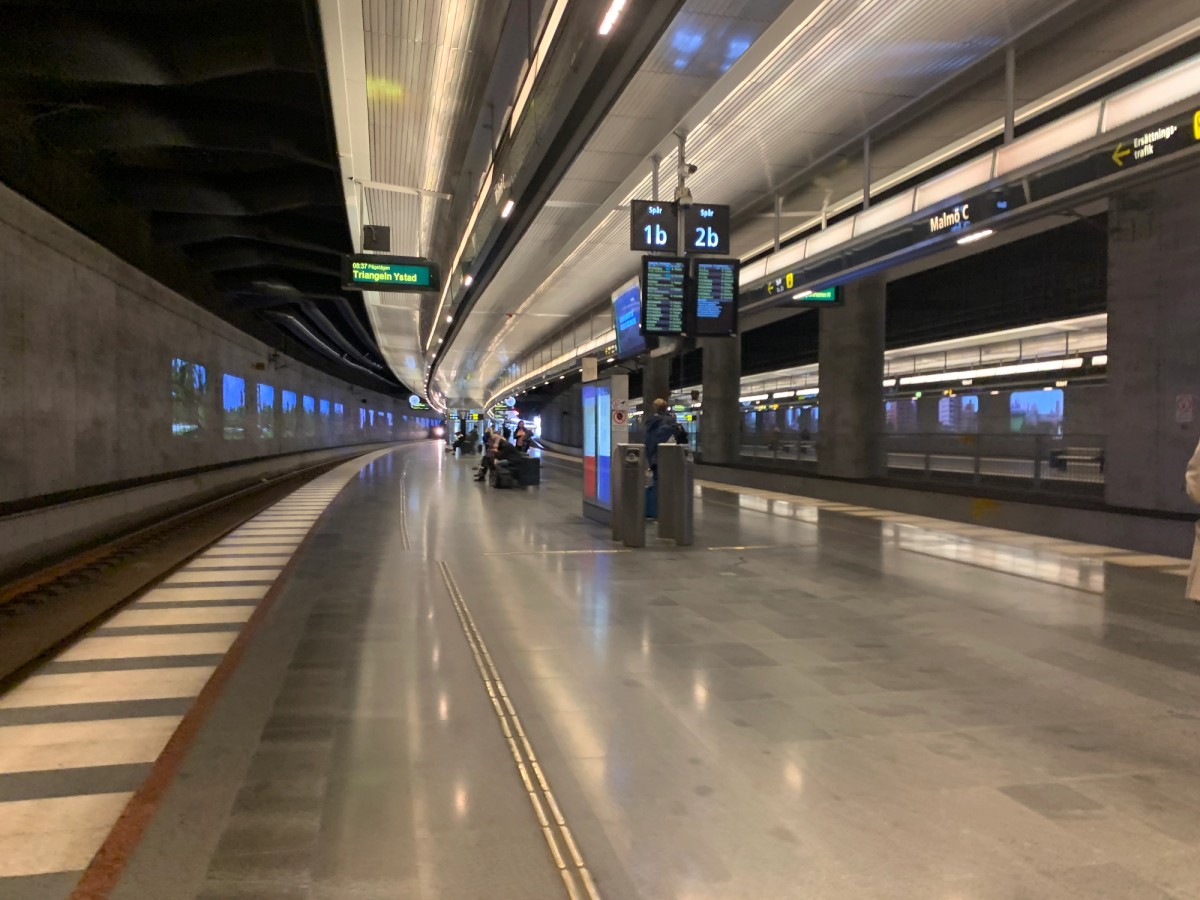
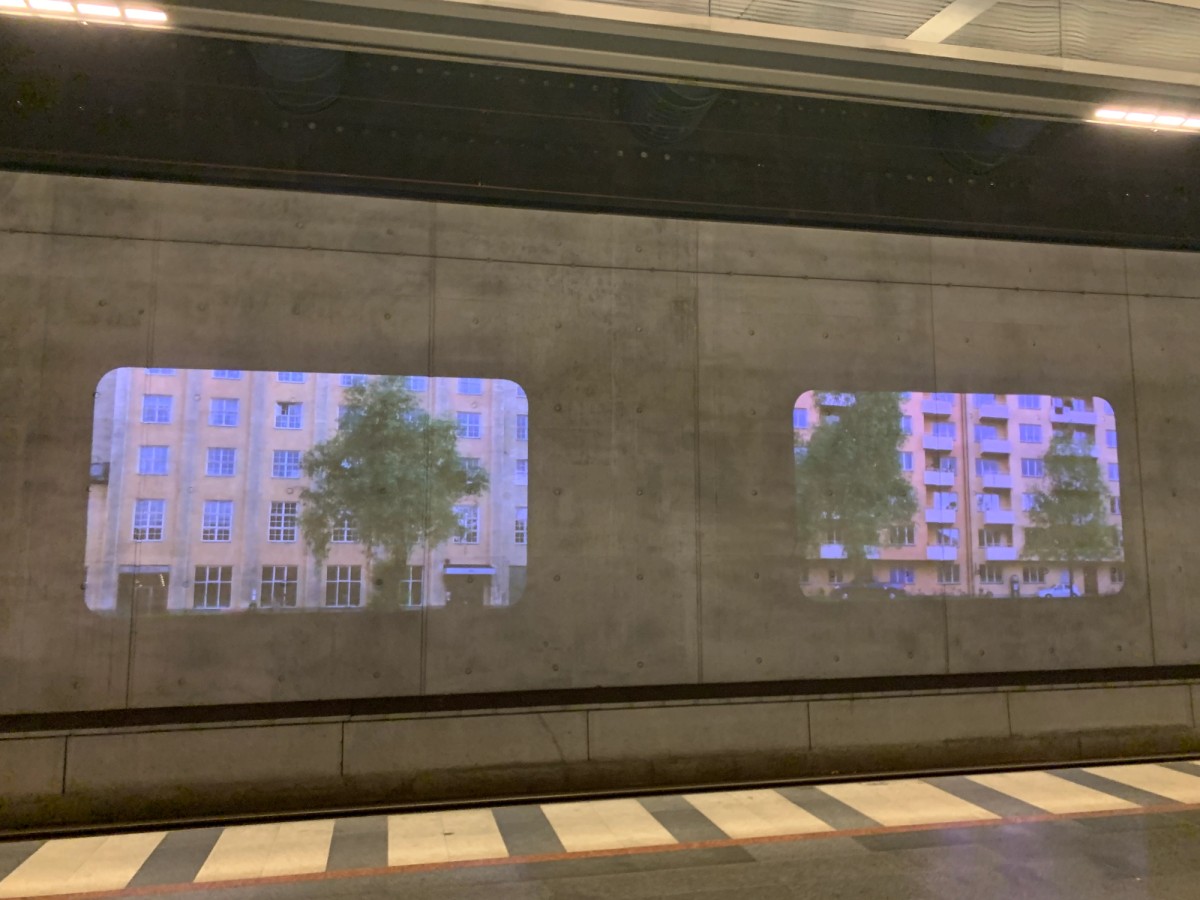
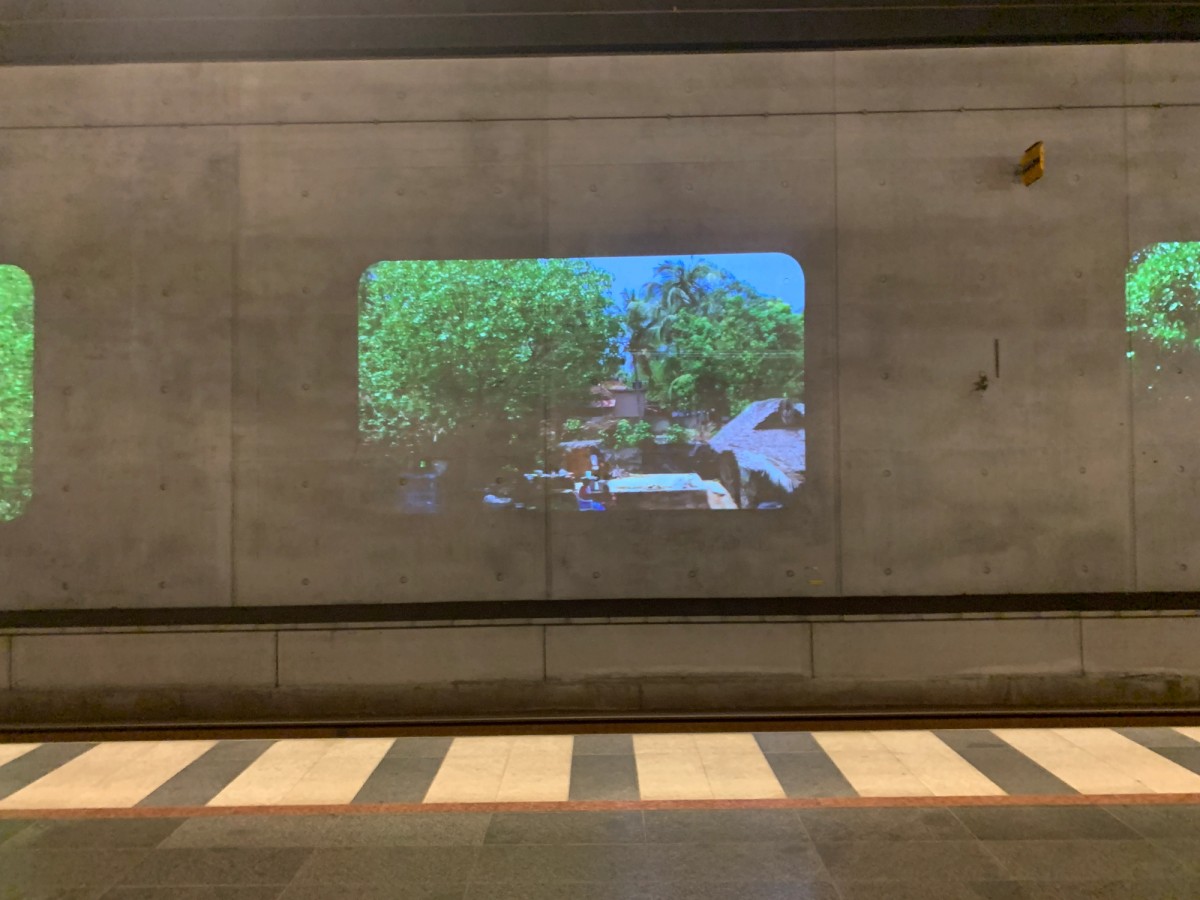
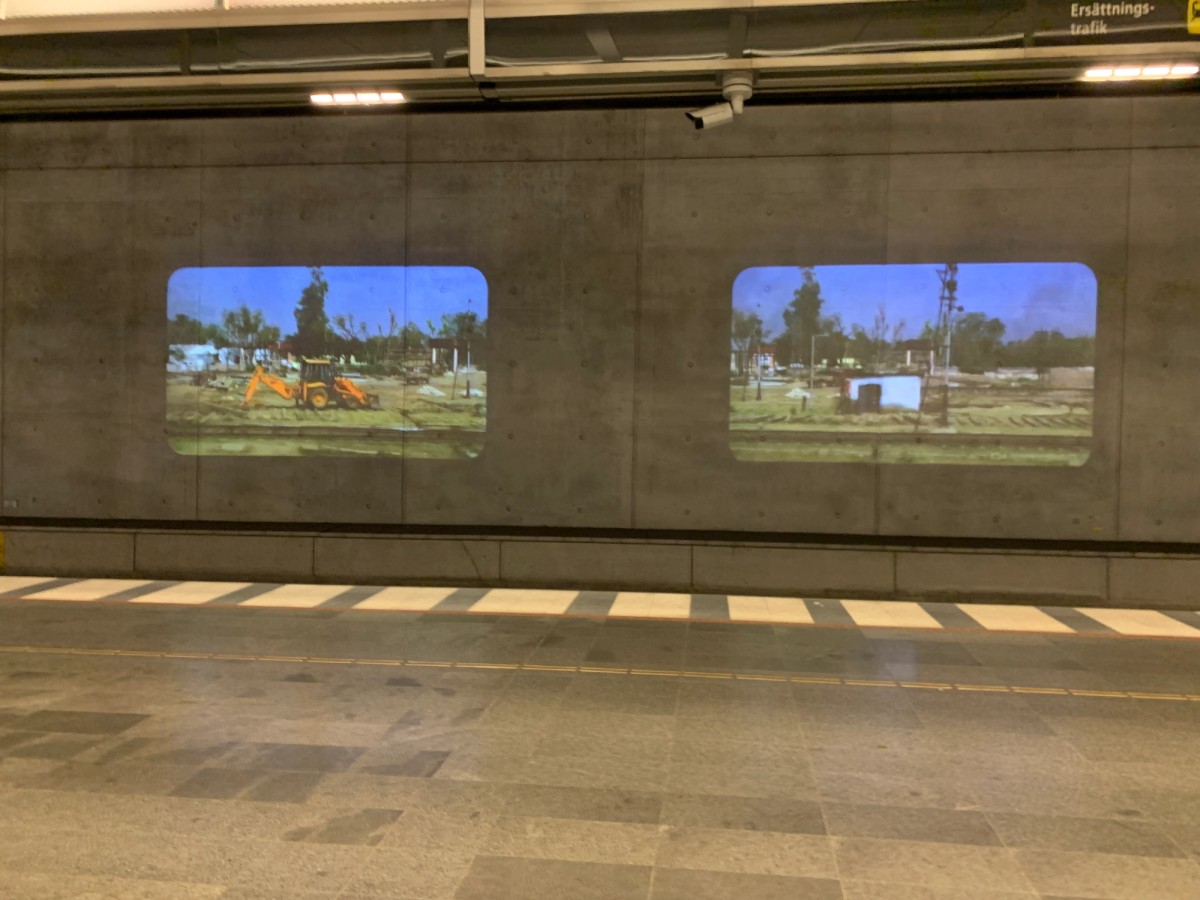
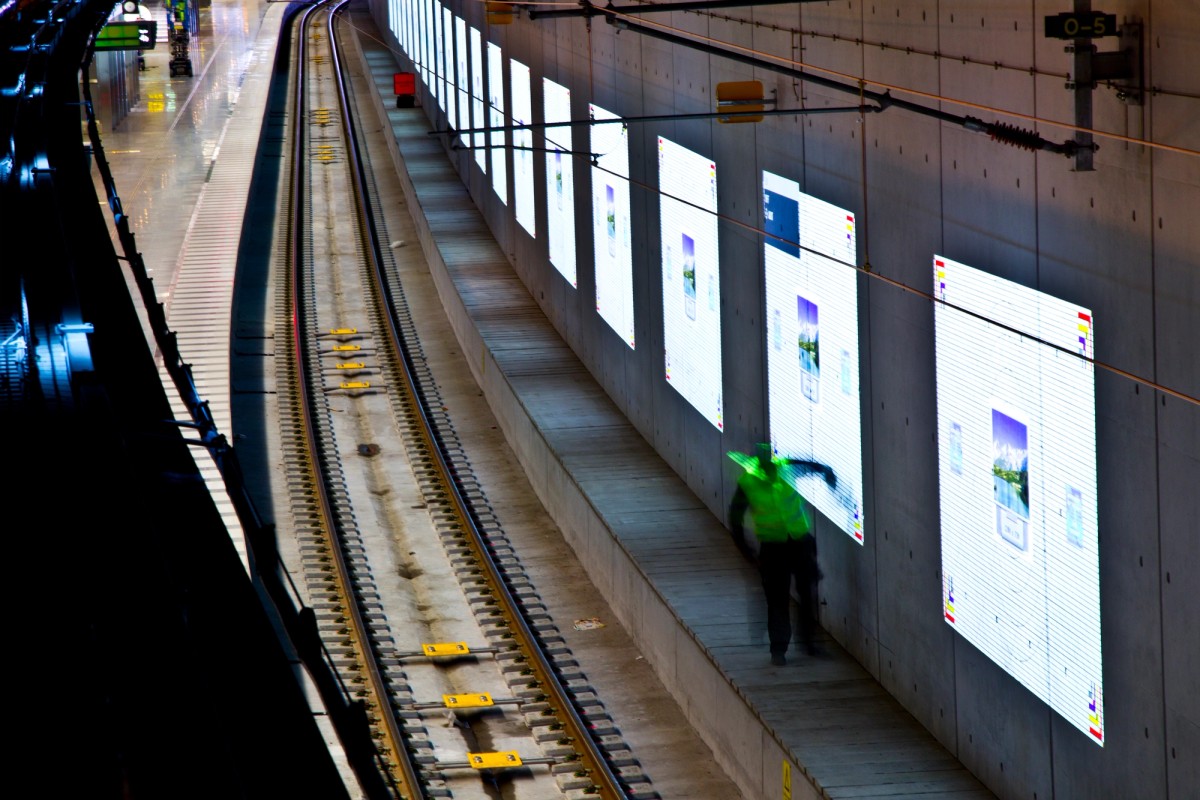
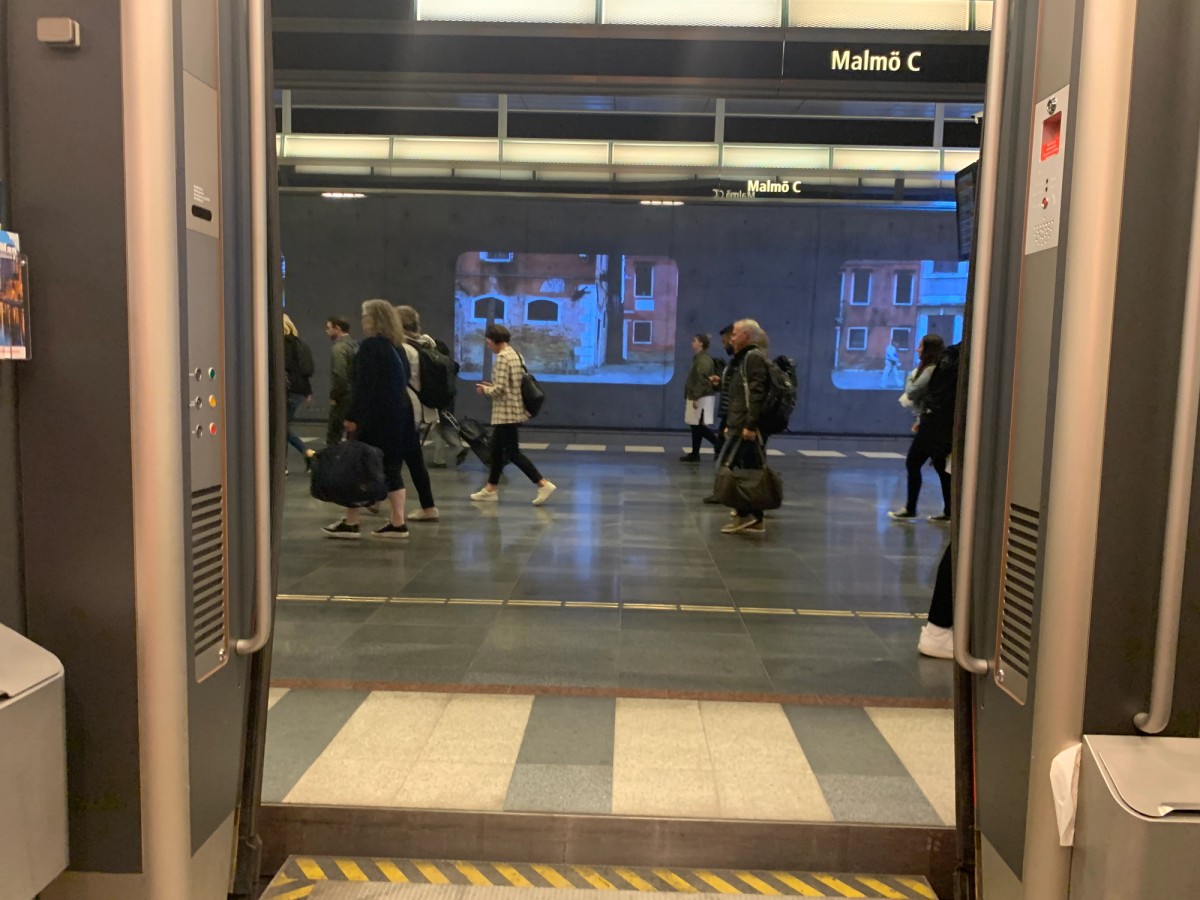
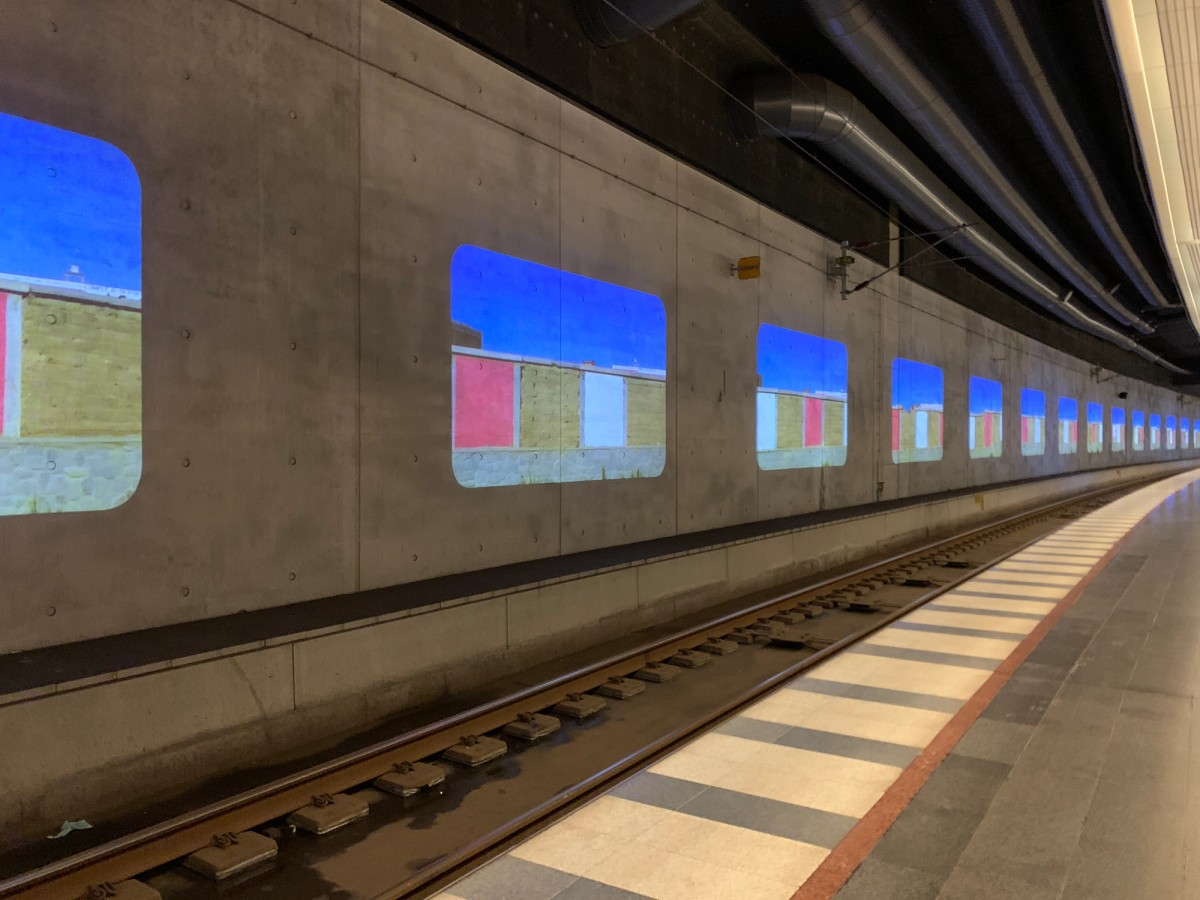
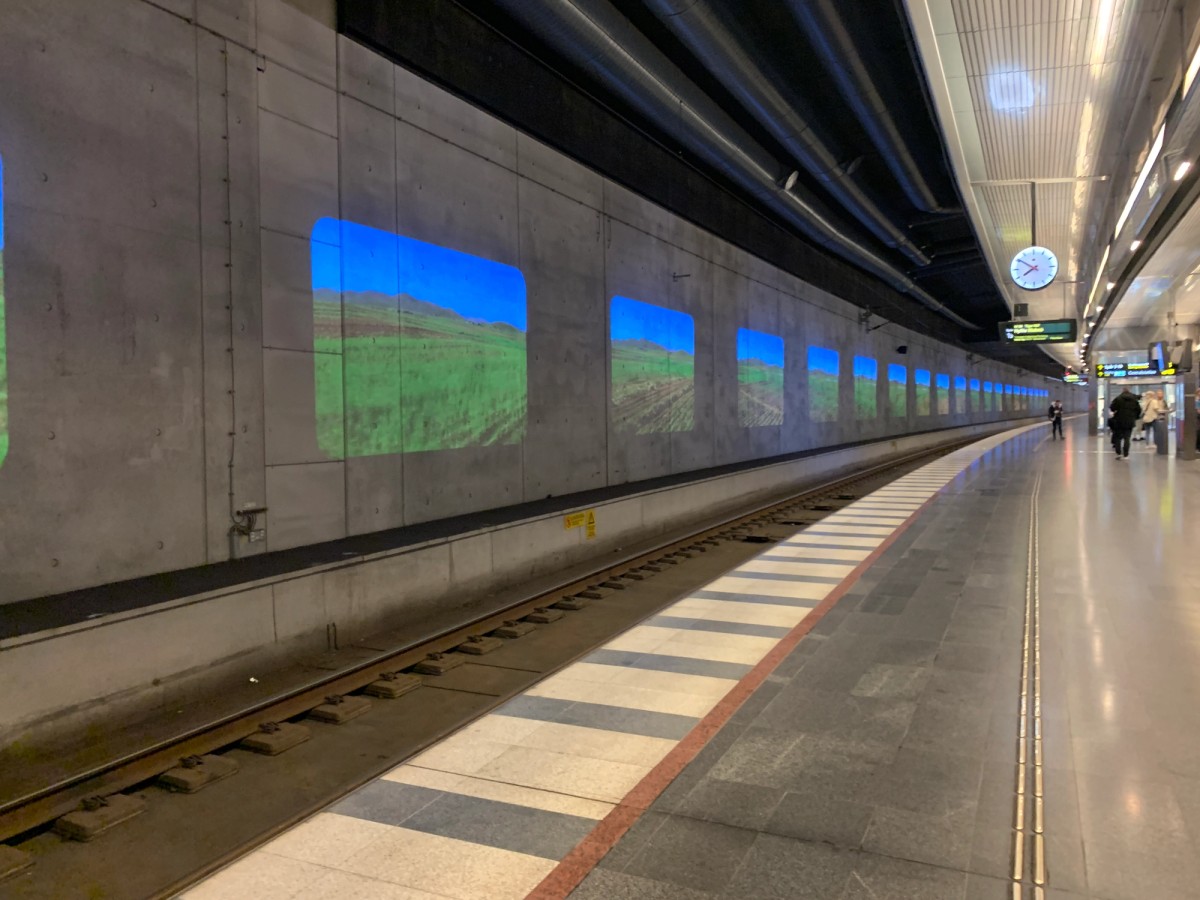
What are the promises and challenges of art-architecture relations, and how has the dialogue between art and architecture changed from questions of spatial interactions towards a politics of spatial and environmental critique? Using the case of the public artwork Elsewhere, situated at Malmö Central Station, the article traces recent interactions between art and architecture, reflecting on questions of power, site-specific relations, and the effects of climate politics. Elsewhere displays moving images of alternating scenes from around the world, projected onto 2 x 22 rows of images mirroring the windows of a train carrier. Travelling along the slightly curved 320-meter stretch of the station’s underground platform, its sequence of images is the only visual feature complementing the raw concrete walls. No commercials compete for attention. Instead, meadows are exchanged for suburbs that are exchanged for city centers, as the images flow slowly along the tracks, their pace slightly slower than a passenger walking along the platform.
Elsewhere – or “Ailleurs, Annorstädes, Elsewhere, Otraparte and so on” as the artist Tania Ruiz Gutiérrez refers to it – was finalized in 2010. It forms a flagship attraction for the new metro line in Malmö that opened the same year. An infrastructure achievement redirecting trains from other parts of Sweden through the city center instead of backtracking them on a route around the city, thus cutting travel time from Sweden to Denmark with 10 minutes. Sweco Architects in Sweden designed the underground addition to Malmö Central Station, opting for a simplified design with surfaces in concrete, natural stone, glass, and steel. The elongated, curved platforms prohibit waiting passenger’s view of incoming trains before they arrive, also limiting access to natural lights, leaving the tracks in somewhat subdued nuances. In contrast, the artwork Elsewhere, with its artificial windows, metaphorically opens the space up towards other vistas.
Ruiz Gutiérrez was commissioned in 2005, five years prior to Elsewhere’s realization, and worked together with a designated project manager to integrate the artwork into the underground station. Financially, Elsewhere is an outcome of the cultural policy of percent-for-art, which is a shorthand term for various policies and practices that reserve a specific percentage of building costs – typically between 0,5 and 2 percent – to the realization of public artworks. As a cultural policy practice that has existed in various formats in Europe since World War 2, percent-for-art funding has given rise to a particular genre of art in architecture. At the time of its realization Elsewhere was reportedly the largest video work developed for a public site in Europe, and it indicated a new ambitious direction for art in architecture in a Nordic context.
This article takes its point of departure in Elsewhere to embark on a voyage through art-architecture relations seen from the perspective of the genre of art in architecture. In one sense, the article constitutes an analysis of Elsewhere. In another sense, the article utilizes the artwork to reflect upon the recent history of art-architecture relations. In this endeavor I lean upon a list of potential names that Ruiz Gutiérrez contemplated for Elsewhere while the work was under development, including The Lost Train, The Train of Shadows, The Skin of the World, and Itineracy. These work-in-progress titles offer metaphoric interventions into a story of art-architecture relations that involve aspirations for a unity of the arts, questions of power-inequalities, notions of representation and site-specificity along with new conceptions of the critical zone and infrastructure work. Together with the moving images of this art in architecture work, the work-in-progress titles lend themselves to a reflection of the promises and challenges of art-architecture relations.
THE LOST TRAIN
The first work-in-progress title was The Lost Train, which “evoked the idea of a train roaming the world, going off on imaginary tracks that disregarded the constraints of time and space.” It is easy to understand why this title was contemplated.Standing on the platform, while waiting for your own train to arrive, it does feel like you are imaginatively travelling to other sites of the world. Elsewhere is a work I meet on my everyday commute from Sweden to Denmark, and I used to spend waiting time trying to pinpoint the place in the world where the footage was captured. One sequence was from the Indian peninsula, with people seated on a large staircase rising from the waters of a riverbank – a feature that distinguishes this footage from most others, where people are either absent or somewhat ghostly figures in the background or blurred impressions passing by in the foreground. Other frames seem to float through European cities, boosting architecture in 19th century style or river boats nesting along wharfs and jetties. Still others featured landscapes, storage houses and indistinct rows of apartment buildings. To pinpoint the exact location, however, is no easy task. In its totality, the work comprises “around 72 hours of projections, broken up into shots averaging 3-4 minutes long, selected from the hundreds of hours of images shot during several years in dozens of countries on five continents.” It constitutes 1,200 assembled film clips that have been filmed from the windows of boats, trains, buses, and cars. Subsequently, the footage has been subjected to a substantial process of postproduction, adjusting pace, perspective and trembling to generate a smoother display of flow. In addition, the footage has been cleansed of advertising and place-branding logo, which challenges attempts to firmly establish locality. Given that the film sequences ordering are furthermore randomized, you will not see the same clip again soon, or in the same constellation as before, but instead be let on to new vistas. It is a never-ending voyage.
As a metaphor for art-architecture relations, the idea of a Lost Train surfaces the art world frustrations with the commission processes for art in architecture. The cultural policies of percent-for-art at once ensure the funding of public art, but simultaneously restrain its possibilities. Why? Many reasons have been suggested: Art is only added at the very end, its placement pre-determined and restricted from the start. Preconceptions of art are dated, favoring familiar and customary expressions of sculpture and painting. Commission committees’ broad democratic representation minimizes interest in the new and daring, opting for proposals that are the least likely to offend anyone. Although public art has developed succinctly in the last 50 years, encompassing both new technologies, performative and participatory formats, public art funding tied to the built environment still seems to primarily support well-known classic formats that make the least fuss and interference into building projects.
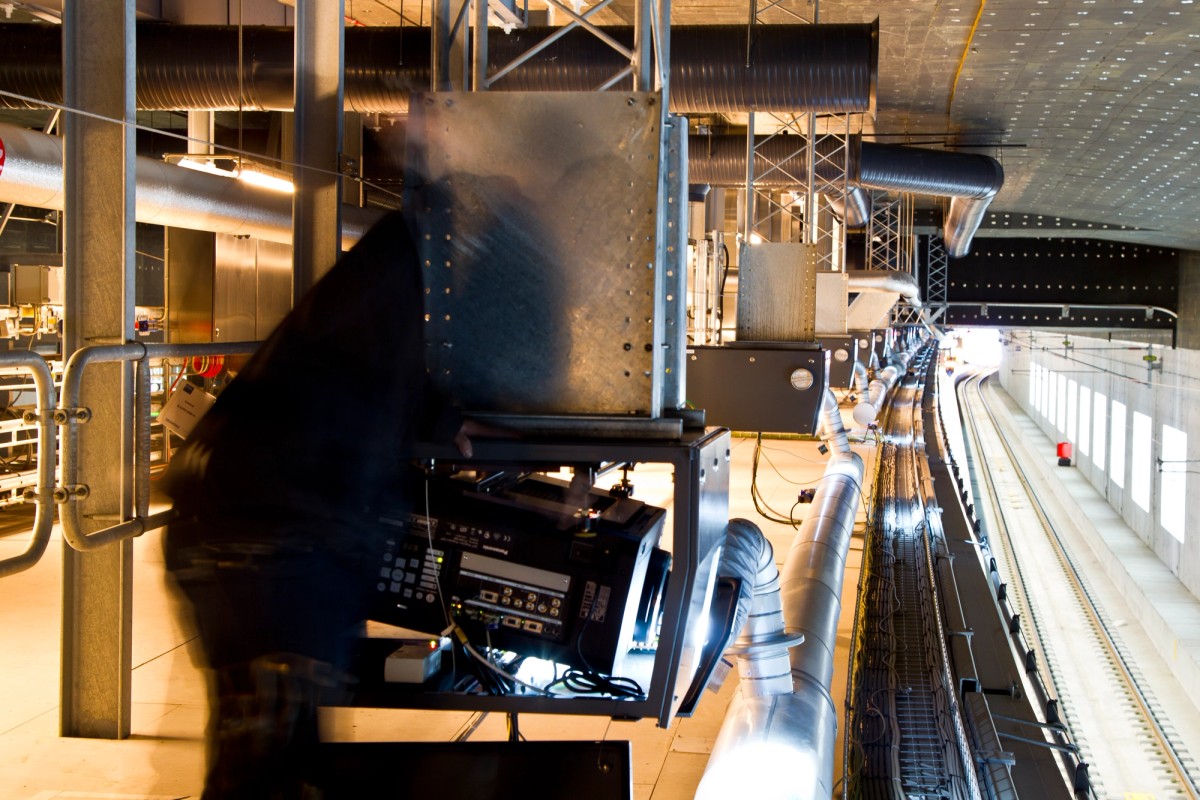
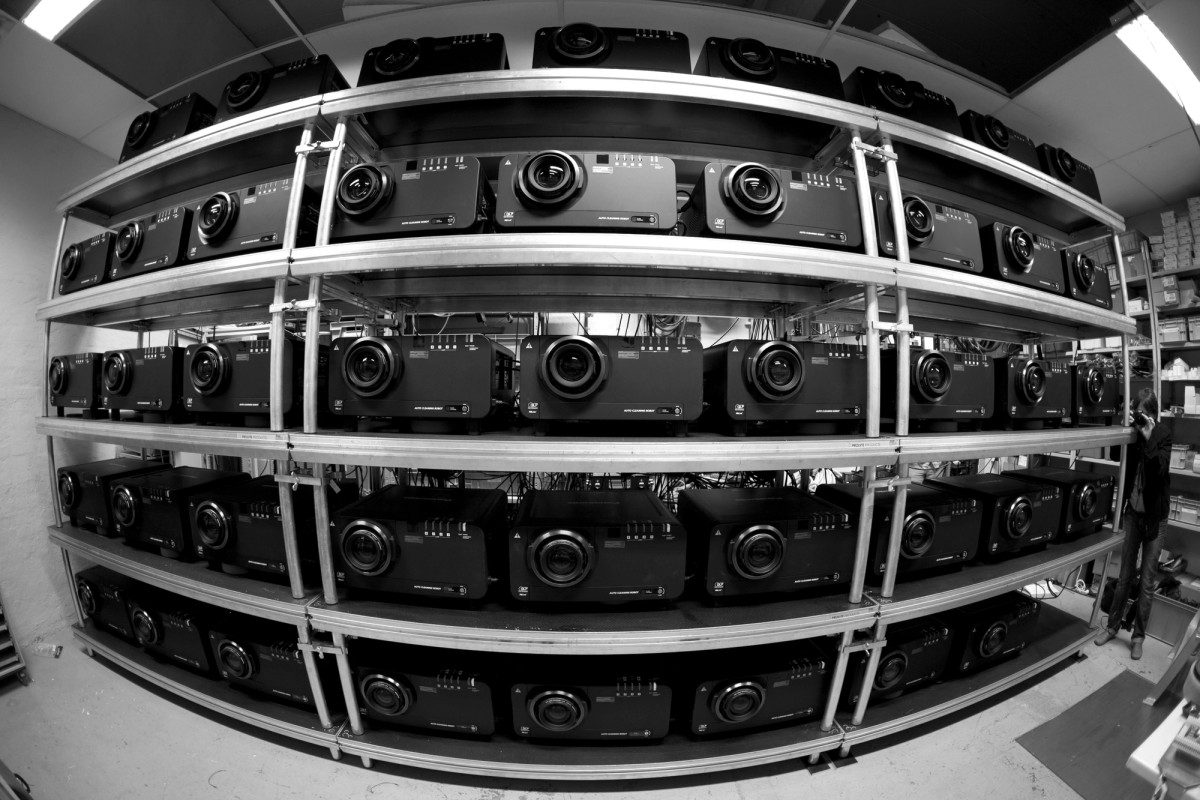
Elsewhere, however, seemed to defy those restraints. From a retrospective perspective, the work almost initiates a new era of more ambitious art in architecture in a Nordic context. The grandeur of its size matched the scale of the architectural space, and its technologically complicated production and installation process testified to the investment that had been put into its realization. In fact, in presentations of Elsewhere, the backstage material and technical dimensions of the work is highlighted in photographs of technical tests, featuring personnel wearing protective equipment and lots of wiring necessary for its accomplishment. It was a flagship project, requiring a flagship effort to realize. If art world critique of commissioning processes had targeted a lack of flexibility and dynamics in commission processes and interpretations of public art’s possible expressions, then Elsewhere indicated a change. The change was noticeable in the ensuing year’s increased commissions of technologically supported works of art, including video work, sound pieces and moving sculptures. In a Danish context, examples include Eva Koch’s My Sea (2017) permanently installed at AUH Psykiatrien Aarhus University Hospital, Ragnar Kjartansson’s Figures in a Landscape (2019) in the Mærsk Tower at the University of Copenhagen, andAVPD’s Possible Impossible (2023) for AAU SUND at Aalborg University. The change was also noticeable in the practice of state public art producers in the Nordic countries, where new forms of commission processes using percent-for-art funding were developed and tested. If The Lost Train is the train we miss, as Ruiz Gutiérrez suggests in her reflections of possible names for the artwork, then Elsewhere indicated an aspiration to no longer miss the train of opportunities provided by percent-for-art funding.
THE TRAIN OF SHADOWS
The next title that the artist contemplated was The Train of Shadows, evoking the legacy of early films and their depiction of moving trains, riveting and startling audiences unfamiliar with the new technological possibilities. As an artist Ruiz Gutiérrez works mainly with the medium of film, concentrating specifically on exploring the possibilities of an expanded cinema, or as she herself calls it, infinite cinema, where moving images expand beyond borders. The aspiration of Elsewhere was to create a kind of simulation of travelling, where the images – although highly manipulated to appear this way – offered the sensation of seeing raw footage captured from around the world. The ongoing sequences of film, in endless, randomized loops, were intended to give the impression of the world travelling through Malmö, mimicking how the trains now travelled more effortless from Sweden onto the continent.
The idea of simulations and shadows, of course, evokes a history of critical reflections of the merits of art, starting with Plato’s conception of art as a mediocre copy of the real thing, that is in itself a mere shadow of godly ideals. Henri Bergson would later lavish a similar ambush against image technologies’ ability to capture reality, rhetorically pointing to the inability of photography, even if it captured all parts of a city, to recreate the experience of moving through the city. Gilles Deleuze, however, subsequently came to art’s rescue, emphasizing the complexities of the arts in generating percepts and affects that contributed to aesthetic experiences of the world, underlining the ability of art to not only represent the world, but to move it somewhere else.
The simulation of travelling in Elsewhere features as an apt match to the immediate site of the underground platform, but in a more metaphorical sense it also represents the new link between Malmö and Copenhagen. It serves to elevate the aspirations of a city on the rise, as the newest attraction to compliment the feat of an infrastructure development project further advancing the relationship to the capital of Denmark on the other side of Öresund, where to access had been expedited 10 years earlier with the opening of the Öresund Bridge. As urban studies researcher Maria Hellström Rainer suggests in her analysis of Elsewhere: “Rather than a dutiful and decorative addition to a damp and shady underground passage for commuters disembarking from and boarding containers, it is an expression of intensified geographical awareness and a new attentiveness to the vital importance of mobility and interconnectedness.”
Contemporary art-architecture relations are haunted by the aspirations for perfect syntheses, the matching of art and architecture. Perhaps it originates in historical visions of gesamtkunstwerk, the merging of the arts, their ideal marriage, where each discipline contributes to the completion of a perfect building. Such aspirations featured heavily in Nordic art discourse and practice in the interwar era, expressed with the terminology of the monumental style, effectively leading to the establishment of public support systems for the arts, including percent-for-art schemes. In the postwar period, however, functionalist architects and autonomous artist expressed more reservation towards integration, while international art theory underscored the necessity that art be concerned with its own formal problems, not site-specific fabulation or the practical work of fitting a work into a spatial setting. Still, ideas of a perfect match haunts contemporary forms of site-specific practice – common across art as well as architecture and design – when works of art are created on the basis of site-readings or even with reference to the spirit of the site, the genius loci. One could argue that Elsewhere is a perfect fit for the site, as it thematically matches the moving trains on the platform, simulating the visions of moving trains. Its formal expressions in the form of 22 projections on each side of the underground station also perfectly tailored to its elongated shape.
It could have been otherwise, though. The 2010-metro line in Malmö features two other new platforms with integrated artworks. Christian Partos’ Track Lights at Triangeln Station and Kristina Matousch’s Depths of Time at Hyllie Station. Track Lights is a large-scale light installation simulating the crowd behavior of insects, with small lights being chased away by incoming trains, only to re-arrive in bundles, when the train leaves again. Track Lights thus responds to and amplifies the movement of the trains, but it also appears as if one is travelling through a kind of digital hub for signal-exchange, a central electrical circuit of the city. Depths of Time, instead, connects the new infrastructure hub to Malmö’s prehistory. Around the pillars upholding the station roof, the artist has inserted glass upon black sand that metaphorically extends the pillars to a prehistoric wooden monument discovered during the excavation of the area. Depths of Time, thus, offers a reading across historical times, positioning the grandeur of an infrastructure project in relation to its local ancestry.
Critical discussions of site-specificity underscore the argument that any place – or any site – might be subject to multiple readings. Every site hosts the potential for different interpretations, dependent upon which layers, contexts and delimitation of site that are employed. Perhaps, a site is only created in the process of constructing a work of art, its interpretation generating the site in the first place. The problem with the idea of a perfect marriage is that it easily ends up in power struggles, where one or the other profession dominates, limits or even destroys the work of others. Suggestively, we could think of art-architecture relations not necessarily as the perfect match, but instead as the possibility of exploring and generating heterotopic and heterochronic openings. The notion of heterotopia originates with Foucault as a provocation to architecture to think of openings and passageways that enable imaginary escapes. Heterochrony likewise suggests an intervention into dominating temporal templates, opening timescales beyond the tick of the clock. More than a shadow of trains passing through Malmö Central Station, Elsewhere might be seen as an opening into other spaces and other times. It interprets and thereby creates the site of the station as a vehicle for potential travel, an expression of the possible openings that connect this discreet site to all the rest of the world. Likewise, the station architecture, with its elongated form, constitutes a passageway between open air train tracks and tunnel, formally underlining the transformation of the station from end stop to a place of transit.
THE SKIN OF THE WORLD
The third title that Ruiz Gutiérrez contemplated was The Skin of the World. For the artist it relates to her extensive filming around the world. As she muses “my filming necessarily took place at its surface, exhausting it. Sometimes I envisioned my long shots as peelings of the world’s skin.” The suggestive title generates several different associations for me. One is to the history of art in architecture as ornament, decoration, or surface-work. In a sense, this is the history that the artworld is hoping to scorn as it relegates art to a subservient role in relation to architecture. It is something added to, additional, and not necessary, nor vital. Consequently, it is something to be dispensed with, should funding run out.
More importantly, the idea of The Skin of the World conjures associations to the notion of a critical zone, employed by Bruno Latour to underline our entanglements with other elements and creatures in the narrow zone of life that we inhabit. While climate change and loss of biodiversity have been discussed in decades, its visibility in contemporary politics and media is recognizably larger today than in 2005, when Elsewhere was commissioned. At the time, a technologically complicated, large-scale, dynamic work of art with moving images seemed a dream come true for a discipline that at least in a critical artworld perspective had remained stuck in old-school forms of permanent decoration. Today, we might wonder which type of expression features as the most progressive: the traditional beautification of a building to support its longevity or the dynamics of moving images matching the ongoing circulation of trains through the station, and indeed through stations all over the world?
Criticism has been raised at Elsewhere for its cosmopolitan outlook, its envisioning of a world without borders, allowing for the smooth passage across the globe for the privileged few whose national birth rights and passports grants such passages. Specifically Maria Hellström Rainer has argued that the artist’s digital manipulation of the footage to appear as one continuous, unending stream of visions, underscores its representation of a world open for exploration. Still, in the artist’s reflections of the work, the question of borders and of different levels of access to the world are not silenced. Her own experience as an artist with Chilean and Columbian background and, more recently, French nationality, indicates an awareness of the effect of borders. She speaks of the differences between first-, second-, and third-class passports in terms of the access they grant to the world, adding: “Along the road stand those without a passport at all, and those for whom the greatest freedom of all is not to be forced to leave their country.”
At the time of its inauguration, the work perfectly captured the aspirations of a city reconfiguring itself from its former position as Swedish periphery into a central passageway that amplifies the relations between a Northern outskirt nation and the rest of the continent. As a commuter since 2010, however, I’ve also experienced less expedient travel. The refugee crisis in 2015 eventually introduced border control, mandatory change of train and added travel time to allow for passport checks. This reenforced differences between first-, second- and third-class passports, but also between national contexts. For a short period of time, Denmark moved refugees through the country, while Sweden instead welcomed them. Before the borders were tightened, I would arrive in Malmö upon my return home from work amidst groups of refugees, greeted at Malmö Central Station by signage on the platform that asked “Refugee? Welcome to Malmö,” along with depictions of maps instructing them where to go.
A few years later, the covid-19 pandemic put a stop to the travels of most commuters. Confined to working at home for extensive periods of time, I sometimes wondered if Elsewhere was the only train travelling through Malmö Central Station, as a ghostly continuation of a practice that is no longer sustainable in a world of repeated crisis. Today, as the climate crisis asserts itself more vividly, with frequent extreme weather conditions, the work might seem almost already outdated, an expression of financial optimism that is no longer tenable. Elsewhere depends upon extraction of materials, specifically in the form of image footage captured through extensive travelling along with expensive image manipulation and a maintenance budget that, at first, determined Elsewhere’s existence to be only semi-permanent, for five years. Subsequently, however, and following support campaigns, Elsewhere’s continued existence has been financially supported by a private foundation. In 2017, these private funds allowed for the initial projectors to be exchanged with new led light projectors installed inside a hermetically tight cooling system to prevent them from exposure to the aggressive train fog of the station environment.
ITINERACY
The last title the artist contemplated was Itineracy, which frames the artwork as a representation of continued passage rather than a multitude of sites of arrival. Ruiz Gutiérrez writes:
At production time the work was called Itineracy, conveying the idea of a station that, not satisfied with its stationary condition would leave with the trains and even further, instead of just waiting for them, passively waving goodbyes. But it also pointed to my own itineracy and that of the occasional shooting crew. Going from here to there like traveling salesmen, we were obstinately more interested in the longest and slowest route than in the destination.
One of my recurrent reflections about Elsewhere is that it conveys an overwhelming non-place repetition. In a sense, the work appears as a signifier of the indistinctness of human expansion, reminiscent of the view from freeways driving in and out of cities bordered by – now customary –landscapes of factories, storage facilities, and large-scale retail shops. This impression originates from both practices of shooting the footage and its subsequent digital manipulation. As the images were recorded by moving the camera along roads, rivers, trains, and other forms of transportation infrastructure, it inevitably captures the landscapes that are visible from such perspectives. The artist herself had that revelation: “From my restricted viewpoint in a moving vehicle,” she argues, “the uniformity is particularly striking in today’s tentacular cities endless outskirts. No matter in which continent they are, they appear as predictable variations of the extended same.”
The sensation of repetitive environments is further underscored by the postproduction process, in particular the effort to erase place-specific signs and commercial advertisement. The no logo policy of image editing accentuates a critical angle towards the commercialized world of capitalism. For me, however, Elsewhere’s critique of capitalism resides rather in its ability to amplify the dull sameness of human expansion. Instead of exotic tourist shots, we see the dreariness of the road to get there. If Hellström Rainer took Elsewhere’s digital manipulation of footage into a smooth flow as indication of its indirect support of the cosmopolitan’s uninhibited outlook on global travels, to me it becomes just as much a critical reflection of a world drowning in the wretchedness of infrastructure expansion. This is not to argue that Elsewhere confronts the climate crisis. In fact, for Ruiz Gutiérrez nature seems equally repetitive and monotone to human expansion. She quotes Oscar Wilde to suggest that nature possesses only “extraordinary monotony,” requiring human imagination to appear as infinitely varied. Following Latour’s notion of a critical zone, and the necessity of generating new imaginaries of nature from within our intertwined position on earth, we might suggest that the perception of nature as monotonous is a figment rather of the limitations of human imagination, than of nature itself.
Today, a particularly strong trajectory of contemporary art-architecture relations concerns itself with the challenges of climate change and the loss of biodiversity. Examples include Superflex’ work on Interspecies Living (since 2009), OOZE architects and artist Marjetica Potrč’s Future Island (2022), and Lea Porsager’s beach environment Klit (2022) that is intended to gradually evolve in contact with nature. In a seminal essay from 1979 on the relationship between art and architecture, Rosalind Krauss proposed a diagram of spatial relationships, where architecture and non-architecture, landscape and non-landscape featured as spatial nodes for an expanded form of sculpture. Today, suggestively, art-architecture relations unfold rather in the endeavor to critically reflect upon our environments and to imagine new ways to develop and inhabit the world. The itineracy of art-architecture relations has in this sense moved from spatial interactions towards a politics of spatial critique.
In comparison, Elsewhere resides in a previous decade, a reminiscence of an earlier era’s aspirations for global connections. Still, part of its itineracy – and perhaps a testimony to the quality of the work in all its assembled openness for interpretation – is that it simultaneously retains a reservation for further travel. The pace of the shifting images does not match the rush of travel, rather countering the flow of moving trains. It figures as an invitation to move slower, to defy the urge to be on the move. While the work can indeed be interpreted as an expression of cosmopolitanism, it is also envisioned as a depiction of multicultural Malmö that is amongst other referenced in a locally famous slogan “Har du sett Malmö, har du sett världen.” [If you’ve seen Malmö, you’ve seen the world]. So why move elsewhere when the world is already here?
–
Ditte Vilstrup Holm is Assistant Professor at the Department of Business Humanities and Law, Copenhagen Business School. She holds a research MA in art history and a PhD in organization studies. Her work focuses on the intersections between art, aesthetics, and organization in the expanded field of public art practices. She explores works of public art and the conditions for artistic practice, including forms of collaboration, cultural policies, governance systems, percent-for-art schemes, and art-architecture relations. The research conducted for this paper forms part of a post.doc-project funded by New Carlsberg Foundation and carried out in collaboration with KØS – Museum of Art in Public Spaces.