For much of the 20th century, architecture’s discourse has been conditioned by the moral imperative of doing good through building new stuff. The figure of the architect was largely seen as a facilitator of spatial progress, which was most often understood as first clearing the site for the new, then mobilizing extensive economies of labor, energy and resources to assemble buildings, many of which have lasted for merely a few decades before being demolished for redevelopment. Much of architectural education was structured accordingly, focusing primarily on the inception of the architectural project and largely overlooking architecture’s enmeshment within broader ecosystems, especially beyond the framing of environment as a matter of systems and equipment. Yet, this conception of architecture’s relationship to ecology has shifted over the decades, as several works have called for reframing the role of the architect beyond the "belief that the process of building is the primary constructive activity”; making buildings more than mere “carbon forms” arising from fossil energy and its “corresponding technologies”; and seeking new approaches towards sourcing building components beyond the extractive systems.
Considering that by some accounts, the construction industry amounts to up to 40% of all global carbon dioxide emissions and a substantial share of waste streams, this ideological shift has been recognized politically – as exemplified by the recent introduction of the mandatory life cycle assessments in the Danish building regulations that now directly ties much of architectural production to practices of carbon accounting. Yet, recently a more radical proposition has been Charlotte Barthes’ initiative of A Global Moratorium on New Construction, which considers an overall ban of all new construction in favor of reusing and reconfiguring what is already built. Barthes invites us to reconsider buildings as complex technical objects made of countless building components, most of which often originate from extractive supply chains – stopping new construction would provide the conditions for rethinking the current growth-oriented modes of construction.
These initiatives – both political and activist – pose a challenge to architectural practice and the broader construction economy as they largely run counter to the growth- and development-oriented operation of architecture. They also pose a challenge to architectural education that is inherently geared towards anticipating the professional realities of emergent future conditions – such as a post-extractive building economy. According to Barthes, up until recently, architectural education has been largely oblivious to “the political ecology and economy” of materials. Thus, any efforts to move towards a post-extractive building economy would necessitate reforming the architectural expertise not only in the professional practice, but also within the architecture school, where the matters of sustainability are not conceived as an add-on to the design studio, but rather embedded into its methodological foundation.
This requires cultivating the awareness that every architectural intention expressed as a drawing or digital model represents not only a part of a building geometry but also a broader entanglement of materials, labor, politics, economy and environment. The architect of the post-extractive era needs to adopt resource-oriented approaches that build upon the understanding of life cycle- and ecological thinking and engage with multi-scalar time horizons. They need to devise tools and workflows for material accounting and working with irregular supply chains, reclaimed materials, urban mining and more circular approaches while seeing buildings as living repositories of materials that may be used again in the future. In this context, propositions such as the global moratorium on new construction serve as a provocation to mobilize architecture for transitioning towards more attentive material and adaptive reuse practices, fundamentally rethinking the value systems of the current construction industry that is driven by monetary revenues – after all, if we can reorganize architecture’s material economy in significantly less extractive forms, construction may no longer be a major contributor to depleting our planetary resources and ecosystems. What follows below are some attempts to investigate such pedagogies for post-extractive architecture over the past two years as part of Studio 3A of Aarhus School of Architecture:
LIFE CYCLE STORIES
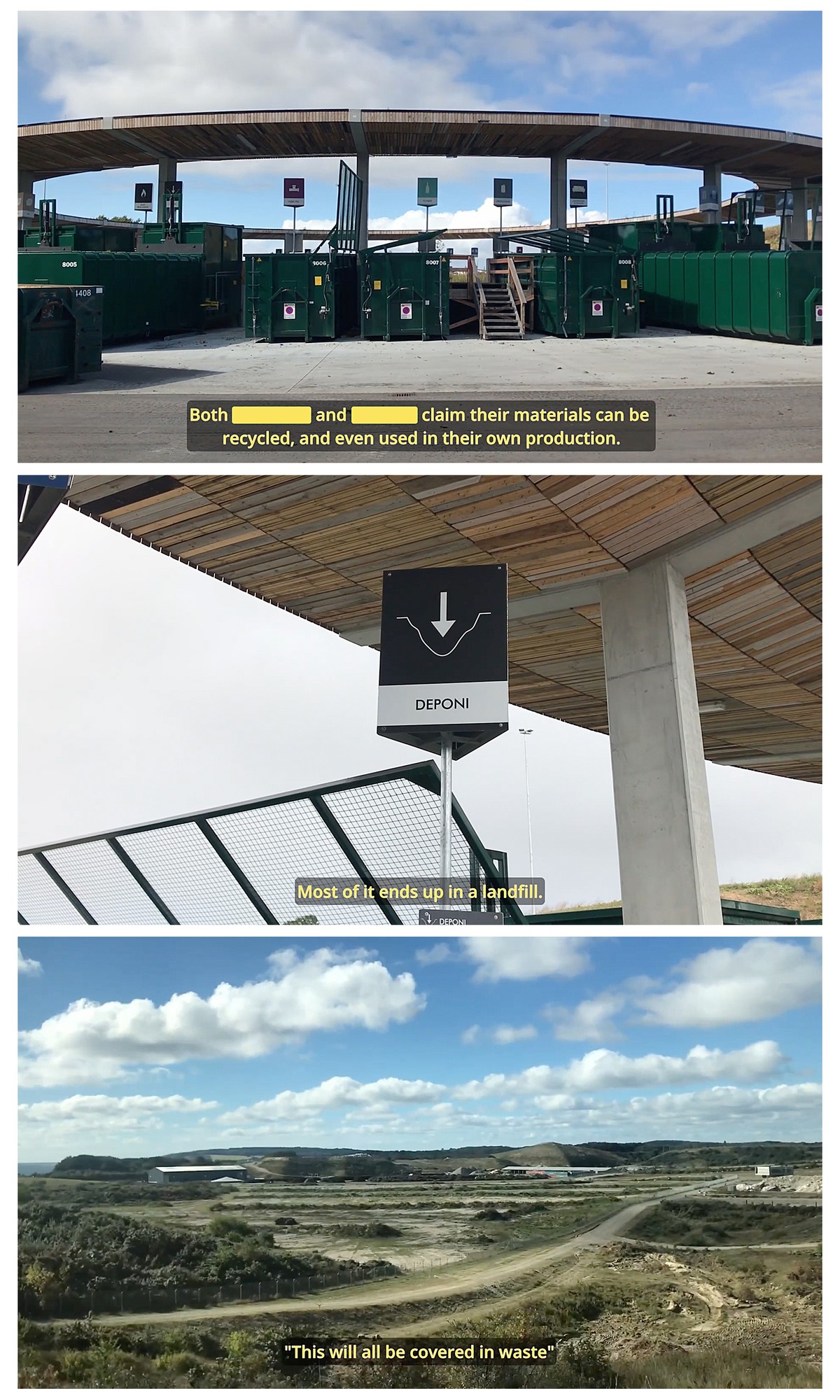
Life Cycle Stories[Ill. 1] engage with the messy realities of building materials in their existence over time. The exercise builds a qualitative understanding of entangled material ecologies by tracing where specific building elements come from, how they are manufactured, transported and put together, as well as what happens after their usable lifespan expires. Through the medium of film, it demystifies the impacts, limitations and opportunities for assembly and disassembly of commonly used materials. Unlike quantitative specification sheets of a life cycle assessment, using the moving image enables one to follow and study the material in an open-ended way across various scales, from territorial to molecular, from processing facility to the built component. The videos were developed using existing research, stock footage, and recordings of own drawings, built models, and visited buildings, production plants, materials resellers and disposal sites.
DECONSTRUCTION SITES
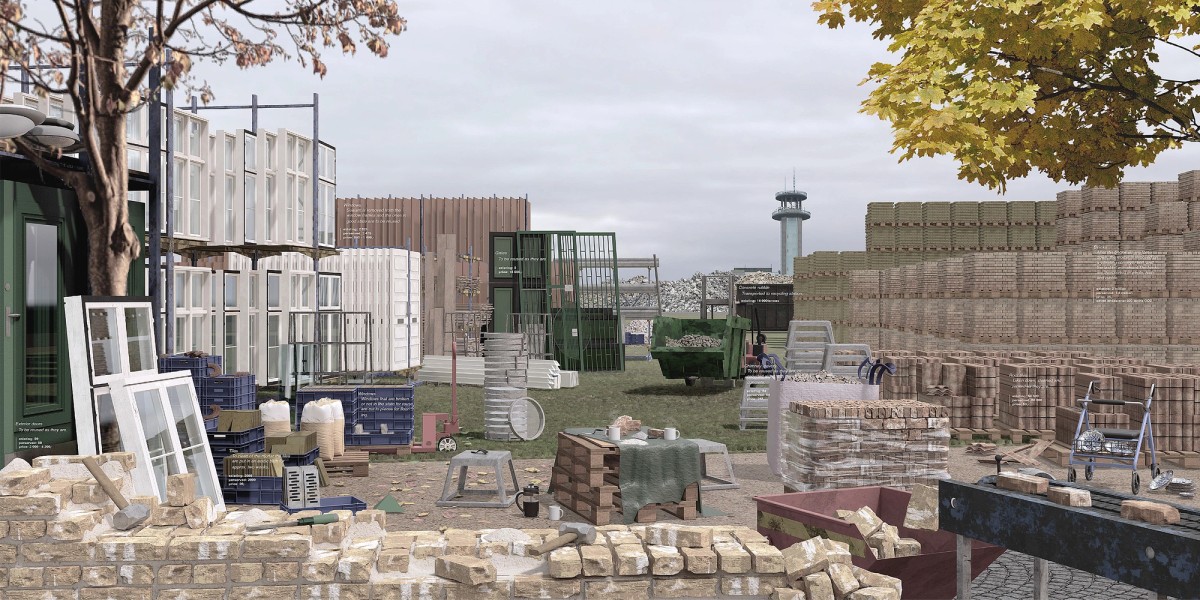
Deconstruction sites[Ill. 2] are speculations of sites of disassembly of existing buildings. They seek to diagnose what prospective materials these repositories will contain, how they will be organised, and what ecological, political, socio-cultural and economic trajectories they will embed. This exercise decomposes selected case studies to quantitatively and qualitatively analyse the built projects and the elements that construct them. Careful studies of the archive material allow for approximate speculation about the volume quantities and nature of future construction waste streams, their anticipated conditions and properties. Conceived as large-scale renderings of the deconstruction sites seek to build better sensibilities for more resilient material sourcing.
VALUE MAPPING
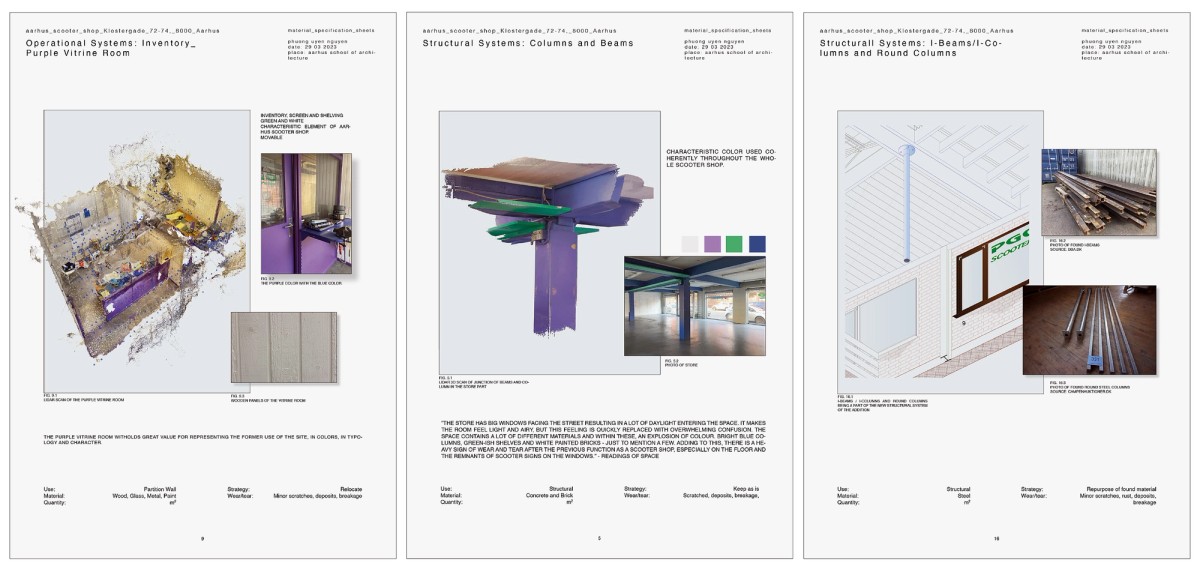
Value Mapping[Ill. 3] is a set of methods for reading a building or a site, accounting for embedded material resources. Through measurement, photo and 3D scanning documentation workshops, and a detailed calculation of material quantities, embodied carbon and potential hazards, the exercise builds an overall inventory of existing components, materials, and embedded stories. This information is represented in a shared, large-scale document and a series of catalogues indexing peculiarities and imperfect properties of reused materials, carefully accounting for demolition, reuse and addition. The documents trace potential material flows and exercise a resource-conscious design approach by making the most use of what is available on-site.
ATMOSPHERES OF REUSE
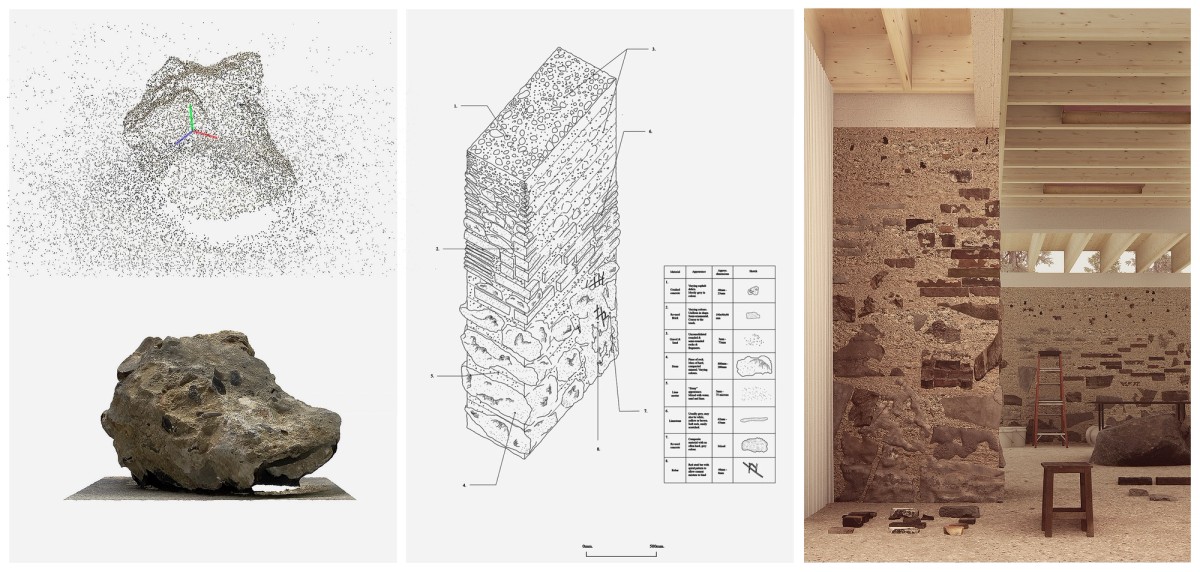
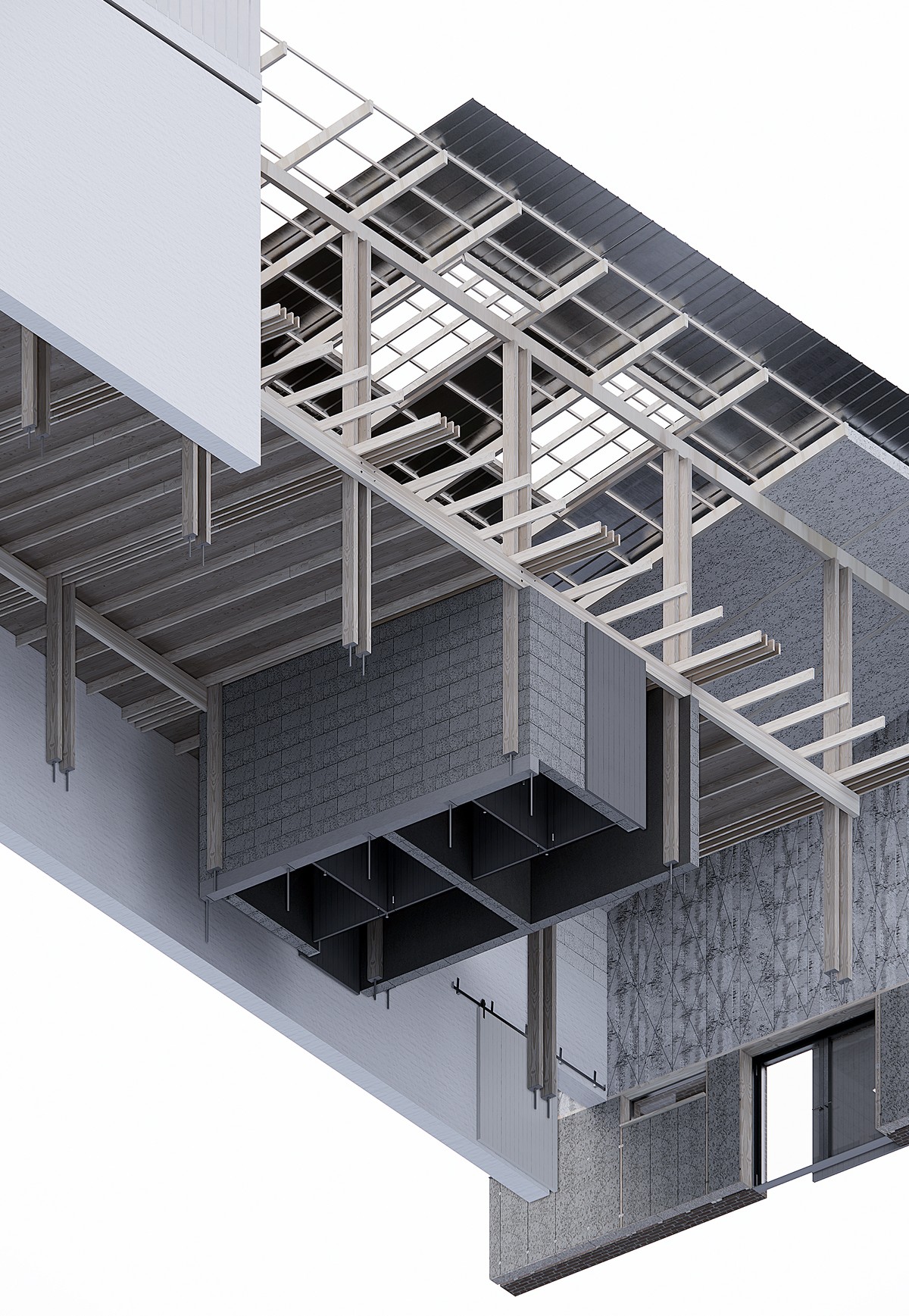
Atmospheres of Reuse[Ill. 4] investigates tectonic systems that reuse discarded building matter, seeking to transcend the reuse aesthetics of salvaged objects or landfill materiality. Instead, it prompts the students to discover new design languages by integrating reused materials with prosthetics and scaffolding elements that negotiate between material irregularities, embedded imperfections and structural soundness. These heterogeneous systems open new design possibilities and forms of expression, changing the perception of waste but also leading to new workflows between material and digital realms.
DESIGNING LIFE CYCLES
Designing life cycles[Ill. 5] engages with time as a dimension of design in the context of adaptive reuse and regenerative building materials. Unlike traditional building components with stable shelf life, biogenic materials may have shorter lifespans, and more frequent maintenance requirements. As part of the exercise, the students are invited to operationalize this instability and factor them through design, engaging with details and construction over time.
WORLD BUILDING
World Building[Ill. 6] borrows its methodologies from fiction writing and game design. It uses the mechanics of a role-playing card game to collectively imagine new forms of desirable architectural futures that exist beyond the predefined limits of present-day ideologies, economies, politics and culture. Unlike the iterative and often cumbersome process of a gradual transition towards a post-extractive economy, world-building attempts to construct a fictional scenario that represents a radical form of current debates about climate change and the place of architecture within that. As we play the game over the weeks, writing stories and projecting certain scenes from the world into rendered images, we speculate on fictional yet perhaps not improbable realities of architecture.
–
Urszula Kozminska, is an architect and Associate Professor at the Aarhus School of Architecture. In her research and teaching, she focuses on post-extractive material practice, circular tectonics and life-cycle design strategies. She explores these topics through an ecological thinking approach, investigating broader eco-systemic entanglements of material flows.
Matīss Groskaufmanis works in architecture, media and education. He is a teaching assistant professor at the Aarhus School of Architecture and operations director at mgr-dev, a shell organization for development projects and collabs. In his practice, he examines architecture’s relationship to environmental regulation, post-extractive building economies, managerial desires and technology.