“I often get the question what my advice would be to young architects; understand that it’s not the architect who is the important person in the process.”
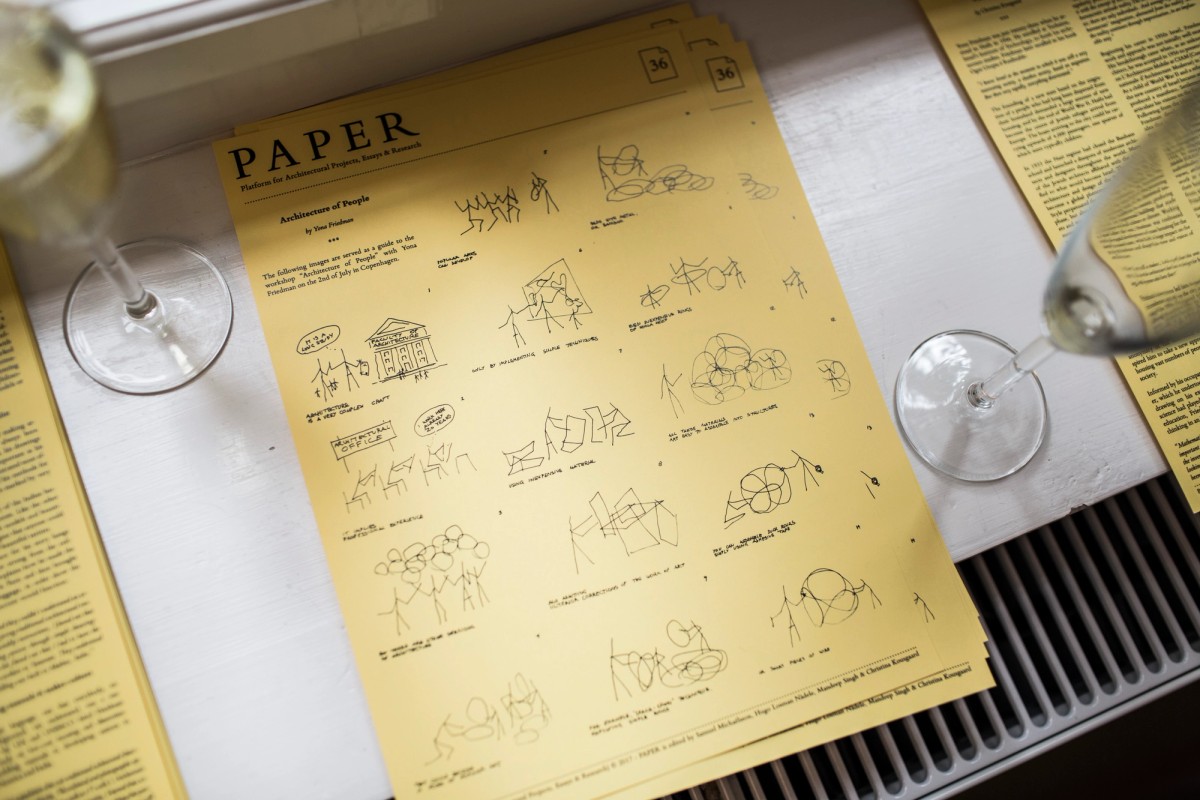
In the summer of 2017 I was lucky enough to meet and spend some time with the legendary architect and urban planner Yona Friedman whilst arranging a workshop and exhibition with Friedman in Copenhagen at Arkitektforeningen (Danish Association of Architects). The quote above is taken from an interview that was conducted by Louisiana Channel on the day of the workshop. This way of seeing the role of the architect, together with his methodology to make architecture more accessible and fun, whether it’s through his comic style diagrams, animations, or models, is something that I find hugely inspiring. [Ill. 1]
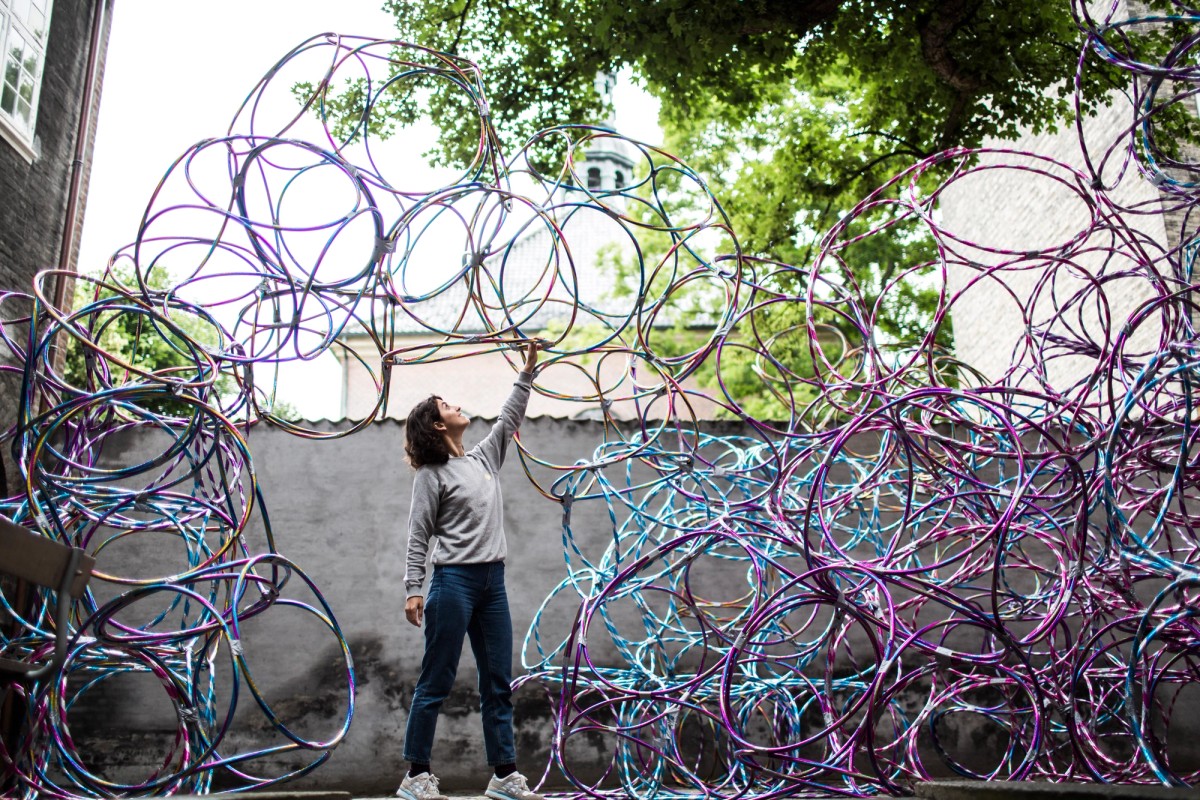
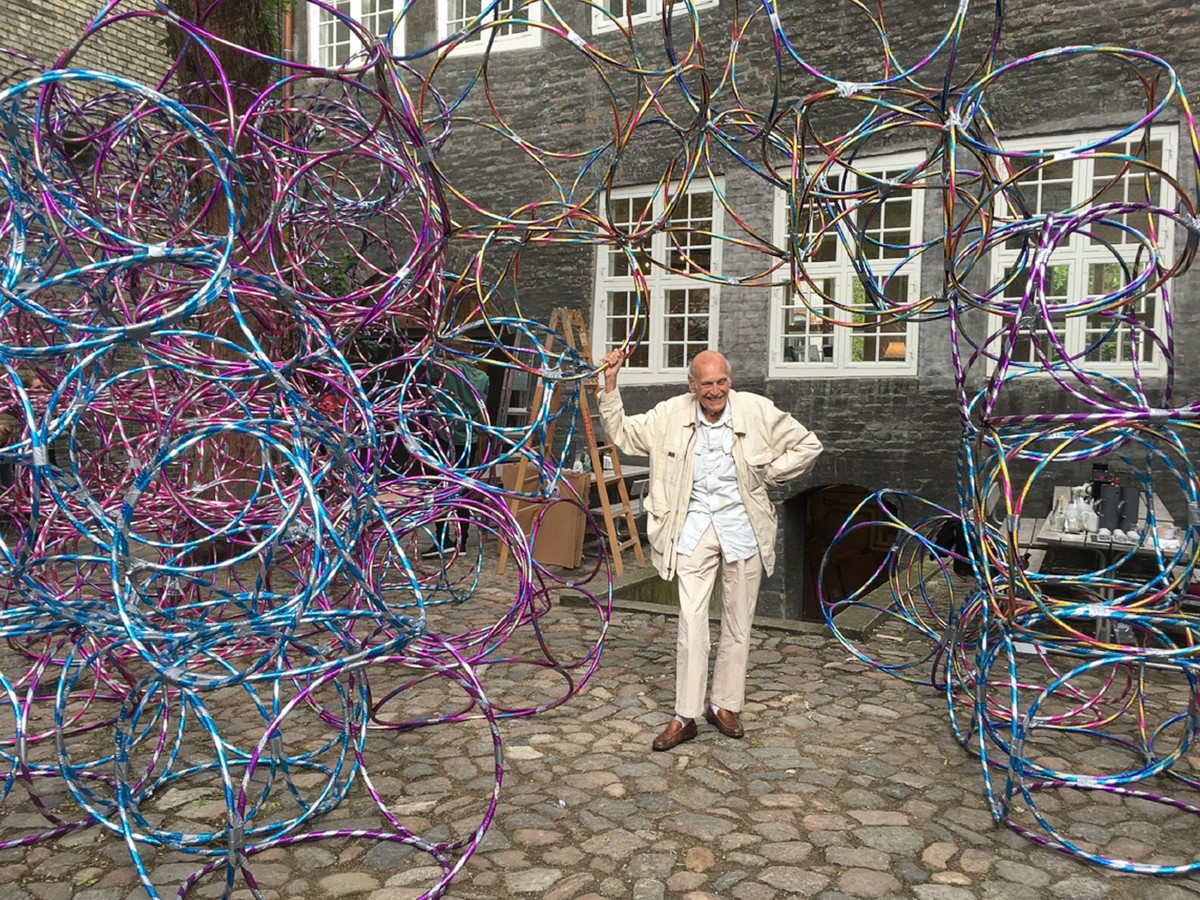
The workshop that we conducted that day together with around 20 young architecture students was led by Yona, and in spite of his age (94 at the time) he was very much involved in the process of organising the thousand hula-hoops in the courtyard of Arkitektforeningen. The workshop, like many of the ones he had conducted before, in Venice, Milan or Beaufort, became a prototype of a way of working, thinking, and collaborating rather than just an installation. [Ill. 2, Ill.3]
Friedman developed his manifesto L’Architecture Mobile (mobile architecture) and ideas for a different approach to urban growth with the Ville Spatiale in 1956. Working on the principles for the Ville Spatiale, Friedman wanted to provide maximum flexibility through huge superstructures over existing cities and other locations. The idea was for future inhabitants to be free to construct their residences within these structures. Friedman’s architectural projects aimed to help and inspire people to do things independently. The flexibility, mobility and adaptability of these lightweight structures inspired radical architects like Kisho Kurokawa and the Metabolists, as well as Peter Cook and the Archigram movement, who has stated that: “..Friedman in fact has been the daddy of the megastructure which can move across any terrain.”
Yona Friedman’s concepts of an architecture with and of people, as well as truly believing that there is another way to creating our built environment, putting a much bigger emphasis on and trust in its users, is something prevalent in Alexander Eriksson Furunes’ work, and especially in his research of dugnad and bayanihan, the two concepts explored in our conversation below.
Eriksson Furunes worked together with Sudarshan Khadka and Barangay Engkanto, and their curatorial proposal, ‘Structures of Mutual Support’ was the Philippine Pavilion at the 2020 Venice Architecture Biennale. He is currently doing Artistic Research (entitled Learning from Bayanihan & Dugnad) on participative planning, design and build processes at the Norwegian Artistic Research Programme (NTNU 2016-20). His work is a critical reflection on previous projects as well as an exploration of collaborative placemaking through new projects in both Asia and Europe.
Samuel Michaëlsson (SM): I’m interested in how you ended up working in the projects where you’ve practised both bayanihan and dugnad. You studied at the AA in London and ended up working in Southeast Asia, could you describe that path?
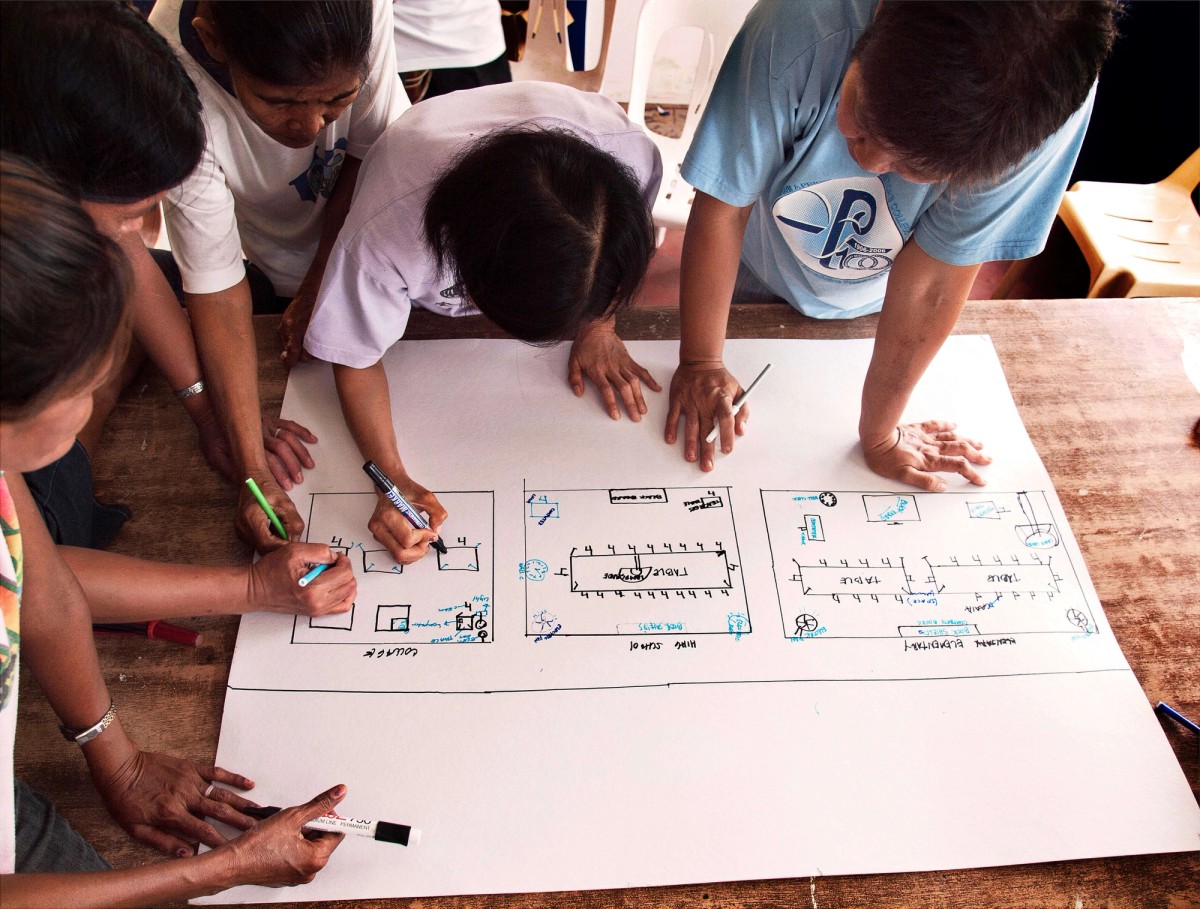
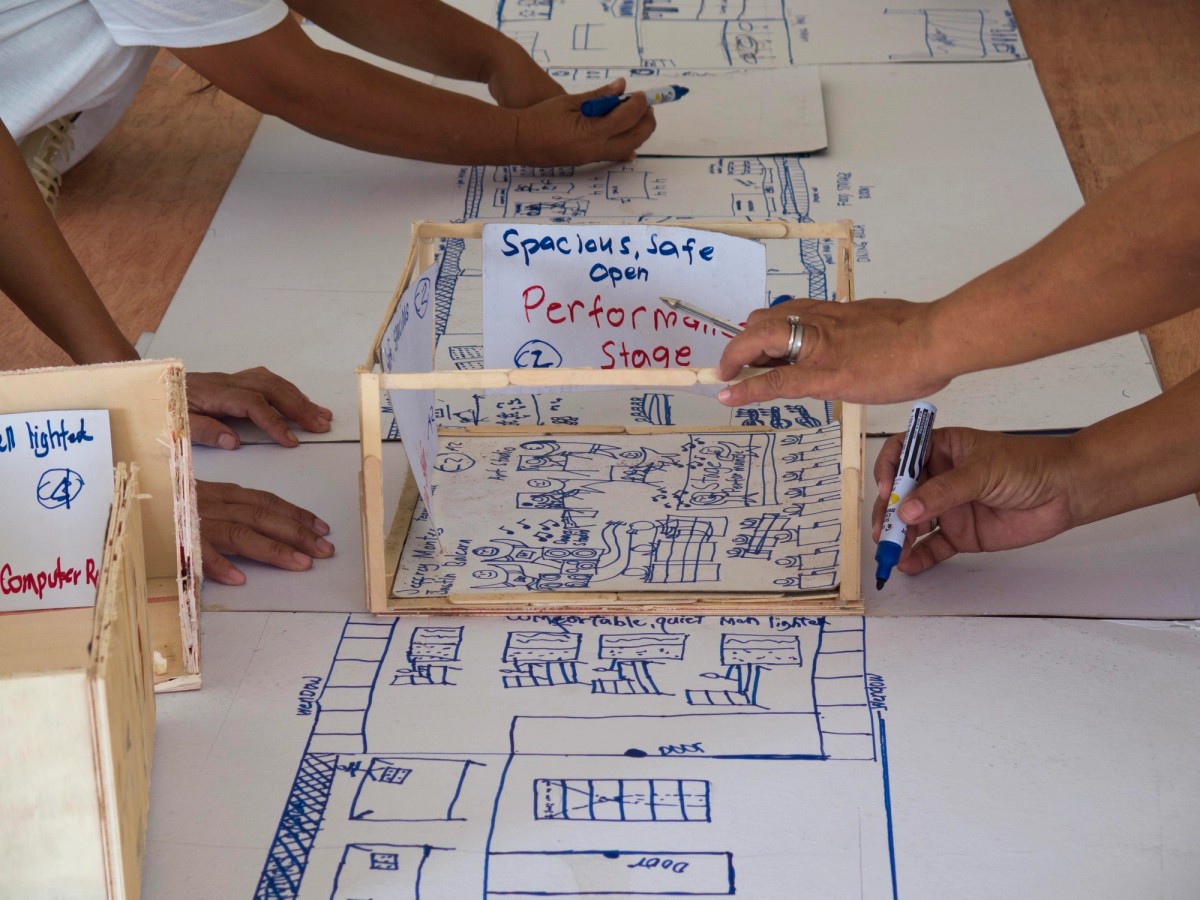
Alexander Eriksson Furunes (AEF):The reason why I started working in Southeast Asia, which was before I was studying at the AA, was because I was doing three years at NTNU in Norway, and there was at the time the possibility to create your own courses. So I had this opportunity to work on a study centre project in the Philippines. So I self programmed the courses and set off with two friends of mine to Tacloban. Unfortunately, the project didn’t happen so I went to Japan to work at Sou Fujimoto. While working there I suddenly got a phone call saying that the project would be happening anyway. I resettled and moved back to the Philippines. I was quite young at the time, and I did not know enough about architecture, so I was really humbled to be asked to do the project. I felt that we needed a lot of resources and knowledge to be part of the process if the building was going to be any good. At the same time we realised that no one knew the kids better than the parents, so we set up a process where we would work closely with the parents, where they would be involved in the decisions of what the building would become. Simultaneously we were tapping into the local government and also working with the city architect to make sure that we were building within regulations. What was interesting about that process, and what set up the whole scope of what would later become my practice and my research, was the experience that we had at the end of that process, where the way we were working was called bayanihan by the community.
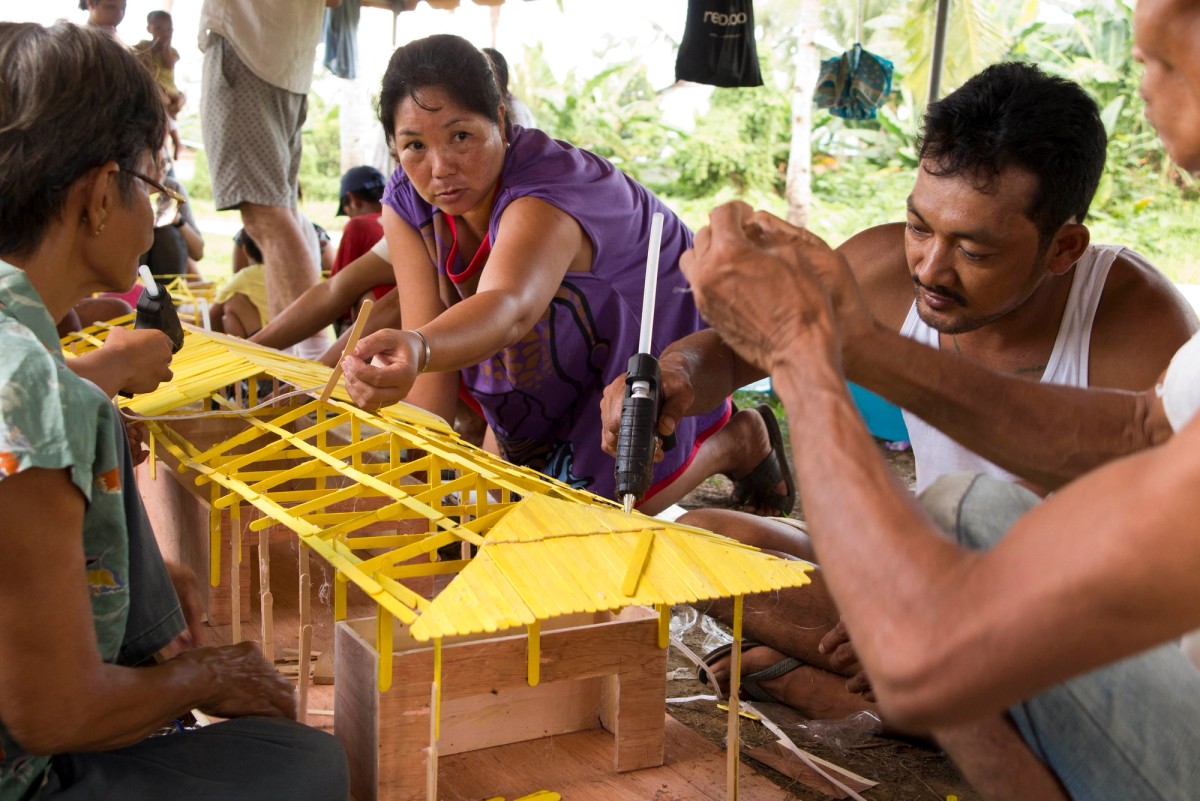
When I asked what bayanihan meant I got the feeling that this was very similar to what we call dugnad in Norway. That was interesting because these forms of practices that are independent of any institutional power structures, whether they are political or economical, belong to the people. I really like the idea that the families built the school for their own kids, and they did it using the resources that they already had. We didn’t have much funds, but we used the wood and bamboo that some families had and did the work collectively. That process made me feel that, well, even if we don't have a lot of money, which is one kind of value, we have social values and access to materials. We had all these things, we just needed a structure to bring it all together.
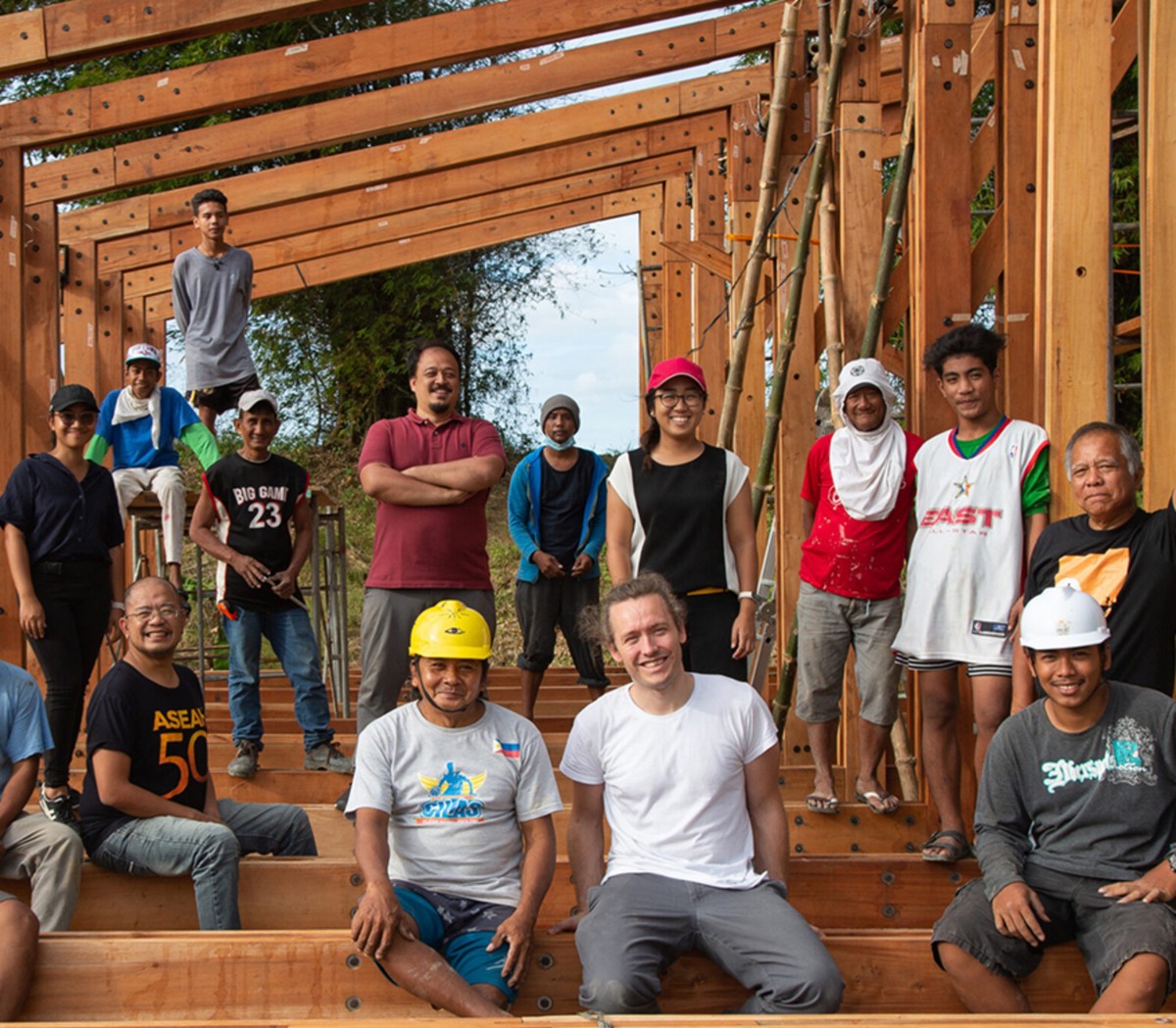
What led me onto the other work was to explore how these traditions could be a door to access other values, resources, and scales that other people have and work with. The study centre project was destroyed by the typhoon Haiyan in 2013, and what is so typical for these traditions is that the most natural way for any community to deal with the disaster is to come together and work together. That’s what they did. And because we had worked through bayanihan before the typhoon, that structure was already in place for us to do the reconstruction afterwards. Since then I have been working with Sudharsan Khadka, who is my colleague and professional partner, and we have been doing work in Vietnam, Brazil and Norway. So we have this ongoing exploration of these traditions all over the world. [Ill. 4]
SM: How do bayanihan and dugnad differ from each other?
AEF:The conditions and context are of course really different, so the expression of these traditions are historically different. We would respond to the challenges of a place, or the climate, and the social context that we’re in. In Philippines the very typical example of bayanihan is to lift the house and move it from one village to another, while in Norway dugnad in today’s society is all about cleaning up in the gardens or public squares, but historically it has also been a way to organise politically or to build community houses. So when you say the word it would create different associations in different cultures.
What was striking to me was actually the similarities. There is always working towards a shared goal where the work is also a social commitment, for example an event often involving food. You strengthen your social ties while also using them to implement a project that you could never do on your own. That is consistent, and it’s also interesting to see that in most cultures they are really proud of these words. Most nations have a very big affection for them. In Norway dugnad is the national word, and in the Philippines it’s the same with bayanihan. The word itself is nation, or community building.
SM: What is the history of dugnad in Scandinavia? Have you found any examples of dugnad in Sweden, Denmark and Finland as well, and is there a difference between dugnad in the countryside and the city?
AEF:Disappointingly I have not found many other examples of dugnad in Scandinavia. Arbetsgille in Sweden for example is actually referring to the feast that happens after work, not necessarily the process of working together. What seems to be a tendency is that the words are very strong in cultures where the traditions have been important. In the Philippines you have natural disasters, and people have to come together and work in the face of calamities like typhoons and earthquakes. Money doesn’t really matter after those kinds of events. In Norway you have a harsh climate where people traditionally have had to help each other out in order to cope. I have not found a good word for it in Germany, France, UK or in Sweden. These are countries that have both strong feudal and hierarchical structures in place, and I think Norway as a nation has not been very strong historically until very recently when oil was discovered. It’s not a strong nation, so people have had to cope on their own, and dugnad was how people did it.
In Japan you have sogo-fujo, and in that society you do have a strong hierarchical structure, but this kind of independent organisation was also very strong. So there is a kind of contradiction here, and there is no real answer to why it exists in one country but not another. It has a lot to do with historical context and many other complex parameters.
Something that often comes up as a question is this works in a rural area, but can it work in a city? What happened with dugnad in Norway was that when the industrial revolution happened and cities were growing, people moved in from the rural areas to the city, and they brought their traditions with them. A lot of the unions in factories for example were organised through these traditions. It becomes part of the city on different levels, even though it might not be as clear as in a rural area. I think that’s a tendency in most contexts where you can see that it’s there, just not as clearly. That’s what makes it quite interesting when we as architects do work in the cities, because if people have an understanding of these traditions it can open up doors to new ways of structuring work.
People have different values and experiences and come from different situations, but we still share something. What we share could be the basis to create a platform for independent collaborative work like dugnad or bayanihan. It’s this kind of independent platform that I think is so important, because governmental or economical structures are institutionalised and have certain value systems and premises for the work that happens. This other tradition has a space outside of that which lets us redefine those values and be critical of them. How can we be critical of the systems in place in the city? These traditions offer another way to engage where it’s not only about being heard but actually being there and shaping your own surroundings. I think that’s why these traditions are also interesting in an urban context, not just in rural areas.
SM:The current discourse around the housing industry in Sweden is a lot about aesthetics. I feel that we should talk more about how the building industry works and how buildings are made rather than just about the facades of the houses. Anders Rubing told me that in Norway, Arkitekturupporet has quite a strong position, and just like in Sweden a lot of the debate concerns the cosmetic values, and we never seem to get to the core problems.
AEF: I think this is quite symptomatic. The way we build reflects the way that we live. If our only real space for engagement is the facade, then it means that the political, economical systems, and the society that we live in aren’t really engaging people in the real structural issues. We are not opening the big fundamental questions about what materials we are using for example. There are bigger questions that are not being asked, because they are not really open to discussion. With Arkitekturupproret I feel like it’s a question of values. Architects see certain values, and the other side focuses on other things, such as the facade. The references are different, and architects with an education might have other references that are unavailable to the people that actually end up living in the projects. You can also ask who is actually represented in Arkitekturupproret and what values they represent.
Going beyond the facade we need to get into the structure of how we build, and that’s where the traditions that we’re looking at are really interesting. The structure of how we build with dugnad and bayanihan is totally different, it completely changes the relation to the resources that you’re using and the labour that goes into it, and it changes the purpose of why you’re building. The purpose needs to be negotiated among all that are involved, so the values embedded in the project naturally change. That’s also why I think it’s very interesting to look at how we have built historically throughout different cultures to understand other structures of building, different from the ones that we are taking for granted and that many architects are engaged in. What is our role as architects in this other structure?
SM:Just like with global capitalism, it’s very difficult to imagine architecture functioning in an alternative system, and the opening chapter in Mark Fisher’s Capitalist Realism, “It’s easier to imagine the end of the world than the end of capitalism,” still seems accurate 14 years later. Do you see dugnad being implemented in larger projects and therefore having a bigger impact and push to change the system in significant ways?
AEF:Me and Sudharsan always get this question about scale, and I think it comes down to the premises of the project. If we are building a skyscraper for example, that’s not the right project for dugnad or getting the community in there, but rather an expression of corporate interest. I think that with dugnad, mutual support, and these traditions, it’s not about the physical size of the building but rather the network that you are establishing horizontally, across nations, and independent of the construction industry. We can build on a scale that is sized according to what the community is capable of building. At the same time I think there has to be negotiation with the context you’re in, and sometimes there are corporate interests and economic investments, so you often end up with some kind of hybrid. That’s where you might get the bigger scale. But I think it’s important to stress that these projects should be independent of those interests. They need to be allowed to make direct action and implementation and not be used only as a tool. That’s actually what you can see in many cultures where dugnad and bayanihan are being abused by governments that want the nation or people to do what they want. There are examples where these traditions have been used to make people comply or to manipulate peoples’ interests. The building industry context is so coloured by neoliberalism, so we would need to use these traditions and still be engaged in that context. It’s a balance. I think it’s really interesting, because it means that we can start talking about other structures of building but also other industries of building that aren’t necessarily based on those values. However they will overlap.
SM: There are some great examples of societies not focusing on constant growth but rather ecological sustainability, such as the ones explored in Julia Watson’s excellent bookLo—TEK. Design by Radical Indigenism. There is also an increasing awareness about how problematic the building industry is among young people, and in turn, young architects. The profession and its institutions have somewhat acknowledged this as well with the Pritzker Prize in 2021 going to Anne Lacaton and Jean-Philippe Vassal. All in all there seems to be a discrepancy in how the industry acts and talks about these problems. What can young architects do to force the industry to change?
AEF:Look into the resources that you already have, social and contextual. We don’t have the budgets of the big projects but you might have the network to do interesting stuff. We all have some kind of community, family or history that gives us some unique perspective on a context, and if we start there we build from different values than those that are money based. We can start small and work with the resources available to explore what it means to work together, and there you can stay as independent as possible. If you aim to build a library straight away you might not get the money to do it, so it’s about growing these processes organically, I think. The act of organising something like this together is a really important experience.
SM: The examples in Julia Watson’s book are interesting because many of them are ancient yet still radical. In Japan a lot of the young architects I met were looking at old methods for inspiration. There are a lot of solutions out there already, but because society is so focused on constant growth and not stable coexistence, maybe these processes are not so widespread.
AEF:Kisho Kurokawa wrote about metabolism and symbioses, how nature works and how that could inspire architecture. It’s a more organic way of understanding our built environment, where it is not a static object but something that lives and changes over time. Just like nature it grows and regenerates. The problem with the metabolist movement was that they were working in a post war-naivety of endless growth and that these megastructures could just keep growing and growing. What younger architects are doing is really interesting. They are tapping into what’s already there and transforming existing structures rather than just creating new ones. The architectural expression is much smaller, but the idea is that architecture in itself is an expression of the life that we have and the way that we live with the built environment. If it requires a huge global economic system to support itself it’s not going to work, because it might collapse if there’s an economic bubble for example.
Vernacular architecture at the scale that reflects the social, environmental, and physical economy of people can stand for a very long time. It is matching the scale of the community living there, and the conditions are in constant dialogue with everything around it. But once that dialogue is cut it collapses and it becomes unsustainable if it can’t be maintained. I think it’s interesting to start seeing architecture as something that reflects a way of life that will be sustainable, not just in terms of the environment but also socially. That’s where the Lo-TEK book is really interesting. It doesn’t need to be low tech per se, it just has to reflect the capacity of people, whatever we build, and what resources we have in society. Learning how to work in that complexity is really interesting.
SM: The importance of a physical space cannot be understated. A place for people to meet and share ideas, especially today when so much communication is only through digital channels. Maybe that’s something that practically can be implemented quite easily in projects and that could be a good way to take the dugnad process into different contexts in Scandinavia?
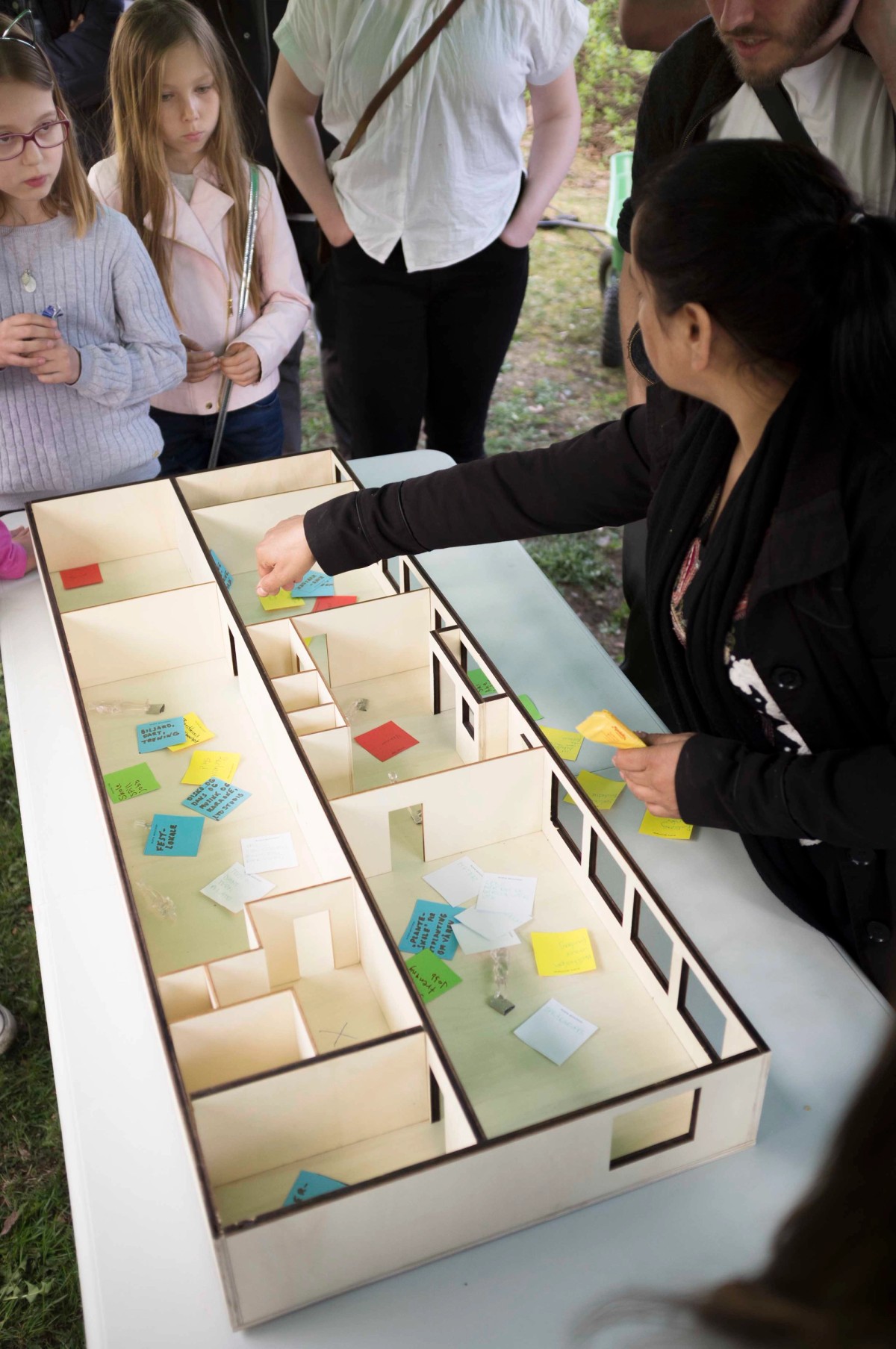
AES: A lot of participation is happening in spaces that don't belong to the people that are the ones participating, like in government spaces or meeting rooms in architectural offices for example. These are spaces that are often unknown to the people going there who are being asked to give up personal information that they don’t really know what’s gonna happen to. You are asked to share and to be part of a process, but the sharing is done on someone else's premise. When doing dugnad in Slettelökka for example we have tried to start with something that is familiar to people and let them create the space where discussion can happen. Later on, that can become a physical space, but it is already a representation of that group, and so they own it. When the next collaboration happens within this space it’s on their terms. That will create a whole different kind of discussion and allow for more opinions, and you will have a different kind of space enabling positive confrontation.
We need to make sure that these kinds of processes are based on mutual communication and not just extracting information from communities and then giving them what they want. If it’s easier to imagine the end of the world than the end of capitalism, it’s also quite hard to imagine anything else than the system that we’re in so long as there is no space or time to do that. Can we create these spaces for imagination?
–
Samuel Michaëlsson is an architect, visualiser, model maker and writer based in Gothenburg, Sweden. He co-founded the architectural magazine PAPER (Platform for Architectural Projects, Essays & Research) in 2011 and is currently studying at the Royal Institute of Art in Stockholm as well as conducting research on Japanese public space.