For version in English, please scroll down.
10 min
En bygning bliver genrejst. Måske var den styrtet i grus, måske forvitrede den langsomt. Det kan have været forsømmelighed, et uheld eller en bevidst handling der lå bag.
Et kvarter eller en by bliver genopbygget, et landskab bliver restaureret, enten til dens oprindelige tilstand eller til noget ganske anderledes.
Genopbygninger tillægger mening til ødelæggelser og giver disse meninger bestandighed i vores fælles hukommelse. Mellem nedbrydning og genopførsel er der et rum fuldt af betydninger og handlemuligheder. Her gemmer sig meget, som er en god og lang diskussion værdig.
I dette nummer af Magasin for Bygningskunst og Kultur åbner vi rummet mellem ødelæggelse og rekonstruktion ved hjælp af tolv meget relevante bidrag.
I DYBDEN
Vi lægger ud med to tekster, som åbner rummet i dybden.
Laurits Thingholm er studerende på kandidatprogrammet for Arkitektur og Landskab ved Det Kongelige Akademi. Men han er også poet. I sit prosadigt Det Vandskabte Rum danner genetableringen af vådmarker udgangspunkt for en erfaring af væde, sumpede marsklande, våde lyde og det flydende, ubestemte grænseland mellem fast og opløst.
Han er i dialog med Niels Grønbæk, lektor på Det Kongelige Akademi, programansvarlig for Political Architecture: Critical Sustainability. Niels er arkitekt, men han er også en grundig tænker. Hans bidrag udfordrer grænsen mellem mennesker og dyr i arkitekturen og gennemhuller den isolerende væg, som holder mennesker frie fra andre arters beboelse. Med udgangspunkt i et gammelt træhus søger teksten svar på, om en kommende arkitektur kan atter lære mennesker at bo sammen—ikke kun med hinanden men i gensidig forhandling med andre væsner.
TÆT PÅ
De fire følgende tekster tager os med ud at rejse for at opleve arkitektur helt tæt på.
Turen går til Inis Oìrr udenfor Irlands kyst, så til Philadelphia, og derfra til Malmö, hvorefter vi tager nordpå til Jakobsberg udenfor Stokholm og sidst til Mostar i Bosnien-Herzegovina.
Anna Eglite og Tom Buckland er begge praktiserende arkitekter med base i København. Ingrid Kennerstedt Bornhall er etnolog og kommuneantikvar i Järfälla Kommun og Villads van Toorn Brix er studerende på bachelorprogrammet Finder Sted på Institut for Bygningskunst og Kultur. Deres bidrag går tæt på enkelte arkitektoniske eksempler for at præcisere stedsrelevante spørgsmål, om hvad genopbygning indebærer i forskellige sammenhænge.
VIDT ÅBEN
Efter disse indgående analyser løfter vi blikket og ser ud mod horisonten.
Professor Robert Mull er leder for the Global Free Unit, en nomadisk arkitektuddannelse som arbejder direkte med udsatte samfund verden over. Her betyder genopbygning først og fremmest gæstfrihed, samvær, proces, glæde og ydmyghed. Arkitektstuderende er i stand til at genopbygge mange andre ting end bygninger. Gennem langvarige live project classrooms genopbygges såvel arkitektur som fælles identitet, velbefindende, menneskelig værdighed og social sammenhæng.
Anne Stahl er arkitekt og har forsket i genopbygningen af Europas storbyer efter Anden Verdenskrig. Hun beskriver efterkrigstidens vidtgående muligheder for nybyggeri og rekonstruktion, og viser hvordan de dominerende ideologier—socialisme og kapitalisme—blev omsat til strategier for den perfekte by. Ved at nærlæse en publiceret komparativ analyse fra 1953 af genopbygningen af Warszawa og Paris træder et samtidsbillede frem af to idealforestillinger, om hvad storbyen egentlig er til for, og hvordan den kan opnås.
BØRSEN, APROPOS
Det er vel ikke gået nogen forbi, at Børsen i København brændte den 16. april 2024.
I det følgende efterår har et hold studerende på kandidatprogrammet Kulturarv, Transformation og Restaurering målt op, registreret og analyseret ruinerne af den fredede bygning. Adjunkt Lars Rolfsted Mortensen med kollegaer beskriver arbejdet og det omfattende tegningsmateriale, som de studerende har produceret.
Bagefter lader vi Børsen give anledning til refleksioner over tre beslægtede områder: a) kulturarvens historie, b) arkitektuddannelse og c) den begrebslige basis for kulturhistorisk værdisætning.
Christoffer Thorborg er lektor ved Aarhus Arkitektskole og specialist i restaurering af arkitekturhistorisk kulturarv. Børsen har givet anledning til et essay om bygningsrestaureringens historie, altså arven fra tidligere forestillinger om, hvordan bygninger fungerer som vidnesbyrd om fortiden.
Filip Ivarsson er arkitekt med særlig interesse for jordhuse og historiske byggematerialer. Han leverer en analyse og et stærkt argument for, at arkitektur- og håndværksuddannelser i højere grad end nu bør interessere sig for ældre byggeteknikker. Ikke kun for at sikre os at bygninger som Børsen kan genopbygges på arkæologisk korrekt vis også i fremtiden, men også for at udbrede forståelsen for de bæredygtige potentialer, som ældre teknikker gemmer på.
Magasinet afsluttes med en filosofisk-politisk kommentar om autenticitet, et fundamentalt anliggende for ethvert genopbygningsprojekt. Anne Silberg Thomsen er praktiserende arkitekt og ser med kritiske øjne på de gængse forestillinger om originalitet, oprindelse, gentagelse og værdisætning, som genopbygningen af Børsen hviler på.
Ved vejs ende lukker vi ikke døren, men åbner for fortsatte samtaler og kommentarer. Genopbygning er aktuelt som aldrig før. Selv om vi er kommet vidt, bredt og dybt omkring, har dette nummer blot berørt overfladen.
Andre eksempler på genopbygning kunne have åbnet for andre problemer: genopbygningen af Gaza og Ukraine havde tvunget os til at se på planlægning og finansiering under krig og konflikter; den opgivne genopbygning af Grìndavik på Island kunne have tematiseret noget så grundlæggende som menneskelig beboelse på jorden; indvielsen af Notre-Dame havde kunnet belyse komplicerede forhold mellem tektonik, kirke, stat og kapital. Der er meget tilbage at arbejde med.
Vi håber at have inspireret og vakt interesse for mangfoldigheden af genopbygningsproblemer, én af de mest presserende udfordringer for arkitekturen i dag.
___________________________________________________________________________
REBUILDING
A building is being rebuilt. Maybe it all came down at once, maybe it eroded slowly. Perhaps it was negligence, an accident, or a deliberate act that was behind it.
A neighborhood or a city is being rebuilt. A landscape is being restored, either to its original state or to something entirely different.
Reconstructions give meaning to acts of destruction and grant permanence to those meanings in our collective memory. Between destruction and reconstruction, there is a space of opportunity and meaning-making. Many questions that are worthy of a good and long discussion can be found here.
In this issue of Magasin for Bygningskunst og Kultur, we open up the space between destruction and reconstruction with the help of twelve very relevant contributions.
IN DEPTH
We start off with two texts that truly open the space in depth.
Laurits Thingholm is a student at the Master's Program for Architecture and Landscape at the Royal Academy. But he is also a poet. In his prose poem Det vandskabte rum, the re-establishment of wetlands forms the basis for an experience of wetness, marshy lands, gurgling sounds, and the fluid, indeterminate borderland between solid and dissolved.
He is in dialogue with Niels Grønbæk, associate professor at the Royal Academy and program responsible for Political Architecture: Critical Sustainability. Niels is an architect, but he is also a thorough thinker. His contribution challenges the boundary between humans and animals in architecture and punctures the insulating wall that keeps humans safe from the habitation of other species. Starting from an old wooden house, the text seeks answers to whether a future architecture can teach humans to live together once again—not just with each other but in mutual negotiation with other beings.
UP CLOSE
The four following texts take us on a journey to experience architecture up close.
The tour goes to Inis Oìrr off the coast of Ireland, then to Philadelphia and from there to Malmö, after which we travel north to Jakobsberg outside Stockholm and finally to Mostar in Bosnia and Herzegovina.
Anna Eglite and Tom Buckland are both practicing architects based in Copenhagen. Ingrid Kennerstedt Bornhall is an ethnologist and municipal antiquarian in Järfälla Municipality, and Villads van Toorn Brix is a bachelor's student in the IBK program Finder Sted. Their contributions close in on specific architectural examples to clarify place-relevant questions about what reconstruction entails in different contexts.
OPEN WIDE
After these close analyses, we lift our gaze and look towards the horizon.
Professor Robert Mull is the leader of the Global Free Unit, a nomadic architecture education that works directly with vulnerable communities around the world. Here, reconstruction primarily associates with hospitality, togetherness, process, joy, and humility. Architecture students can rebuild many other things than buildings. Through long-term ‘live project classrooms,’ community architecture is being rebuilt together with common identity, well-being, human dignity, and social cohesion.
Anne Stahl is an architect who has researched the reconstruction of Europe's major cities after World War II. She describes the extensive post-war opportunities for new construction and reconstruction, and shows how the dominant ideologies—socialism and capitalism—were translated into strategies for the perfect city. By closely analyzing a published comparative study from 1953 on the reconstruction of Warsaw and Paris, a picture emerges of two ideal conceptions of what the metropolis is really for, and how it can be achieved.
BØRSEN, APROPOS
It probably hasn't escaped anyone's notice that the Stock Exchange in Copenhagen, known as Børsen, burned down on April 16, 2024.
During the following autumn, all students at the Master's Program for Transformation and Restoration focused on measuring, registering and analyzing the ruins of the listed building. Associate professor Lars Rolfsted Mortensen and his colleagues describe the ambitions of the semester and the students’ achievements, not least by disclosing some of the many drawings that has been produced.
Following this introduction, we let Børsen give rise to three studies in related areas: a) the history of cultural heritage; b) architectural education, and c) the conceptual foundation of cultural history valuation.
Christoffer Thorborg is an associate professor at the Aarhus School of Architecture, and a specialist in the restoration of architectural cultural heritage. The Børsen incident provides an opportunity to reflect on the history of building restoration, i.e., the history of the modern idea that buildings are valuable as testimonials of the past.
Filip Ivarsson is an architect with a particular interest in earth houses and historical building materials. He delivers an analysis and a strong argument that education in architecture and craftsmanship should take a greater interest in older building techniques. Not only to ensure that buildings like Børsen can also henceforth be rebuilt with archaeological accuracy, but also to develop an understanding of the potentials for sustainable building practices that older techniques hold in store.
We conclude with a philosophical-political commentary on authenticity, a fundamental concern for any reconstruction project. Anne Silberg Thomsen, a practicing architect, renews the critique of originality, origin, time, and valuation: persistent conventional notions that the reconstruction of Børsen still rests upon.
At the end of the road, we leave the door open for continued conversations and commentary. Reconstruction is more relevant than ever. Although this issue of Magasin for Bygningskunst og Kultur has covered several relevant aspects and topics, it has only scratched the surface.
Other examples of reconstruction could have given way to other problems and concerns: the reconstruction of Gaza and Ukraine would have forced us to look at planning and financing during war and conflicts; the presently abandoned reconstruction of Grìndavik in Iceland could have addressed something as fundamental as human habitation on Earth; the inauguration of Notre-Dame could have shed light on the complicated relationships between tectonics, church, state, and capital. There is much left to discuss and raise questions about.
We hope to have inspired and sparked interest in the diversity of reconstruction problems, one of the most pressing challenges for architecture today.
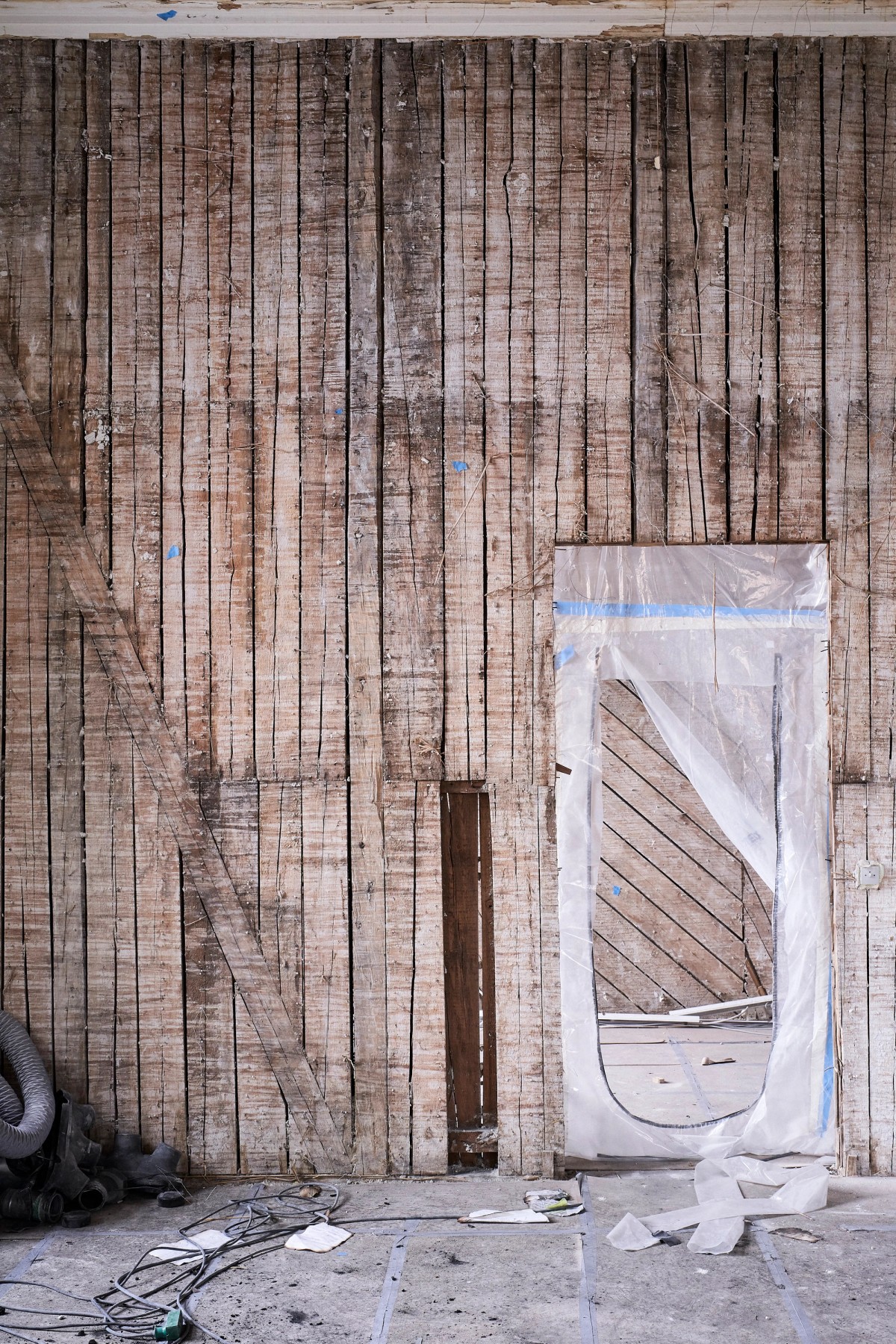
Extinguish damaged interior, Børsen, 2024. Photo: Lars Rolfsted Mortensen.