This essay aims to recollect and reflect upon the collective research experience carried out in the form of the filming workshop Moving Landscape at the Bachelor Programme Finder Sted / Taking Place at The Royal Danish Academy.
18 min
Our filming workshop Moving Landscape took place in the Autumn semester 2021. Our aim was to introduce the students to the interrelations between the fields of architecture and the moving image, deploying film as a critical tool for spatial design and architectural storytelling.
We spent a week together on campus, exploring the highlights of the depiction of space in film history, in parallel with providing the tools for a practical training in filmmaking. The students spent the following week filming their project site, Kiruna, searching and listening to the local narratives, possibly finding the sparks for future design projects.
Starting a design semester with a filming workshop was a complete experiment, and a leap in the dark. As we supervised the editing and finalisation of thirteen short films during the third and final week, we were amazed and moved by the outcome of this collective testimony.
ON FILMING ARCHITECTURE
Architecture is in many ways the complete opposite to the ephemeral nature of cinema, but what in architecture is perceived as static by its material properties reveals itself to be just as temporal in its spatial values. We often think of time as something that architecture is to overcome, and forget how intimately linked it is to space. Albert Einstein proved this in his theory of relativity, and Siegfried Gideon exemplified these notions in his book Space, time and architecture. By recognizing the inherent nature of movement in space, we are confronted with cinema as a field that deals with the very nature of architecture.
In the realm of the moving image, film can teach us to fully experience movement in architecture, to witness moving landscapes and be moved by them. To understand the kinetic essence of space, whilst learning to actively document what we unconsciously experience every time we mentally walk through a map or a floor plan, while observing it in the two dimensions.
What would happen if architecture students were to start a studio semester with a movie camera at hand?
Walking through an environment holding a camera demands a different degree of engagement, a bodily presence on site, a full awareness of one’s subjective and lively sensitive observation.
Introducing architecture students to the methodology of film can be a way to address and tackle the abstraction that the usual architectural representation provides us. Recognising the social context through temporal engagement establishes an intimate proximity to the physical environment, beyond architectural contemplation.
Our territories and project sites are polytropic and affected by multiscalar phaenomena: the design process requires an immersive exploration into the context, and the reversion of the common planning paradigm, or the top-down juxtaposition of global designs over local histories, a process described by Walter Mignolo in relation to the links between territorial exploitation and the colonial mindset.
Given the present state of ongoing environmental, and ideological crisis, we cannot help but get involved and engaged in systemic change in architecture.
In the words of Timothy Morton, “there are no ideological twists and bends to carry away our physical and philosophical waste into some illusory beyond.”
Among the first steps into ecological awareness in architecture is the acknowledgement of the dynamic nature of landscapes and their metabolisms, and the continuous physiological metamorphosis of the cities where we are called to intervene. Construction, durability, maintenance, decay; permanence, the interim, the transitory.
With its unique synthesis of time within space, film has long been deployed as a medium to detect and document the ephemeral state of cities and landscapes in transition, or simply in movement.
FILMMAKERS ARCHITECTS
A number of times filmmakers deliberately became witnesses of a changing environment, documenting cities and societies as they were permanently transforming.
Today, we only experience those cities that don’t exist anymore through their films, and yet they are real and rooted in our urban imagery and in the collective memory of modern times.
These films captured not only the formal character of cities and landscape, but especially targeted, more or less directly, the social issues and inherent conflicts, narrating the life taking place in the constructed landscape.
The theoretical module of the filming workshop was aimed at acquainting the students with such episodes in film history, urban témoinages from filmmakers-architects, who intertwined urban subplots to their narration and deployed cinema as a critical tool to society and the built environment.
“To grasp its secret, you should not, then, begin with the city and move inwards to the screen; you should begin with the screen and move outwards to the city. It is there that cinema does not assume an exceptional form, but simply invests the streets and the entire town with a mythical atmosphere. That is where it is truly gripping.”
Jean Baudrillard, America, 1989
So, Jean Baudrillard poetically phrases in America: the cinematic essence of cities has become a fundamental aspect of modern iconography. Such thought was formulated during years where architectural theorists and filmmakers shared common interests and were notably mutually influenced.
During the 1970s, American metropolises were the scene of a rich and interdisciplinary discourse on the cinematic experience of artificial landscapes. The city in motion described by Denise Scott-Brown, Robert Venturi and Steven Izenour in Learning from Las Vegas from 1972 was lyrically depicted in Michelangelo Antonioni’s Los Angeles in Zabriskie Point from 1970.
Film critic Graham Cairns remarkably describes how Antonioni portrayed Baudrillard’s consumer society through the visual cacophony of signals and commercials, where boundaries between buildings and scenographies blur. Zabriskie Point provides an immersive experience into what Scott-Brown, Venturi and Izenour named the architecture of the “decorated shed,” this whilst in movement and from the driver’s perspective, dwelling the vehicular landscape.
A frame from the film taken from the protagonist’s car cabin starkly resembles a photograph featured in Kevin Lynch, Donald Appleyard and John Myer’s The View from the Road. The groundbreaking work published in 1963 also meant to include film as a strategy for urban thinking.
WHO INFLUENCED WHOM?
All this could also be seen as a holistic, collective evidence of an architectural era.
Photographs taken by Wim Wenders from his quests for locations and wanderings, above all those collected in Once, also resonate with the peri-urban imagery in Zabriskie Point and the pictures taken by Venturi and Scott-Brown throughout their urban studies.
Wenders was a great reference for our methodology, and among the greatest role models as filmmaker-architect. He prolifically contributed to the discourse on North American urbanism from a European perspective, like Reyner Bahnam, yet another architect who deployed film to study the city of Los Angeles in his BBC documentary Reyner Bahnam loves Los Angeles from 1972.
Wim Wenders is a source of inspiration for his sense of space and for always seeking the narrative drive in the landscapes he dwells in. His pictures are universal and site specific, as they unfold the persistence of memory, the fragile essence of history and the importance to preserve simplicity and anonymity in the constructed habitat.
An active advocate for informality in the urban space, he meticulously preserved and documented the empty and unnamed locations as little hidden treasures. In Wings of Desire from 1987, the metropolitan hierarchy is sublimely flattened. Landmarks of Berlin float next to urban voids, circuses, endangered corners of resistance where the urban life truly unfolds.
“It’s as if cities were under obligation to do something with these corners. It’s pathetic. They are places doomed to disappear because they are totally anachronistic and because the city cannot bear that they have been left out of their urban planning”.
Wim Wenders, The Act of Seeing. Essays and Conversation, 1997
A beautiful synchronism connected Wenders with filmmaker Claire Denis, who collaborated on Wings of Desire as assistant director, and who explored and unveiled the landscape of colonial French Africa throughout her filmography. Beau Travail from 1999 may be the most acclaimed and powerful example. A poetic visual stream of consciousness where oneiric sceneries of Djibouti are harmonised with the socio-political overtones they carry.
Chantal Akermann’s News from home from 1977 and Abel Ferrara’s New York films approach the city through its own eyes, rather than depicting what it is believed to be. Their films convey a versatile perspective of urbanism and act as testimonies for the informal spaces which have now vanished from the city.
The catalogue could be never ending. The amplitude of filmmakers that were and are still active in the urban debate, conscious about the drift of our habitats, is indeed an incredibly rich resource for the architectural discipline.
These episodes in architecture and film history laid the foundation for what would be reference and tools for the students of the bachelor program Finder Sted / Taking Place at The Royal Danish Academy to confront a convoluted and almost unimaginable project site. By approaching the environment through the lens of the camera, they became active witnesses to the moving landscape of Kiruna.
BORDER(LINE) LANDSCAPES OF EXTRACTION, CITIES ON THE EDGE OF EROSION
Today the most distinctive peculiarity of the town of Kiruna seems to be the fact that it is actually being moved.
Many are debating on the significance and propriety of this statement, yet the city has gained a great amount of attention and has become the object of speculation due to the ongoing relocation.
Raw facts are synthesised by ArkDes director Kieran Long in one sentence in his foreword to Kiruna Forever, the publication that accompanied the omonimous exhibition on show between April 2020 and February 2021 at ArkDes Stockholm: “The city of around 22,000 people is being simultaneously destroyed and rebuilt in order to facilitate business at one of the world’s most important iron ore mines.”
This induced, accelerated movement locates Kiruna into a wider ecological sphere of influence, and moreover can only be explained by adopting a multiscalar understanding and a global perspective.
Global Kiruna was also the title of an artistic project by Iwan Baan, Anne Dessing, and Michiel van Iersel featured in the exhibition, focused on the circulation and spread of raw material, from the local extraction to the global distribution and implementation in the construction business. Aerial shots of the extension of the LKAB mine are displayed next to close-up photographs framing repetitive series of train wagons carrying the iron elsewhere, across nations, worldwide.
The discourse on Kiruna’s relocation brings into question its coming to being in the first place; the conception of history, past, present and future imagery, and the very notion of time take on a completely unique meaning in Kiruna.
As Carlos Mìnguez Carrasco argues, the successful slogan Kiruna 4-ever that was title to the winning competition project for the new city by White Arkitekter and Ghilardi + Hellsten Arkitekter, brilliantly evokes and plays with Kiruna’s Time as key to its idiosyncratic entity.
The town came from the mine in the first place, and is bound to its rhythmic, mechanical routine. The artificial clock sets an alarm after 1 am every single night, when a controlled, man-made artificial quake takes place. These phenomena, together with the physical presence of LKAB and the mining-induced topography, shape the sensorial landscape of Kiruna, with which inhabitants are acquainted and may find reassuring in some way.
“For the community to exist, the ore had to be mined, but for the ore to be mined, the community also had to be torn down”, writes Eric Niva referring to his hometown Malmberget, another mining town in North Sweden and a historical precedent of Kiruna, with respect to the mining-induced ground collapse and consequent relocation. Malmberget’s instability was also reflected in social and human fragility, as testified by Eric Niva’s moving contribution.
How could the younger generations cope with the awareness that the soil below their feet was slowly eroding, and their hometown was invisible to the eyes of the main country and rest of the world?
Whereas Malmberget’s community hardly survived the relocation and its future was figuratively and to some extent literally swallowed by the Captain’s Pit hole, which split the old town centre in two, Kiruna seems to aim at a forever projection, and has taken upon a destiny somehow disjunct to the mine itself.
A cyclical refrain of chance and necessity is suggestive of this delicate balance. The mine came first, yet the presence of one among the greatest and purest bodies of magnetite traces back to wider geological scales. The elastic notion of time is also found in the recurring saying that refers to the Kiruna landscape as “where the Sami Indigenous People have lived since time immemorial,” evoking the spatial and temporal scales of indigenous heritage and coloniality.
EXTRACTION OVER SETTLEMENT
Meanwhile Kiruna, the youngest town in Sweden, is replicating itself. As Kieran Long evocatively depicts in his contribution When is it Rational to Demolish and Entire CIty?, “The vast majority of what anyone knows as Kiruna is simply disappearing. A new town, also called Kiruna, will take its place.”
Will the new Kiruna better embody the utopia of the Swedish model, or become an uncanny double of its old version?
Along with material doubles come imagined doubles, the progressive versions of Kiruna as an ideal town. As Adolf Sotoca beautifully articulates, “futuristic visions of an ideal community are used, once more, to transition from a critical moment of disruption.” For most of the local inhabitants, the plural versions of Kiruna coexist.
These imagined utopias resonate with the human archive of memories, building a tableau vivant for the city’s identity.
In a city raised in transnational tension, how do the global and the planetary systems encounter the local scale of intimacy? Do they?
Was that ever on the agenda, or is it right now, as the city is being moved?
As architects, the fact that LKAB mine mainly supplies the construction business locally and internationally may bring us to close the cycle and question our direct and indirect involvement in this case. The students who attended our filming workshop today are the ones who will be called to question contemporary and future construction policies.
Couldn’t it be a great paradox, future architects questioning the extractive-driven future of an extraction-bound city, built to fuel the construction business?
“Architecture is never neutral and it is often complicit in reinforcing power structures; in Kiruna, the role of architecture is no exception”, writes Carlos Mìnguez Carrasco.
If LKAB is part of the Swedish DNA, we could add that extractive and exploitative territorial policies are silently part of the established architectural education’s DNA.
Studying Kiruna today is an incredible and unique opportunity for students to grasp the complex and multiscalar dynamics that shape our territories and our working culture, and to understand the responsibilities that we, as architects today, hold towards the environment.
We hope Filming Kiruna succeeded in breaking the virtual boundaries of distance and abstraction by getting closer to those immediately affected, those individuals that are now facing what our entire community could face – sooner rather than later if we don’t act to interfere in these extractive cycles.
ECOLOGIES OF HISTORY, MEMORY AND DWELLING
The significance of the term ecology traces back to the intimate relationship between living beings and their habitats, and to the notion of Ancient Greek oikos — home, dwelling place.
An enquiry of ecology within the frame of architecture may start from the very intuitive, instinctive bound living beings create with the space they choose to inhabit. From nomadic civilisations to contemporary urbanisation, the process of anthropisation of the landscapes in the quest for absolute comfort has rapidly escalated, temporarily outscaling natural and geological cycles. The initial intention to transform the land into a more habitable environment has proven contrary side effects to this day, carrying the consequences of the highly exploitative industrialisation, and subsequent climate crisis.
Urbanisation and industrialisation processes are aimed at the permanent occupation of the territory. When Henri Lefebvre argues that “society has been completely urbanised” in The Production of Space, he clarifies how every aspect of contemporary life has become part of the urbanisation dogma, and landscape is now incorporated in the urban ecology.
Territorial transformation rapidly turns into consumption, as wastelands and drosscapes are produced, in search of new land to dwell and exploit. Kiruna is once again a perfect emblem to this global paradigm, where dreams of the future towns override the old and cast a shadow on the scars and voids that are left behind. Kiruna is located at the margins of what Eric Niva defines “the Sweden that Counts”, yet its vocation is to supply a vast number of countries and regions with its pure iron ore body.
As Walter Mignolo anticipated in Local Histories / Global Designs, the present day urges to address our understanding and epistemology of the environment through border thinking, that means, shifting from the established, centralised urban perspective towards the point of view of marginalised areas. Moreover, Mignolo argues that border thinking requires border dwelling. It is therefore necessary to live and experience the borderlands of our communities, and call into question those who inhabit them. Kiruna and its many counterparts may deserve to be seen and built from their own perspectives and for their own futures, aside from their global function as delocalized satellites of global extractive cycles.
Kiruna, like many other places today, performs not only as an experimental ground for future dwelling ecologies, but also as a precious testament of our cultural and environmental heritage.
Our role as architects is to be active witnesses of the ongoing transformations in the production of space, and their material consequences on the environment. These observations can become crucial to envision future ecologies to come, both in social and natural consideration.
Discovering the microcosm of an individual, a house or a neighbourhood through the medium of film can give access to a scale of intimate proximity, unveiling narratives that might question the ideologies we apply to society and the built environment.
“To dwell, is to be at home everywhere.”
With a great title to a great book, Ugo La Pietra brings us back to the etymology of ecology and the very essence of the architect’s mission. The paradigm is reversed; the rural is no longer distant, and the borderscape is omnipresent. By dwelling Kiruna through the eyes, voices and memories of its citizens, we are reminded how to imagine a homeland and rebuild an ecology of mutuality with the land.
NOTES ON A COLLECTIVE MOSAIC
Filming the landscape requires an attentive presence, a holistic gaze and a direct engagement in the environment. Our presence is noticed, and oftentimes appreciated; stories naturally unfold. What we often witness while investigating a territory through the medium of film, is that people are often just waiting to be seen, longing to be noticed, and listened to.
Architecture film director Heinz Emigholz used to say that once we find a good frame, we should stay and wait for the miracle to happen.
The participants of the filming workshop were extremely receptive in listening to the local narratives and in capturing diverse experiences that provided a comprehensive and lively mosaic of the city.
Each film adopts a narrative structure almost as in an architectural project, following a specific itinerary, seeking harmony through rhythm, pairing image to sound.
At times the story comes in the shape of a collective stream of memory, the narrators embodying a selfless, polyphonic crowd that projects nostalgic memories and future hopes on their homeland. That is specifically the case of the film ironically titled Don’t waste your time looking back: you are not going that way, that deals with the necessity to safeguard memory and once again challenges the notion of linear time. These characters-entities seem to live suspended in a spatiotemporal aura where they simultaneously experience their present, immediate past and imminent future in a fictive dimension similar to what Gilles Deleuze describes as crystal image:
“The present is the actual image, and its contemporaneous past is the virtual image, the image in a mirror. [...] Our actual existence, then whilst it is unrolled in time, duplicates itself alongside a virtual existence, a mirror image.”
These precious urban documents enclose the unique experiences of the local witnesses and the distinctive elaboration of the narrators, constituting a territorial inquiry where objective and subjective perspectives collide. No definite answers are given yet, instead a great set of open questions is presented.
Among the most touching contributions to this collective discourse was the sincere and lively witness of Dan, the unaware protagonist of To leave Kiruna but still live there. The polite and wise old man, carefully packing his belongings and getting ready to leave, embodies the city as a whole. In the warmest scenario, Dan is the synecdoche of the moving Kiruna, a patient and resilient spirit that embraces both nostalgic attachment and naive and genuine optimism for the future.
–
Silvia Cipelletti and Emil Hvelplund Kristiansen are architects and invited guest teachers at Finder Sted / Taking Place.
Sigfried Giedion, Space, time and architecture. the Growth of a New Tradition, (Cambridge : Harvard University Press, 1956)
The definition was developed by Ila Bêka and Louise Lemoine through their filmography and didactic practice. http://www.bekalemoine.com/teaching.php
Walter Mignolo, Local Histories / Global Designs, (Princeton University Press, 2012), XI
Timothy Morton, Zero Landscapes in the Time of Hyperobjects, (Graz Architectural Magazine: 2011) (7):78-87, p.82
Jean Baudrillard, America, (London: New York: Verso, 1989), p.56
Graham Cairns, The Architecture of the Screen : Essays in Cinematographic Space, (Bristol: Intellect 2014), p.113
Ibidem, p.111
Robert Venturi, Denise Scott Brown, Steven Izenour, Learning from Las Vegas. (Cambridge, Mass: MIT Press, 1972), p.13
Wim Wenders, Once, (New York: D.A.P., 2010)
Wim Wenders, The Act of Seeing. Essays and Conversation, (London: Faber & Faber, 1997), p.26
Kieran Long, When is it Rational to Demolish an Entire City?, in Kiruna Forever (Arkitektur Förlag AB, Stockholm 2020), p.19
The pictures accompany the foreword of Kiruna Forever (Arkitektur Förlag AB, Stockholm 2020), pp.9-16
Carlos Mìnguez Carrasco, Relocating a City in Territories of Extraction, in Kiruna Forever (Arkitektur Förlag AB, Stockholm 2020), p.36
Eric Niva, Beyond the Sweden that counts, in Kiruna Forever (Arkitektur Förlag AB, Stockholm 2020), p.56
Kiruna Forever (Arkitektur Förlag AB, Stockholm 2020), p.59
Kieran Long, When is it Rational to Demolish an Entire City?, in Kiruna Forever (Arkitektur Förlag AB, Stockholm 2020), p.19
Cfr. Dominic Hinde, A Utopia Like Any Other: Inside the Swedish Model, (Luath Press, Edinburgh 2016)
Adolf Sotoca, More Than One City. Kiruna and the Technological Megasystem of Sweden’s North,in Kiruna Forever (Arkitektur Förlag AB, Stockholm 2020), p.80
Carlos Mìnguez Carrasco, Relocating a City in Territories of Extraction, in Kiruna Forever (Arkitektur Förlag AB, Stockholm 2020), p.35
Cfr. Carlos Mìnguez Carrasco, Relocating a City in Territories of Extraction, in Kiruna Forever (Arkitektur Förlag AB, Stockholm 2020), p.34
Henri Lefebvre, Robert Bononno, and Neil Smith. From the City to Urban Society inLefebvre, The Urban Revolution, (Minneapolis; London: University of Minnesota Press, 2003), p. 1-22
Eric Niva, Beyond the Sweden that counts, in Kiruna Forever (Arkitektur Förlag AB, Stockholm 2020), p.56
Walter Mignolo, Local Histories / Global Designs, (Princeton University Press, 2012), XVI
Ugo la Pietra, Abitare è essere ovunque a casa propria, (Mantova: Corraini, 2019)
Gilles Deleuze, Cinema 2: The Time-Image, (Minneapolis: University of Minnesota Press, 1989), p.79
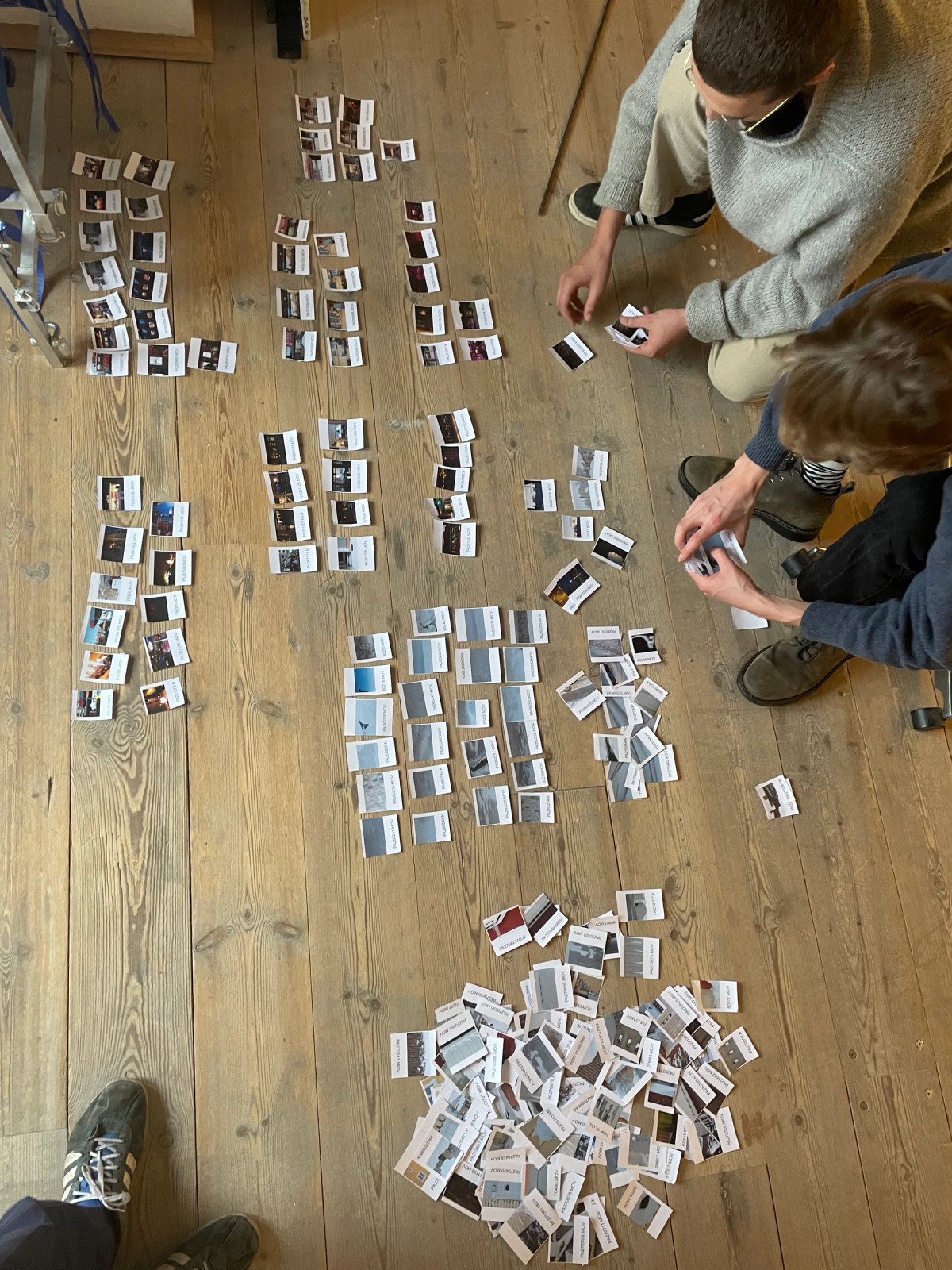
Ill. 1. Workshop, Moving landscape, 2021. © Silvia Cipelletti and Emil Hvelplund Kristiansen
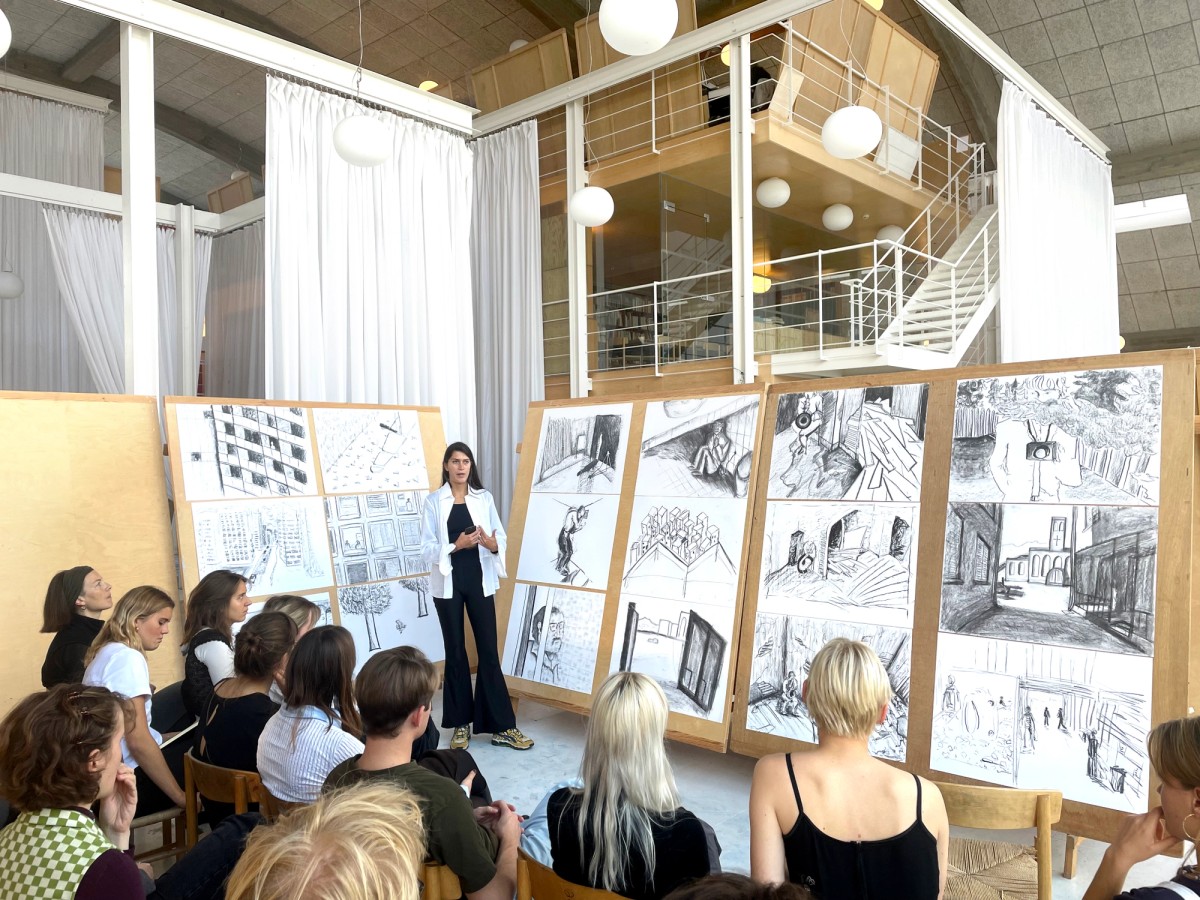
Ill. 2. Workshop, Moving landscape, 2021. © Silvia Cipelletti and Emil Hvelplund Kristiansen
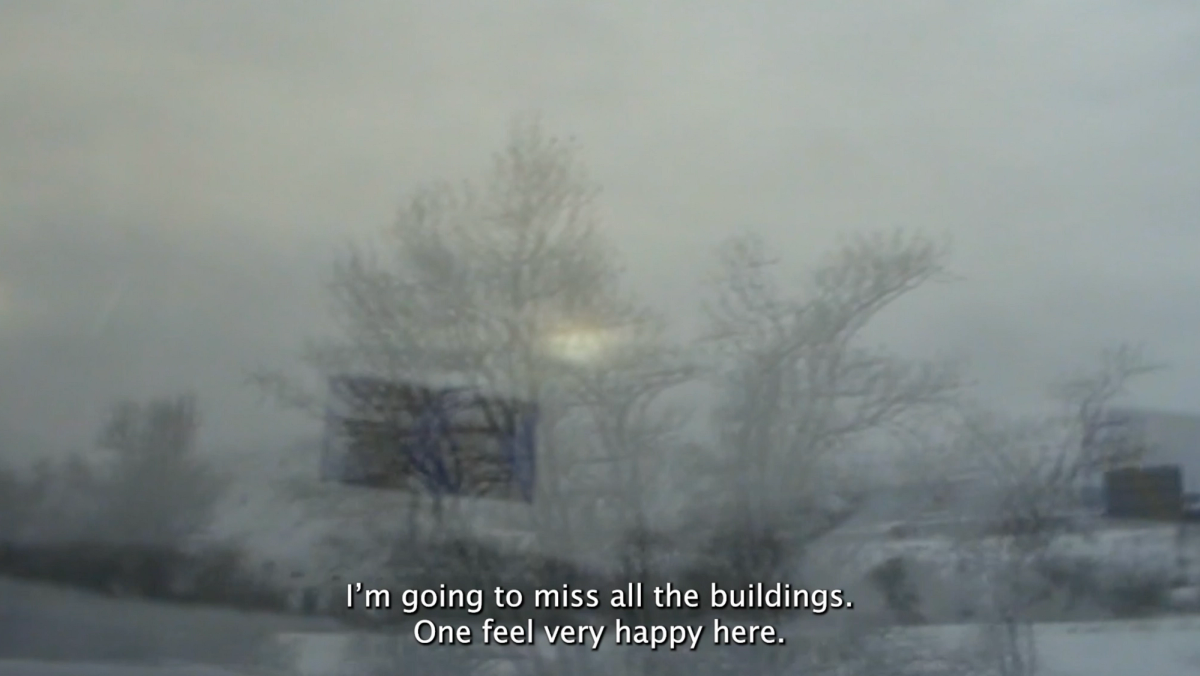
Ill. 3. Still from the film Don’t waste your time looking back: You’re not going that way, 2021. © Anna Munch and Josephine Isbrand
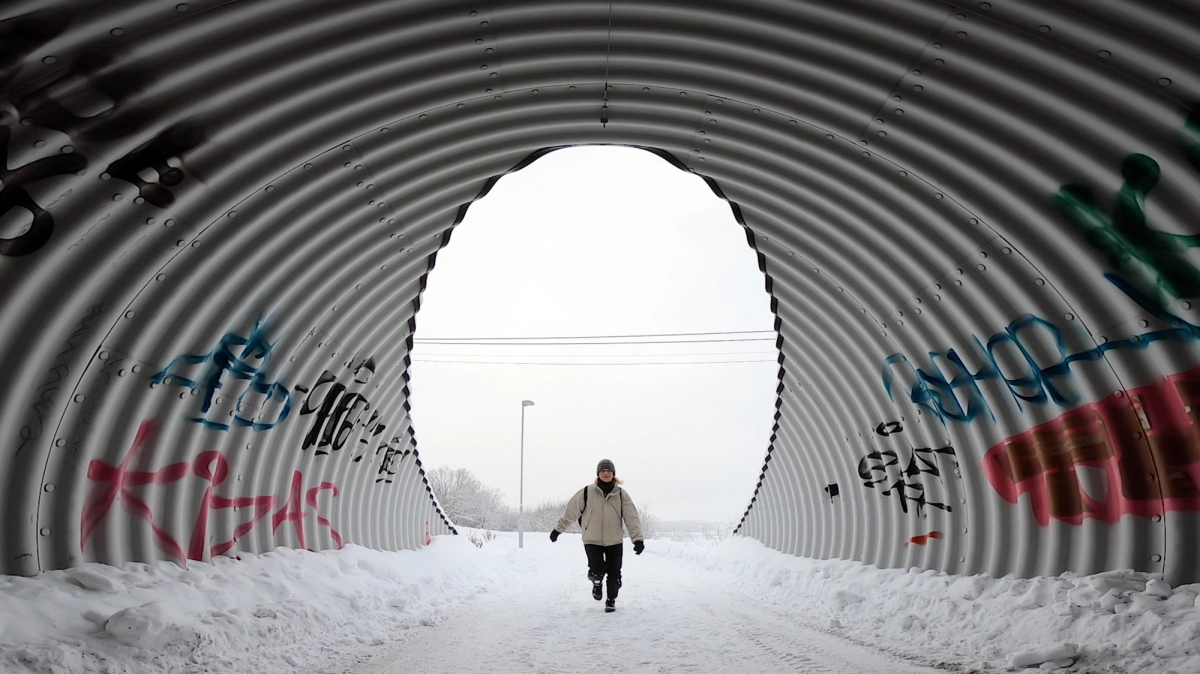
Ill. 4. Still from the film What is up?, 2021. © Cecilie Deibjerg Morsbøl, Albert Rygg Karberg and Margreta Eydunsdóttir Samuelsen
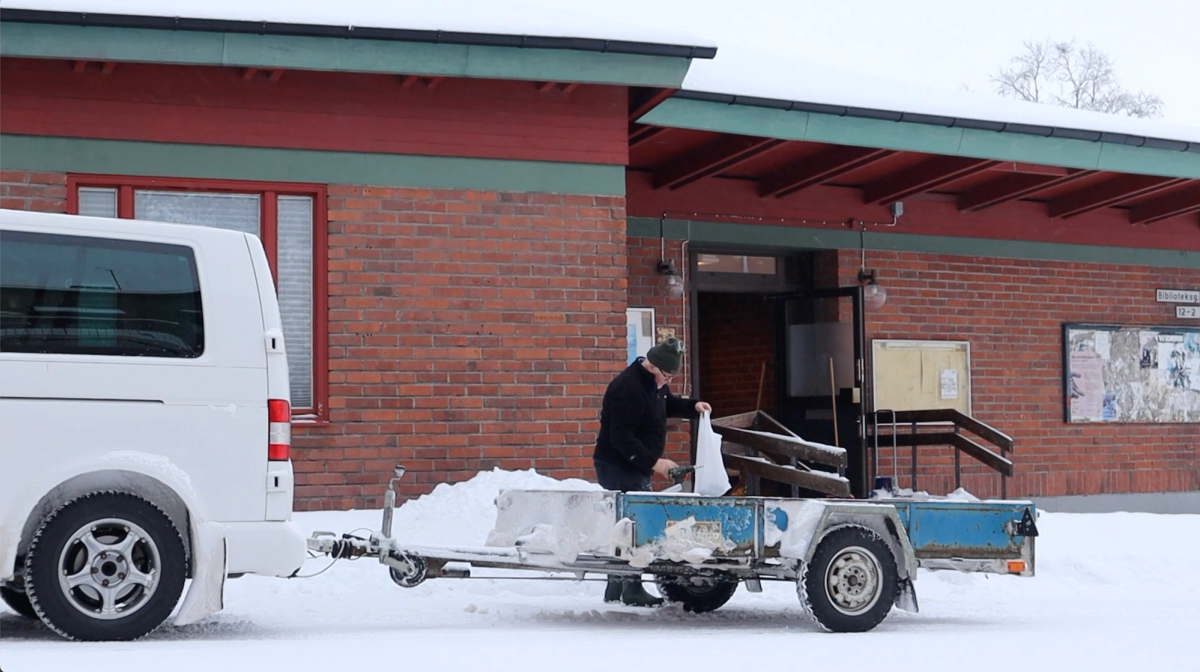
Ill. 5. Still from the film To leave but still live there, 2021. © Caroline Haudrum Axelsen and Lærke Bjerg Poulsen