“You might have to fight for room, room to be, room to do, room to do your work without being questioned or being put under surveillance. You might have to fight to find a safe path through life, a way of progressing, of getting through, without having to give up yourself or your desires. A fight can be how we acquire wisdom: we know so much from trying to transform the worlds that do not accommodate us. But that fight can also be just damn hard; when you have to fight for an existence you can end up feeling fighting is your existence. And so, we need each other: we need to become each other’s resources.”
Sarah Ahmed, Complaint as a queer method
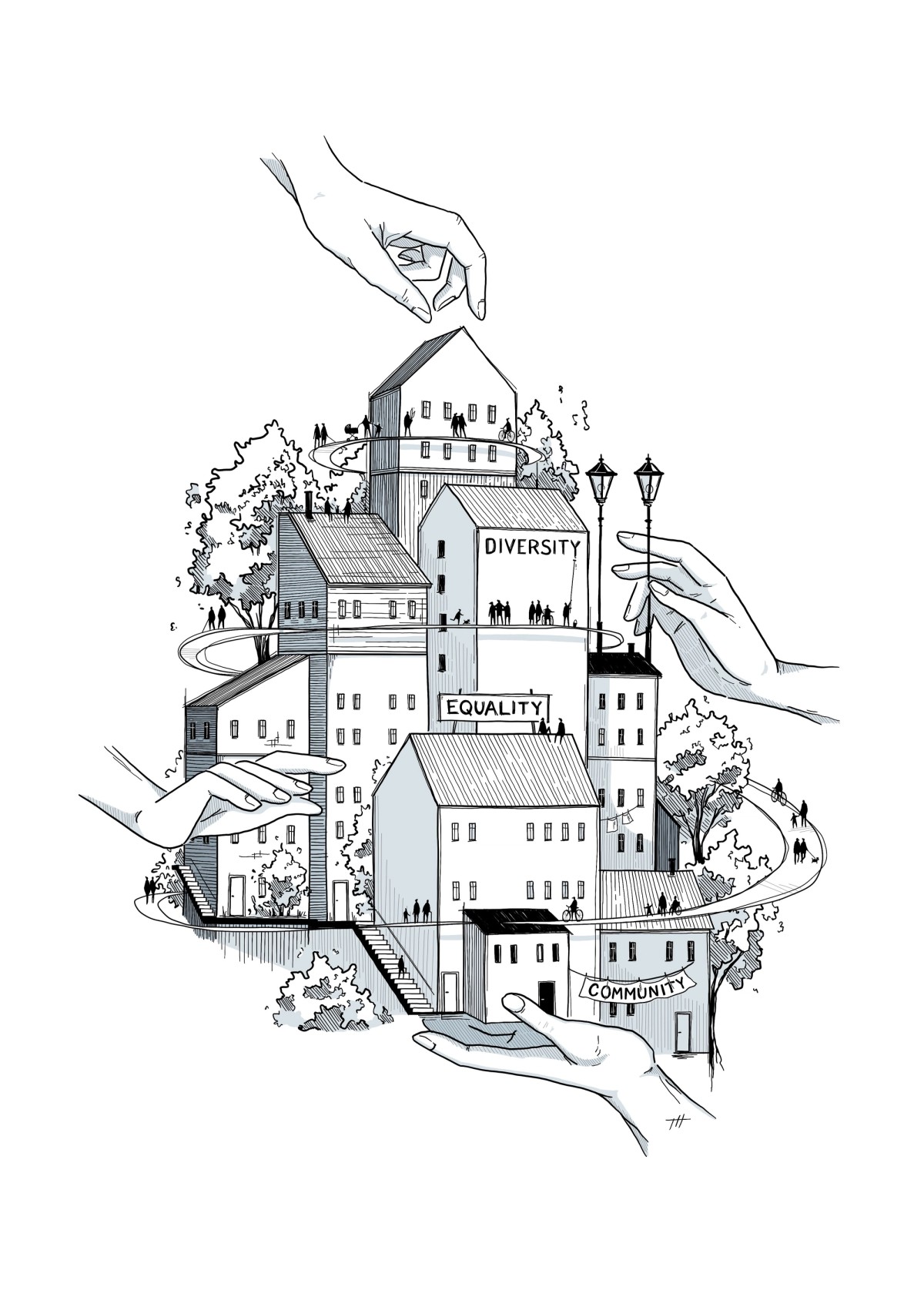
Architects in their field often work actively in relation to clients, collaborators and other actors. Their role is to listen, analyse, reflect, respond, suggest and bring critical and hopeful visions forward. However, architects tend to neglect to see themselves as active actors who can challenge the structures and cultures inwards—of their own profession. Some of the main current challenges are how to incorporate more diversity and inclusion in the field, perhaps through increasingly more collective practices as fundamental building blocks of the profession itself. In this context, the introductory quote from writer and scholar Sarah Ahmed above sets the frame for this essay, which is focusing on the experiences, learnings and aims of the initiative Building Diversity, that wishes to work for the field and within the field of the profession.
ACTIVISM AS A MULTIFACETED PRACTICE
In this essay, we discuss and explore collective activism as a tool to create change and working together as a way of challenging the power imbalances. The first part of it contextualises the role of the individual in the sharing of personal experiences and stories to create room for collectivism. Based on the process and work of the initiative Building Diversity, the essay will exemplify how the initial role of the individual stories (examples of sexism in the architectural field in Denmark) were the foundation for making the structural and cultural problems concrete, and challenging organisations, institutions, and other stakeholders. The second part of the essay is an edited transcript of an open-ended dialogue within Building Diversity where a series of key questions were asked and discussed concerning the role of collectivism. These questions focus on how the collective has enabled various spaces for discussions and change, and at the same time explore topics around group dynamics, self-care vs. self-exposure, and the challenges of insisting on dialogues as one of the ways forward.
The initial group, Sexism in Architecture, that later became Building Diversity in 2022, started in 2020 in the midst of a second wave of MeToo in Denmark. The initiative then consisted of a group of architects from municipal and private practices as well as academia, who collectively saw the need address the problems and challenges of discrimination and unequal opportunities between genders in the Danish architecture field. This led to a broad range of dialogues and meetings with organisations, architectural companies, educational institutions and individuals, to discuss broader and specific issues within the question of equal opportunities for all.
The starting point of coming together as a group was shaped by a reactive force against an existing and ongoing situation. Something that afterwards got the opportunity to grow into what it is now, a proactive initiative that has a broader agenda with regard to imbalance of power. We work as an independent group and seek to collaborate with other organisations, individuals and collectives for sharing knowledge. The group is not funded for its work, it has running projects for the scope that have received funding for their feasibility, while the members remain volunteers with a dynamic relationship of roles. It is part of our collectivism to have adaptable and open shared work relations, and in order to keep the workload flowing we have online meetings every two weeks for a touchdown. We aim for a monthly workshop, where we can also physically enjoy each other's presence. None of the meetings are obligatory in any way, nor is the work personal or assigned.
SHARING OF EXPERIENCES
In November 2020 Sexism in Architecture formulated and distributed a call for signing a letter, where we collectively drew attention to sexism in the Danish architectural field. We openly invited individuals to anonymously share their own experiences, and we rapidly received more than 180 stories concerning different kinds of misbehaviour spanning from verbal to physical sexual harassment, as well as other kinds of abusive power experiences. What sparked this first call was a reaction to the, at the time, refusal by the organisations in the field to admit to the numerous problems that are affecting individuals in the different environments, of both learning and practising architecture, as well as the harming culture of how and who a successful architect is. Inevitably alongside the lack of acknowledgement and dismissive treatment with regard to mentioned problems there was lack of any action by any established organisation, therefore Sexism in Architecture made the first step forward to bring to the surface the hard conversation of the matter.
When reading and understanding the submitted stories, it became clear that the experienced sexual harassment and other types of discrimination were directly related to the misuse and abuse of power. This was both in relation to relations in private architectural companies as well as in the educational institutions where we were introduced to many stories describing the misuse and abuse of power. Following the gathering of the stories, we agreed, with permission from the contributors, to publish the stories through our @sexism.in.architecture Instagram account and various media platforms to gain a larger outreach. This became one of the fundamental milestones in the process and the notion of the wider collective as an enabler to put pressure on people in powerful positions in various parts of the architectural field in Denmark.
Through the process of establishing dialogues across the field, we contacted different organisations, for instance the Union of Architects and Designers (FAOD), which then initiated a member-based survey about sexism in the Danish architectural field. The results from the survey confirmed the arguments we as a group have been making and further supported the need for change. An ongoing part of the process also includes the dialogues with architectural companies to rethink their internal policies, work conditions and in general to be open to change. Following the different dialogues, we held a public workshop, where we presented our findings, how we wanted to progress and invited people to join our group.
As a new group, we entered the challenges with no presumptions of where and how it would be developed. However, we knew from the beginning that we wanted to continue to push educational institutions, organisations, and companies to engage in the debate of creating inclusive, diverse and open educational and work environments. Our aim is to learn and grow through this process of rethinking the way that we consume the current culture of the field. We believe that we can use our shared experiences as starting points, and not claim to become experts of developing policies, but actors of a system that wish for improvement. The top-down force tailored universal solutions are not part of the collective’s way of thinking and acting. We make space to host conversations that can be adaptable based on the different types of contexts. We are eager to sharpen ideas and discover where each step has the potential to go, both in academic and professional grounds of the architectural field.
Through sharing others’ and our own experiences, we have opened up the debate about sexism and other types of discrimination. We now aim to take the initiative further from a proactive point of view by promoting diversity and equality. Hence, we decided to change the name of our initiative into Building Diversity. Under this new name we want to investigate and unfold the possibilities of how the Danish architectural context can become more diverse and inclusive.
THE ROLE OF OPEN-ENDED DIALOGUES
As a group, we recognise that when handling sensitive matters that involve the quality of life of people on such a multifaceted level, it is essential to have open-ended dialogues. The complexity and need for growth as a society, and within the field of architecture, is longed for and one step after another needs to be taken with kindness and an open mind. But how could we, as humans who are highly involved in these ideas and experiences, stay objective and concrete? Our best tactic for the matter is to join more minds together in order to tackle various fronts. The notion and practice of dialogues are constantly active, for both our internal and external work, as a way of pushing for the agendas of progression in the architectural field.
Dialogue implies something more than a simple back-and-forth conversational exchange. It is a communication process that allows participants to change and be changed. Parties don't know exactly what they will say and may say something they have never said or thought of before.
Kenneth N. Cissna and Rob Anderson, Communication and the Ground of Dialogue
However, these dialogues often take place among like-minded people, amplifying echo chambers, and therefore there is a need for a broader range of perspectives to be represented. Our activism works alongside ethical principles to leave out toxic behaviours and mark a path of respect. The room we seek to make for further inclusion embraces opposition as well. The desired environment we aim to create is an open invitation where dialogues can flourish and change may take place, in all directions. We admit that bias moments will occur as well as blind spots on subjects, but we embrace the vulnerability of our human nature and with courage focus on building bridges between those situations.
This is one of the first lessons learned when coming together, that while being in a group, we get to challenge each other, change perspectives, and support each other without washing away the importance of each individual. We, once more, recognise how our differences make us stronger, our disagreements make us grow and our softness makes us last through hard times. We wish to keep on expanding and to be able to participate in more dialogues of any nature, agreeable or not, that lay the groundwork for the healthy practice of collectivism and honest inclusion.
The dialogue recited below took place between the following members of Building Diversity: Thea Christine Høeg (TH), Asal Mohtashami (AM), Nataly Timotheou (NT), Cristina Gimenez (CG) and Christine Bjerke (CB).
OPEN-ENDED DIALOGUE: THE COLLECTIVE
How does Building Diversity work as a collective and how do we understand the collective?
CB: The notion of the collective brings forward a series of fundamentals for actively working with change within a field. One of these is the way that being a group instead of an individual can sustain a momentum in terms of the outreach through the collective. By being a group, we are able to go beyond our own networks, challenge ourselves and others and it opens up for reaching out to different parts of the field and diversifying the discussion, otherwise often taking place in echo chambers of like-minded people.
TH: Being in a group made it so much easier, because you knew that there were five or more other people that had your back in complex situations. And we had many discussions, about how to deal with different situations and how to address issues – at the same time developing and understanding our own aims and figuring out where we wanted to go with it. In that process it was valuable to have a dialogue that was a continuous reflection on why we are doing this and why it is important. If one person starts feeling doubt, then there is always another person saying ‘we really need to do this’. That was important to have, because it was definitely not easy to begin addressing sexism in the architectural field in Denmark.
NT: I feel like what you just said is what made me eager to join – the idea that when you share a passion it would be great if it can become a reality, but it is also so multifaceted, so it takes a lot of energy and a lot of minds to tackle it. There is this sensation that it is safe to be together and we learn from each other through this common passion. This makes it possible to allow for flexibility and openness, because we are more interested in our common purpose, instead of roles, hierarchy, etc. Sometimes we are all overwhelmed or experience some setbacks—but I feel we give each other the fuel to keep going.
CB: One thing I also find really valuable is how we can always ask each other for advice, both professionally and in our everyday activism – for example in relation to how to deal with certain situations. Having a group of people where you have a deep trust in each other, and others understand the context—is of inestimable value.
CG: To me, the fact that we are different people, who come with different points of view and perspectives, multiplies the points that we can focus on. We have a lot of variety in the way we do our activism, and we approach the issues through many different projects. They are independent, but they all support the main purpose of creating more diversity and equality in the field and beyond.
NT: To me, this is a take on our profession beyond the profession. It is us as people first, that had an interest in architecture and took on the profession, but we would like to remain who we are and not become a title.
OPEN-ENDED DIALOGUE: SELF-CARE
How does Building Diversity practice self-care and the notion of protecting oneself in the context of exposure?
TH: From the beginning, we had this notion that we are stronger together. Being a group of people that have a common purpose gave us a lot of momentum, and it also allowed us to not have to stand out as individuals. Consequently, you cannot be attacked as an individual either. At the same time, it gives legitimacy to a cause when a group of people stands up and says this is something we need to change! It is a lot more challenging when you do it by yourself.
AM: I think that it was really nice that when you get criticism or are being met with negativity, you do not have to deal with it on your own. We can be open and share our frustrations with the topic and exchange ideas of how we should react to it. It was nice not to be alone with that feeling and the self-care of taking care of each other and if someone is having a lot in their life at the moment to be fully involved, there is no judgement. You do not even need to explain if you cannot participate. Another thing about self-care is how people feel included in the group. One aspect is our communication and the way that we talk to each other, which we aim to be respectful and curious. Selfcare for the group is therefore equally important, and there should always be a focus on creating a healthy environment in a group.
CB: I think that one of our other strengths as a group is that we are not only colleagues in the field, but also friends. We value our group as also being built on social relations and we equally share other experiences together, so that it is a combination. That is also self-care.
NT: I do not have the experience of the exposure because I just recently joined in 2022, but I am thankful that it did have exposure, so it reached me beyond our personal connections. Because through that exposure there was the chance to actually see what it is that you looked for and how you practised it. From the other side Itcreated the inclusion in order to host this group and that is self-care from the other side. I felt the great need to put together some sanity into my feelings and thoughts about what I was experiencing in the field. Finding the group was my self-care.
OPEN-ENDED DIALOGUE: SMALL VICTORIES ADD UP
How does Building Diversity face the challenges of activism?
TH: It takes a long time to get to a place where you get heard, but we are starting to see that what we have been doing has caused various changes in the field, on both a smaller and larger scale. That being said, it still sometimes feels like an impossible task, that we will never be done with. We often forget to see the small victories. It is only when we look back, we realise that we actually achieved a lot of the things that we aimed for, and we managed to talk to a lot of the people that we wanted to talk to. Fortunately, many listened and changed policies and other aspects of work conditions in companies, organisations and beyond.
CB: It might also be that historically activism is often perceived as visual in terms of demonstrations, etc. In a way, how we started the initiative and the different steps we are taking, the activism itself is very distributed through different projects within the initiative. For instance, the way we confronted the organisations through dialogues, meetings, etc. and in that way put pressure on them to take the issues of for example sexism in the field seriously. Another example could be the way we indirectly pushed for the challenges of sexism and discrimination to be included in the official strategy plans of one of the largest architecture schools in Denmark. I think there is a lot of power and agency in activism that finds a way to structurally work within the systems. What is interesting, and also important, is to make alliances with other voices in the field, and then combine these different ways of doing activist work. I think it is not that one way is more positive or negative than the other. The way we have developed it is authentic to who we are, which I think is important and is essential to also be trusted. Small victories are also the situations where we have, for example, initiated a discussion, which then might be pushed forward by others and thereby the idea of entitled ownership is dissolved.
NT: Because at the end of the day, when you work with diversity or inclusion, it comes also by nature of the group to not be aggressive or attacking but to respectfully stabilise the boundaries and the necessities of change and development. So it might be underground but underground in a sense of what I would call walking the talk.
TH: Definitely. It is one of the things we have been talking about since we started the group; that it was so important for us to always seek the dialogue because we believe that it is only through conversation that we can create and contribute to change. It is not productive to alienate people because you do not agree with them on certain issues and perspectives. You need to create space to have constructive dialogues with some sort of understanding of where they are coming from. Having this sort of empathy, even though it is sometimes difficult, I think, is very important if you want to create change in the long term.
OPEN-ENDED DIALOGUE: CREATING ALLIANCES ACROSS THE FIELD
How does Building Diversity aim to expand the dialogues beyond the collective?
CB: I think our current publication project, (Who is the Architect?, 2022), is a representative example of expanding the dialogue beyond the collective. Since it is developed in a collaborative manner and in terms of working with different interdisciplinary contributors. Additionally, it can take many different contexts when it is published. It is an example of how, as a group and the notion of collectivism, we are aiming to make the various dialogues go beyond our own networks or our group. The publication is also working actively with different methods of creating dialogues or articles, conversations, events, etc. but also the publication as a way of making an imprint in the discussion in the long term. For me, this is one of the many ways as a group to go beyond the group itself.
TH: I feel that this also supports one of the foundational beliefs of our group—that we do not have the answer. We have a lot of questions and things that we have experienced or that we have seen, and that we would like to challenge. We are not suggesting that we have an answer or solution to how these challenges should be solved, or that we believe there is a singular way to do things right. It is a continuous exploration and the only way to move forward is to include others. We are not the ones to tell people what to do. We are more interested in asking other people how they see things becoming better or how we can help them try to improve things.
CG: I believe in an open window for everyone to express themselves. Inviting people from outside the group to participate and collaborate provides a broader perspective on our group discussions and projects.
AM: Going back to this collective idea, Ifind it interesting that the collective is a combination of different kinds of people, cultural backgrounds, and experiences. Each person has their own experiences and network. Since we are a group of different individuals, we can reach out to each of our networks. I feel there are so many possibilities, not just me alone, but everyone in the group and beyond, making it possible for us to reach out and get our message across. Also by getting exposure in a way that people become aware of our work, like for example with our participation in the exhibition Women in Architecture at Danish Architecture Centre.
CB: The notion of alliances, that we talked about earlier, and the way we are building it as a platform, creates a certain openness required to challenge the echo chambers. Those alliances can also create different kinds of discussions, structural and cultural changes, amongst others, to how things are categorised or conditioned. It will be interesting to continue to work as a collective with these alliances and collaborations.
NT: What we have just described can eventually become even more engaging on a level of workshops where all of these alliances, the publication, and the various experiences, can be shared and multiplied. As a group we could also consider the idea of documenting what we are doing in a more visual way, so it can become material for communicating about not having the answers but the questions. This material, potentially including videos, graphics, all the abstracts, and publications, could begin to build up a start-up package for working with inclusivity and diversity, that can then be shared in different ways.
CB: It is a nice aim to have as a group. It also emphasises that the collective should be representative in a productive and reflective way, which is something that we need to be continuously working on. This includes our own biases, blind spots and the fact that we are not fully representative as a group in the Danish architectural field. As a group we need to communicate the perspectives that we take and not perceive it as limitations, but instead a base for honest work.
EPILOGUE
The malleable organisation of Building Diversity manifested by the changing team composition, diverse working methods and intersecting themes the group deals with allows it to define a space for a relational exchange of resources. Collectivism becomes a positive form of power and working method, condensing experiences and diverse views into the production process of the group. This enables the group to adapt, both in its organisation and work, to new challenges and circumstances, hopefully continually creating within and around the field of architecture room to be and room to act.
–
Building Diversity (initially Sexism in Architecture) was founded in 2020 by independent architects who collectively see the need to voice issues of inclusion and equality in the field of architecture through open dialogues, written material and online presence, amongst others. Current members are Thea Christine Høeg, Asal Mohtashami, Ida Sofia Carolin Bergström, Emma Elfvik, Nataly Timotheou, Bruno Malusa, Cristina Gimenez and Christine Bjerke. Contact Building Diversity at contact@buildingdiversity.dk, follow the activities at Instagram accounts @buildingdiversity / @sexism.in.architecture or read more about the initiative on https://buildingdiversity.dk/.