ACT I
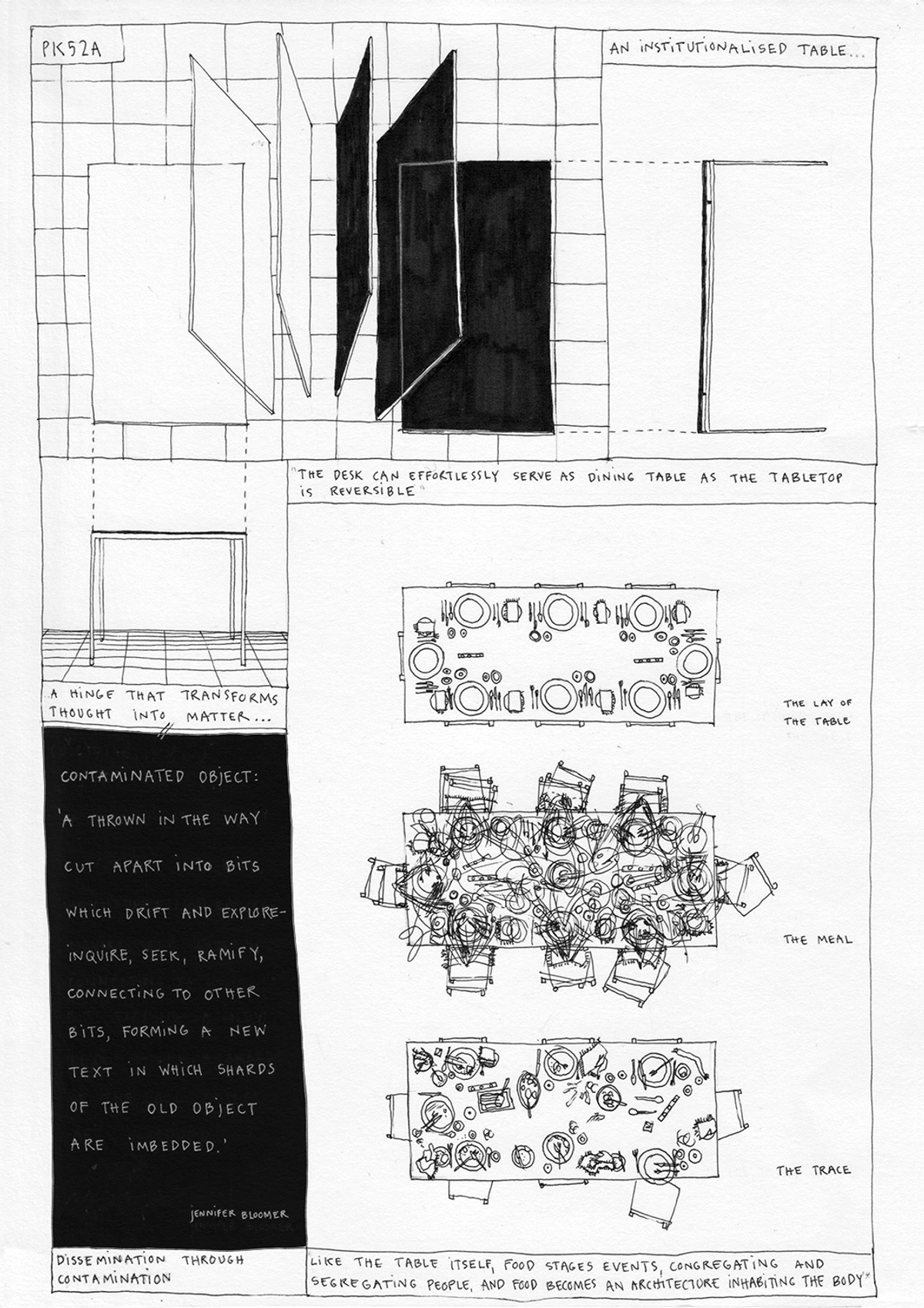
[Auditorium 6. A PK52A tabletop is carried into the centre of the auditorium and placed on top of a PK52A table frame. Andrea dresses the table with a piece of white cardboard, a parallel motion bar, and a sheet of paper. It is her final critique. A ritual which (hopefully) (if all goes well) will result in Andrea’s transformation into an Architect. She is wearing a suit, hoping it will better her chances of convincing the audience that she is in fact serious, and that what she is about to present is, in fact, architecture. As per tradition, NIELS, her tutor, initiates the ritual. Establishing and confirming the crit room and code of conduct as so many times before.]
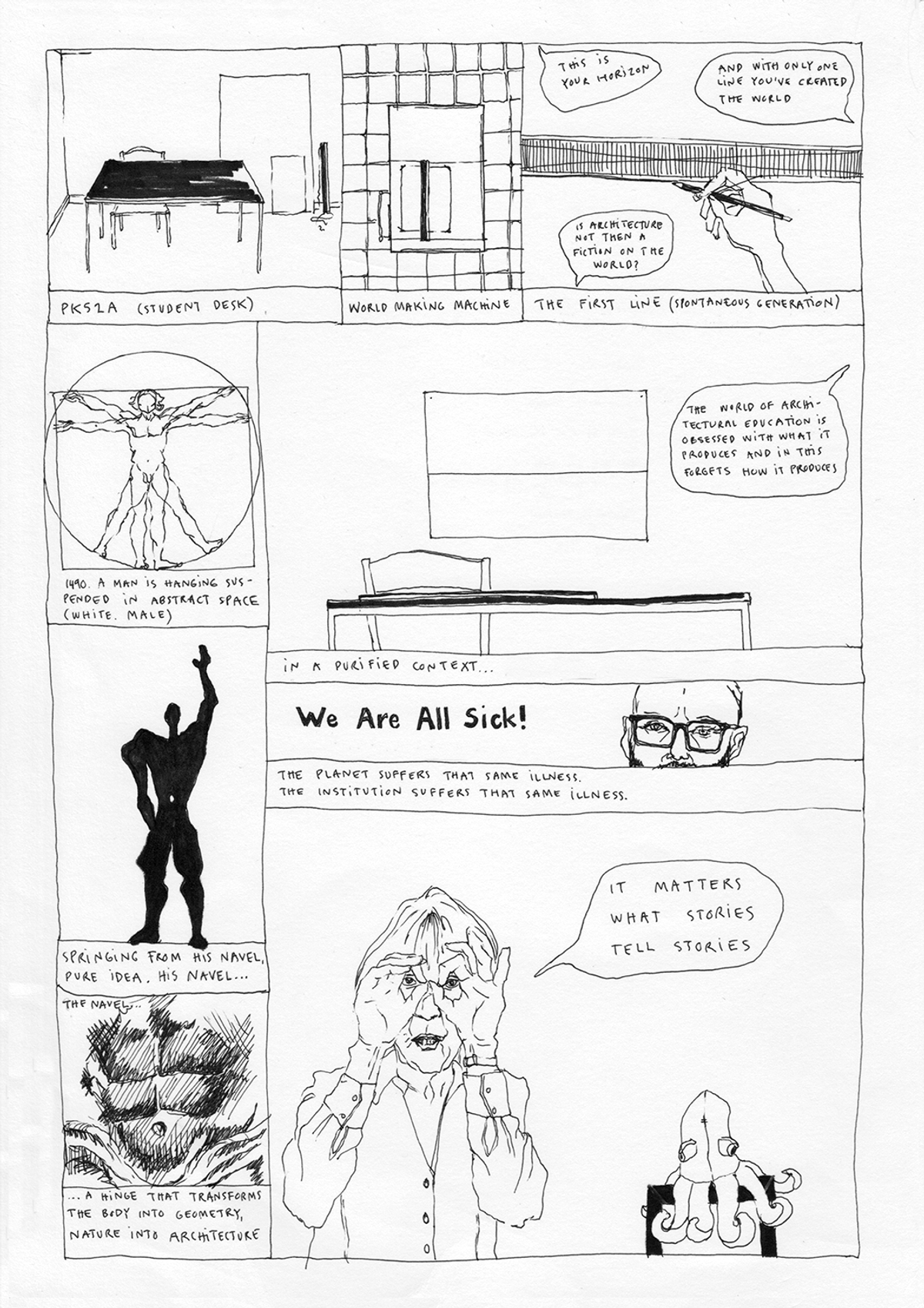
ANDREA: “Upon entering Architecture School, you must acquire a desk (PK52A), a piece of cardboard to match the dimensions of the desk, a parallel motion bar, and a blank piece of paper. You draw that first line to ensure that the ruler is parallel to the edge of the table [Ill.1]. (RULER from root *reg. Regere, regime, regina, rex.) This line is the horizon, they will tell you, and with one single line, you have created the entire world. It’s intoxicating, isn’t it? You are a world-making machine. Following in the footsteps of the creative god, calling the world into existence through the utterance of a line.
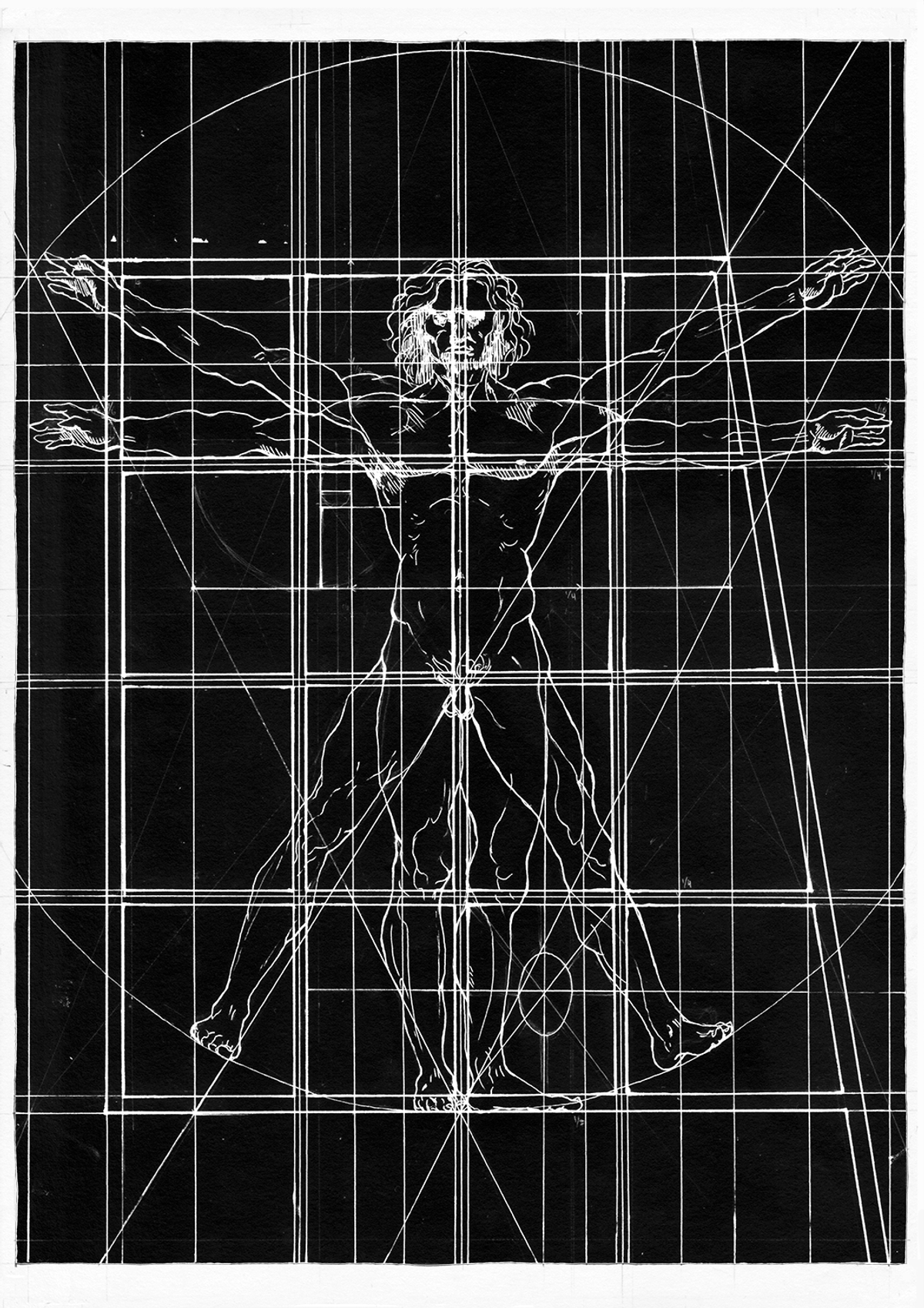
“It all began with the Vitruvian Man, hanging suspended in abstract space. Inscribed in a circle, in a square, springing from his navel, pure vectorised idea. Somewhere down the line the man became Man. Capital M. REX and RULER. A universalised (white, male) body of perfect natural proportions. And his navel, a hinge that “transforms the body into geometry, nature into architecture”. Feeding, breathing life into Architecture as a living man.”
FILARETE: “As it is with man, so it is with the building. First it is conceived and then it is born. He who wishes to build needs an architect. He conceives it with him and then the architect carries it. When the architect has given birth, he becomes the mother of the building.”
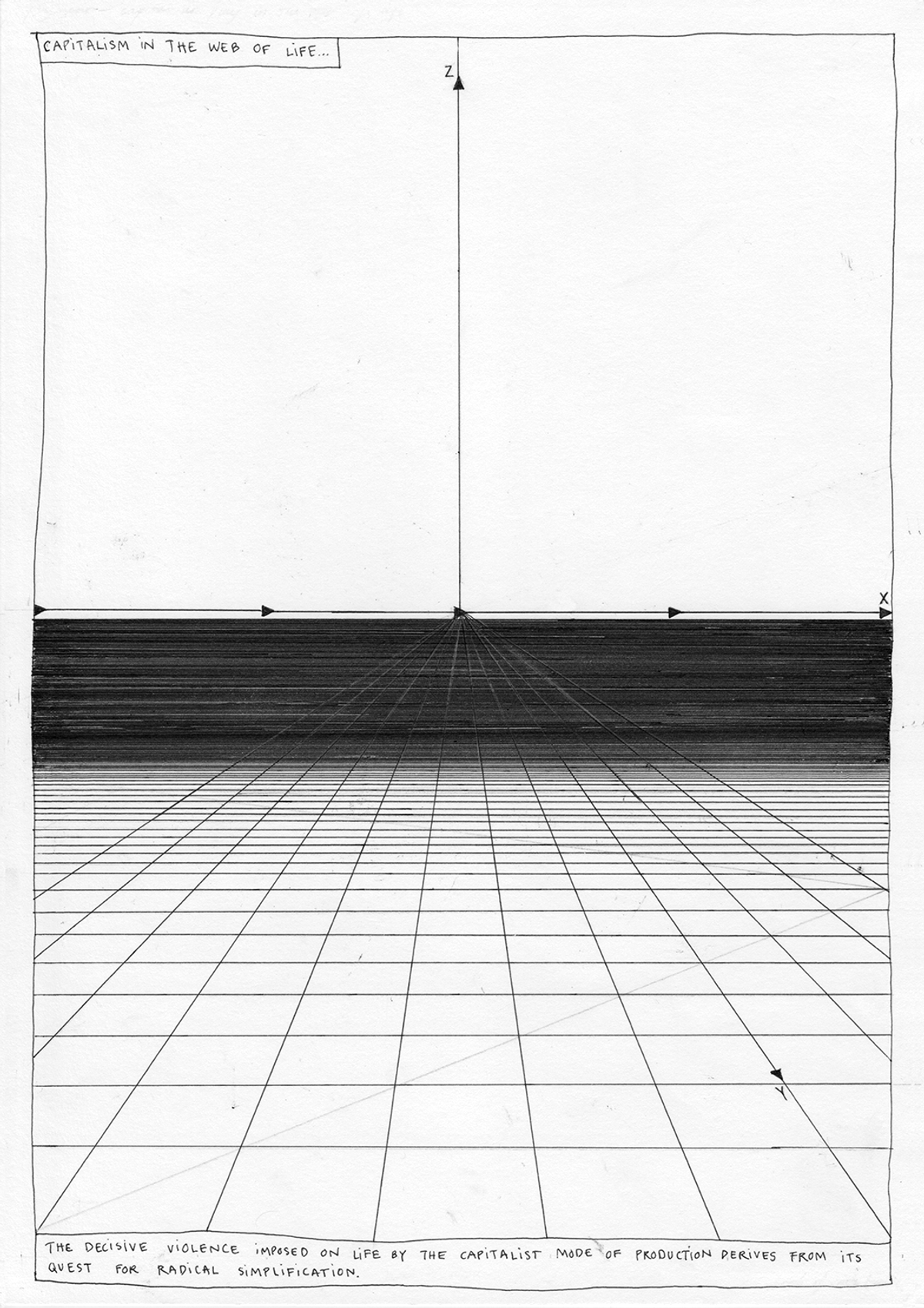
ANDREA: “And that line is the same line [Ill.2]; time tapered to an arrow of progress, cleaving the world in two: nature/culture, mind/body, coloniser/colonised. A world of interchangeable parts, ready for the taking. And that line is the same line; the growth curve that moves smoothly through infinite, scalable expansion, piercing clean through our bodies, shouting its course through our mouths like ‘it’s easier to imagine the end of the world than the end of capitalism’.”
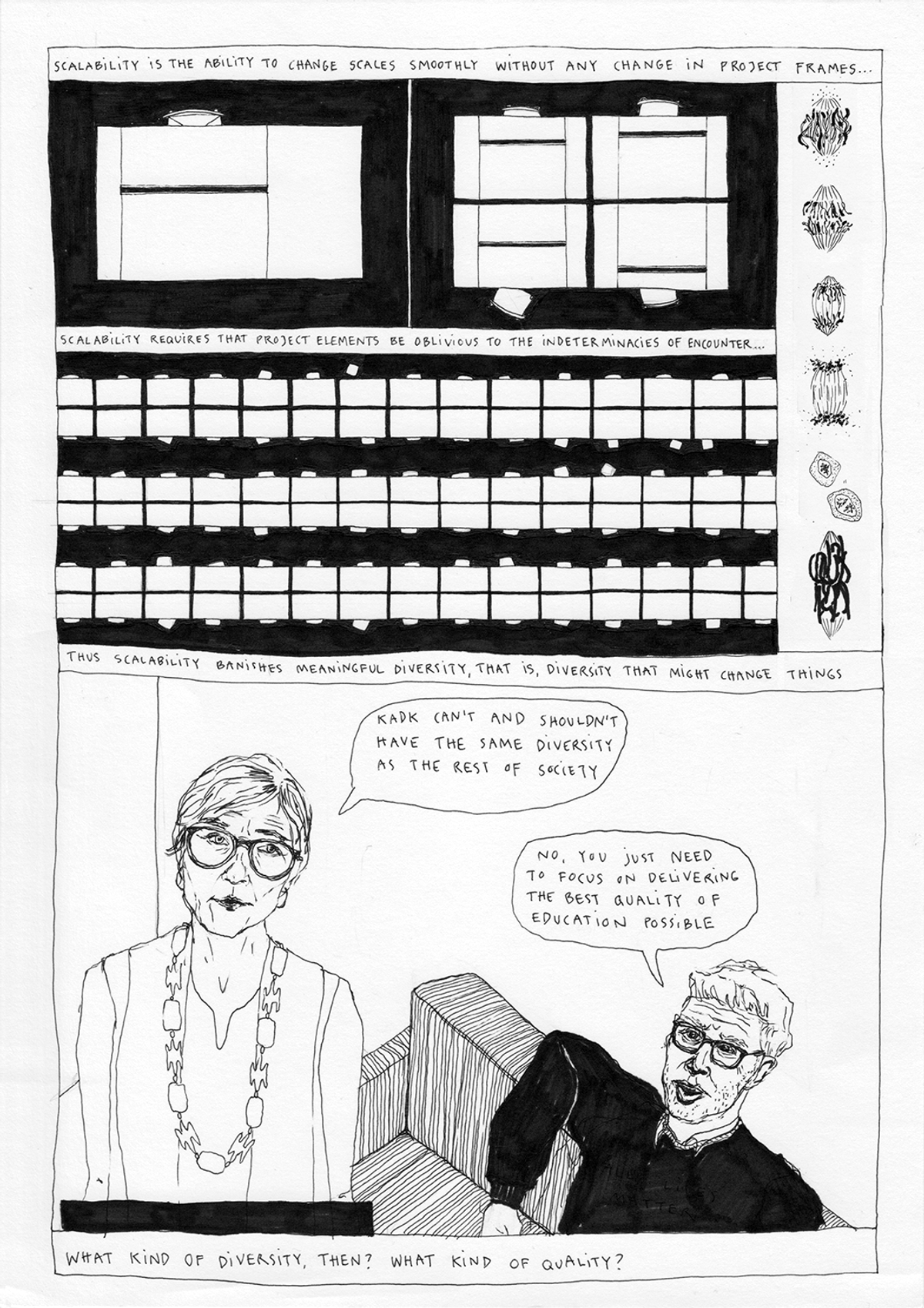
ANNA TSING: “scalability requires that project elements be oblivious to the indeterminacies of encounter [...] thus, scalability banishes meaningful diversity, that is, diversity that might change things.”
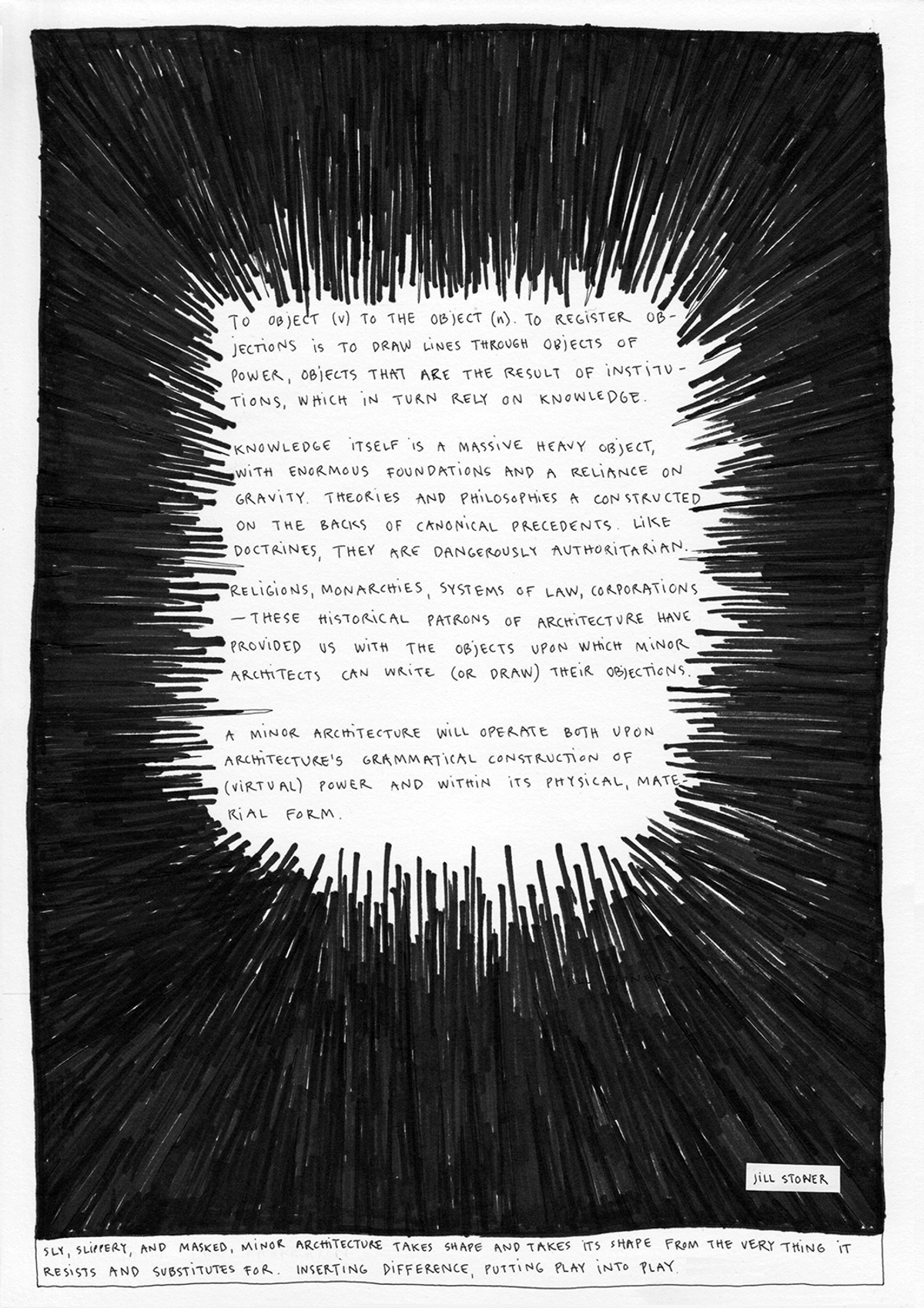
ANDREA: “Like when the LENE DAMMAND LUND on behalf of the school proclaims, that “KADK (now The Royal Danish Academy) can't and shouldn't have the same diversity as the rest of society” And MARTIN KRASNIK agrees “No, you just have to deliver the highest quality of education possible” [Ill.3]. As if the two were somehow mutually exclusive. Or when they told us, You are the elite, and we believed it. Refuse that story. Become minor [Ill.4]. Insert your protests into the map of architectural education, make them sprout and spawn like seeds, like dissident verbs, asking if not the same diversity, then what kind? Disorganise. Twist their words, make the major stories stammer producing languages of madness from the belly of architecture itself.”
JILL STONER: “to become minor is to exchange focused ambition for scattered flight and love of masters for that rejection of master languages with which we began”
ACT II
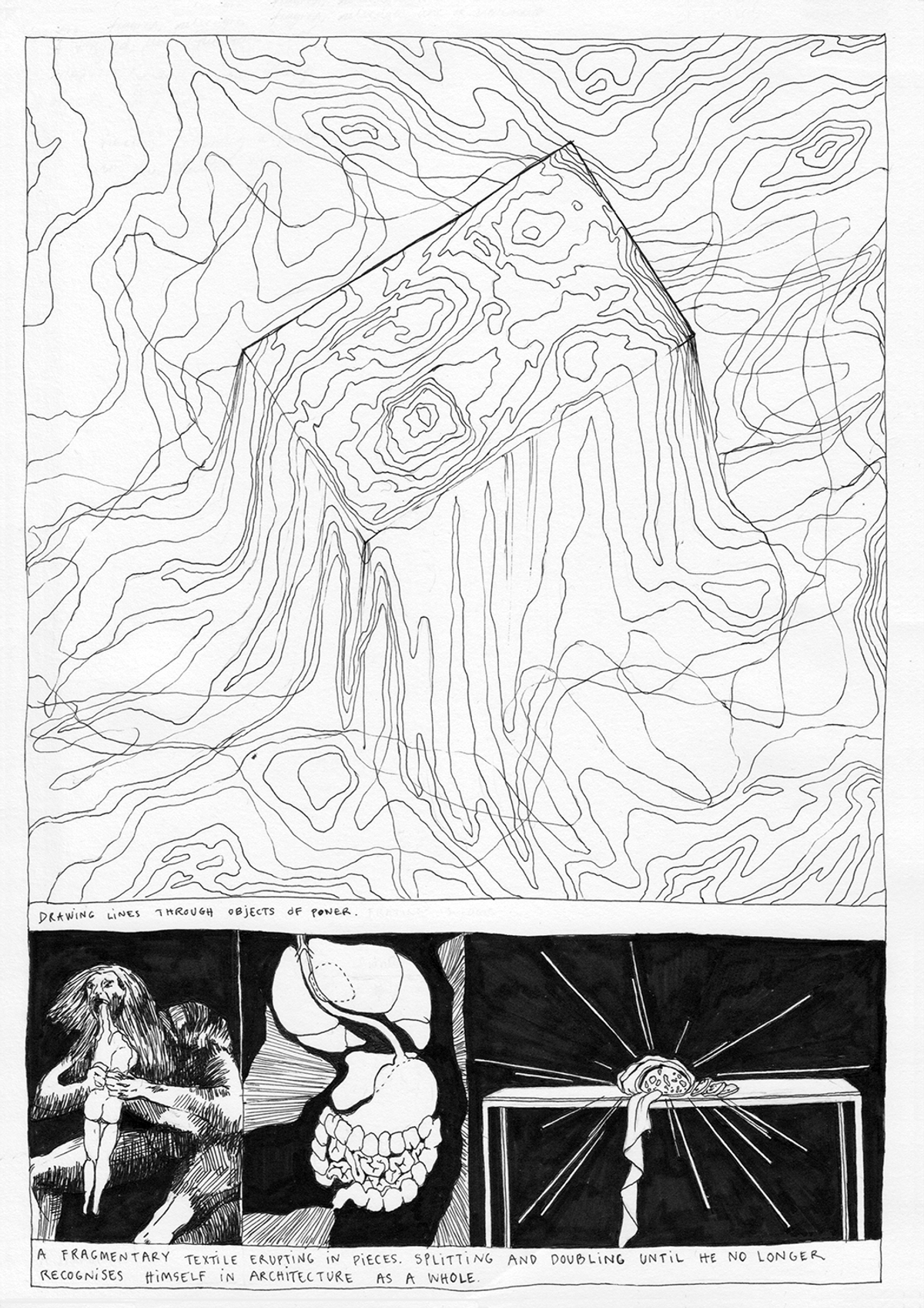
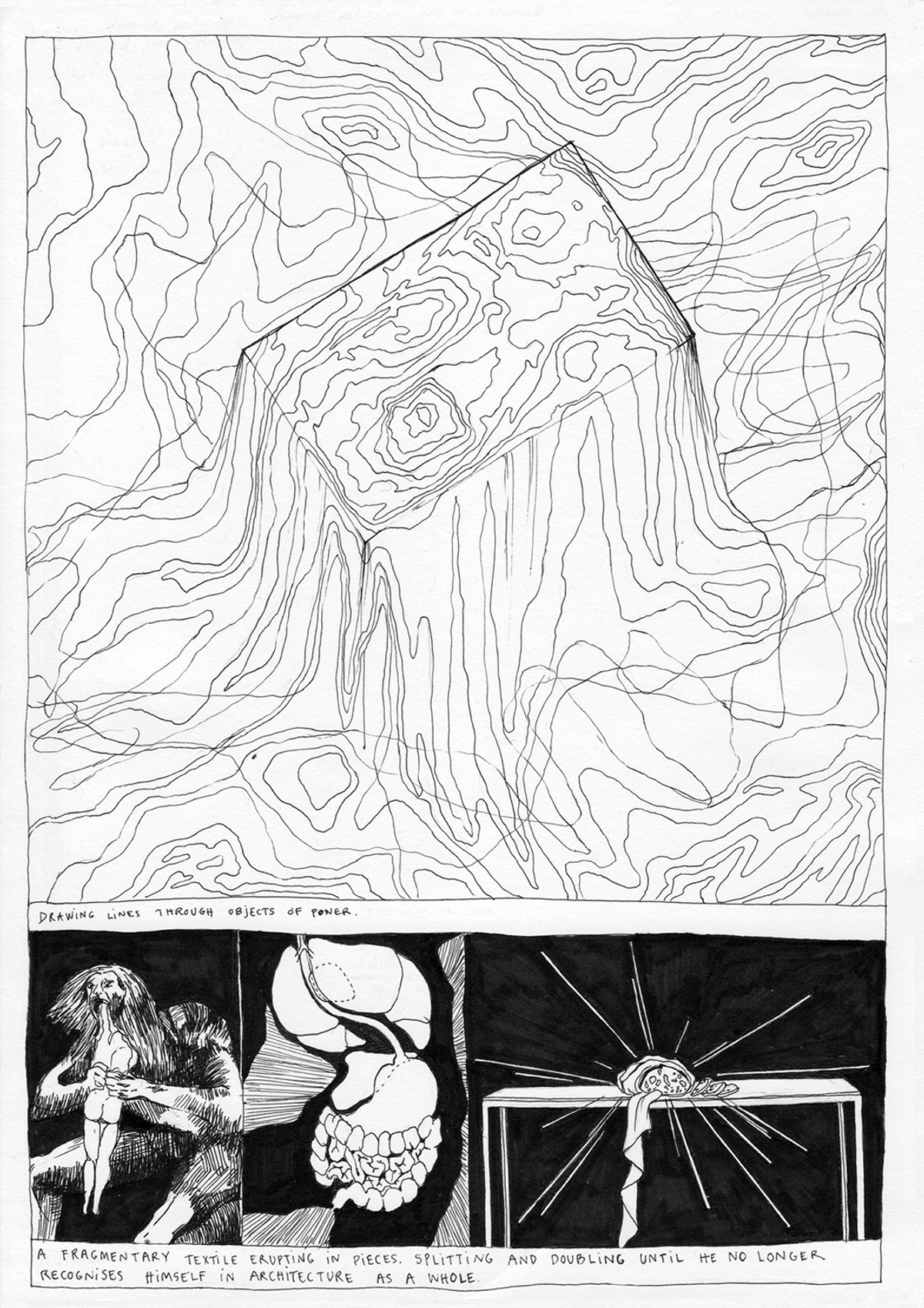
[Assisted by DAG, ANDREIA flips the tabletop around on the frame [Ill.5]. Meanwhile, NIELS turns off the lights in the auditorium and draws the curtains. ANDREIA unfolds a tablecloth and drapes it over the desk. The tablecloth is a topographical map of Rønnebæksholm, a manor house, park and garden turned gallery in Næstved where major and minor stories are entwined, and where ANDREIA had a series of significant encounters throughout the year. She attaches a lamp to the edge of the table and switches it on. The spotlight illuminates the table and sharpens the contours of the landscape.]
ANDREIA: “This is a map.”
LAURA OGDEN: “Maps allow for multiple entryways and practices of modification. [They] always offer the possibility of new routes, new configurations, and new horizons.”
ANDREIA: “The way we move through the map changes the territory it represents. How can we redraw the territory of architectural education? How do you build an architect?”
DAG PETERSSON: “Do you begin with a ruler or a garden?”
ACT III
[In the garden.]
ANDREIA: “The manor garden of Rønnebæksholm is a renaissance style garden modelled on manor gardens of the past. The renaissance gardens were birthed from principles of divine proportion and geometric precision. Stretched out on the ground the garden, an architecture, a living man. [Ill.6] The manor garden consists of sixteen planting beds held in a grid of axial footpaths organised around a heavenly centre, the rose pavilion.”
SWAMI BRAHMAVIDYA: “By contemplating this centre, you will be able to enter and go into another person's body, and to take possession of that person's mind, and to cause him to think and to do what you want him to do; you will obtain the power of transmuting metals, of healing the sick and afflicted, and of seership.”
ANDREIA: “Nested in the manor garden The Medicine Garden for Radical Care is growing. Chamomile, valerian, peppermint, lavender, sage, pineapple sage, hops, runner bean, rudbeckia, masterwort, garden angelica, devil’s-bit, figwort, yarrow, maidenhair spleenwort, southernwood, flax, white mustard, nettle, borago, curly kale, calendula, cornflower, centaurea, wild carrot, strawberry, lunaria, large-flowered evening-primrose, opium poppy, cherry, elder, nasturtium, mullein, blue vetch, broad bean, orpine, thistle, alyssum, red clover, comfrey, raspberry, rosemary, beggar’s button, st. John’s-wort, dandelion. A tangled text(ile) flowering and setting seeds that scatter and drift through the garden body, taking root, setting the garden adrift”
THE SEED: “We shall enter the body stretched on the ground. Palms feet eyes ears nose mouth veins intestines. Body-house-city parts sucking life from the omphalos. We shall enter and take possession like a sickness. Like the sickness that we are – A RUPTURE – and come bursting through and he will swallow us whole. He is the whale, yes, but we are the horse in his belly – A RUPTURE – Palms and feet and eyes and ears and nose and mouth and veins and intestines. All open. And he will swallow us whole. He might be the whale, yes, but we are the horse in his belly A RUPTURE palms and feet and ears and ears and eyes and veins and navel and nose and lungs and mouth and mouth and mouth and veins and wombs and tongues. If he is the whole then we are the body / house / city / parts bucking in his belly, a fragmentary textile ERUPTING into pieces, so many pieces, fermented and jarred, decomposing into madness dispersing seeds of madness, splitting and doubling until he no longer recognises himself in architecture as a whole.”
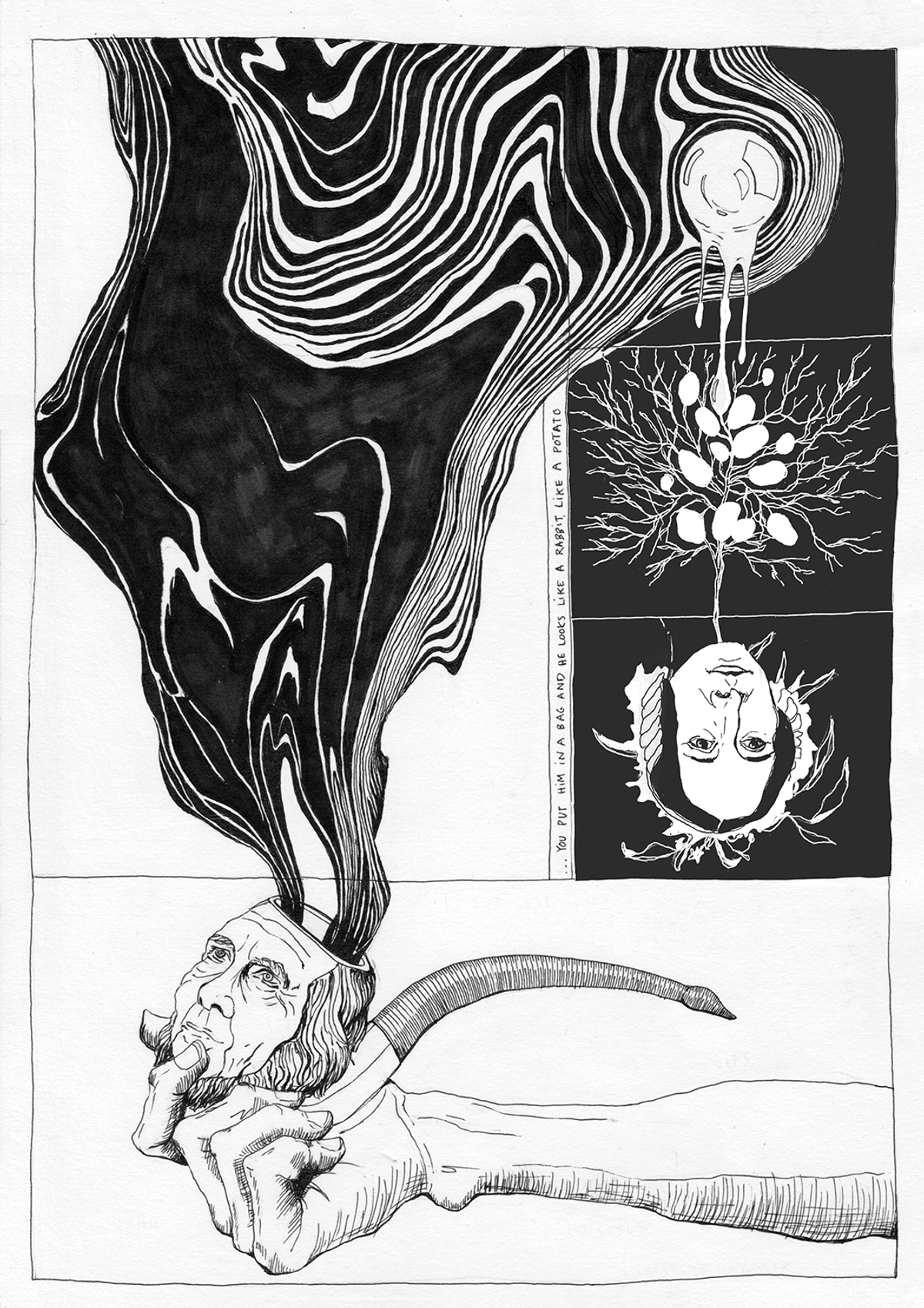
[In the Auditorium, ANDRHEA places a loaf of bread swaddled in cloth at the centre of the table [Ill.7], she walks back through the garden and picks a posy of mint, calendula and chamomile. She fastens them at the waist with a string and enters Grundtvig's pavilion at the north-east corner of the garden. The Pavilion was a gift from Marie Toft to Grundtvig. A space where Grundtvig could write his texts as the pair conceived their ideas for the democratisation of education and equality. Inside The pavilion is a desk, a chair, a lamp, a generator, a plaster bust, a divan with an oversized pipe on top, its plaster bowl an omphalos in the shape of Grundtvig’s head. [Ill.8]]
ANDRHEA: I sit down at Grundtvig’s desk. Notebook open, pen ready, trying to adopt his exact position. Enter his body and mind from this womb of thought. Mining my mind, trying to transmute my thoughts into metals, say something clever, in the name of Grundtvig, to pay back in gold what the Institution has invested in me – Congratulations, you are now an architect – Internationally competitive. Cut with geometric precision.
ANNA TSING: “I hardly know how to think about justice without progress”…
ANDRHEA: ... “progress without accumulation, me-the-architect, as anything but the interest on a capital investment. So I turn to the Grundtvig-shaped pipe instead. I kneel at the stem, put my lips to the button and inhale.
WIKIPEDIA: “Omphalos stones were believed to allow direct communication with the gods. Holland (1933) suggested that the stone was hollow to allow intoxicating vapours breathed by the Oracle to channel through it.”
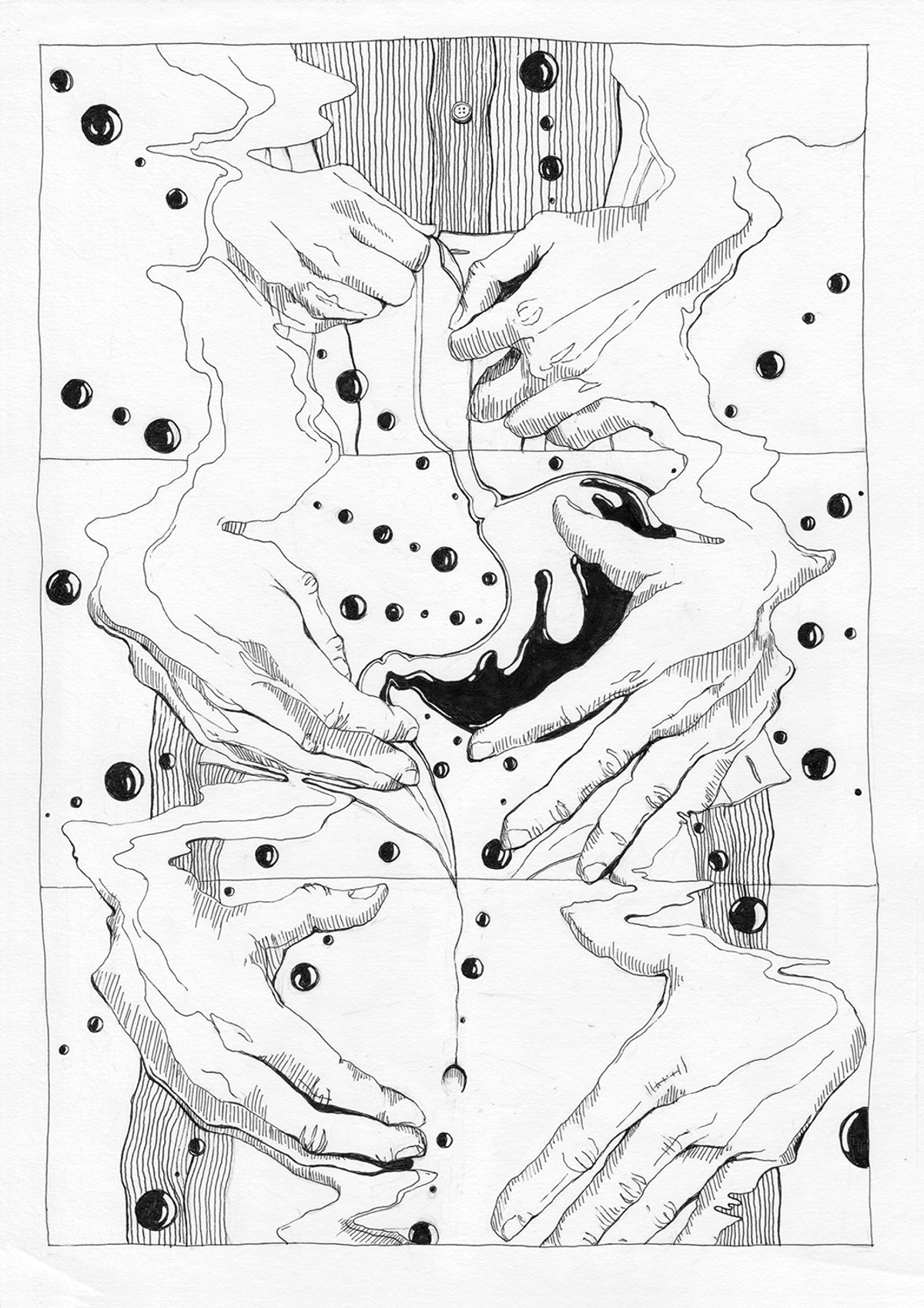
THE SEED: “In the garden. A ray of sun tickles the hand, tingling in the tangled fabric of bodies, breathing ripples through the garden that bursts into laughter as the pistils open their mouths and disperse their seeds their seeds that settle into the pores of ANDRHEA's skin blossoming over her eyelids, down her cheeks, wrapping themselves around her throat like a necklace, like a necklace spilling over into dress of flowers and frayed edges, she begins again. She makes disturbance a beginning.” [Ill.9]
ANNA TSING: “That is, an opening for action. Disturbance realigns possibilities for transformative encounter.”
ANDRHEA: “Encounters that might change things.”
[In the auditorium, ANDRHEA unscrews the lid of two small bottles and drips three drops of chamomile and calendula tincture into five glasses before filling them with mint kvass. She scratches at the seeds still lying dormant in her skin. They tremble in her palm. Opium poppy, hops, mullein, figwort. She grafts them onto the map. Sap flows, seeds swell. When exposed to the light the seeds will erupt with a rush of voices and stories.]
ACT IV
[A stark light enters the room. Fruits hang from the ceiling. The medlar is a tree in the rose family. The fruits are hard as stone when picked, then left to blet until soft, brown and wrinkly. Once bletted the flesh is soft and tender with rot and an apricot sweetness. The medlar has been used as a symbol of lost virtue, a ruined woman, “no sooner ripe but rotten.”
ANDRHEA places a jar of medlar cheese on the table in the auditorium.
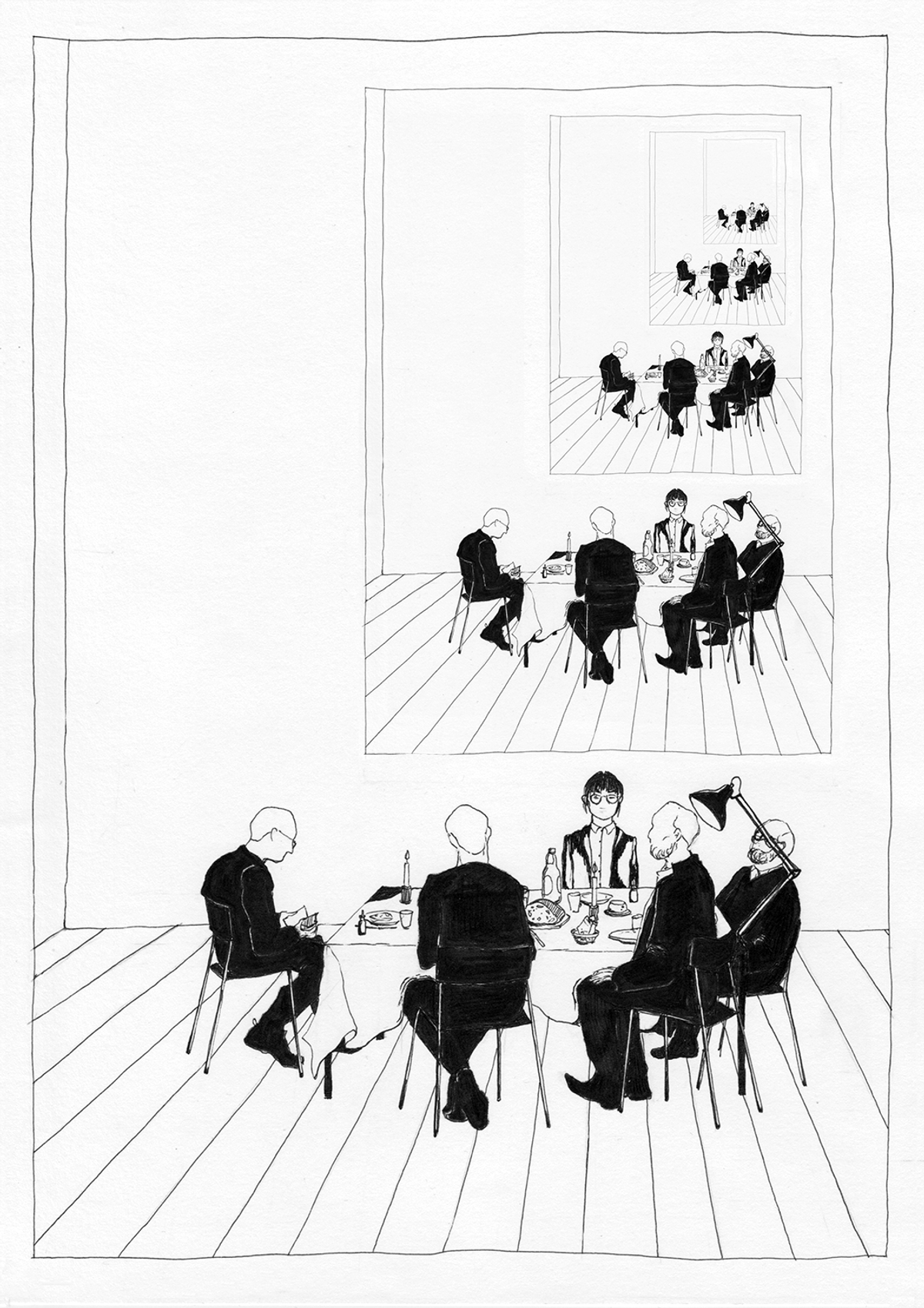
The table is all set now. She invites the institution to join her on stage. [Ill. 10] Together they eat from the garden and transmute from the inside out. [Ill.11]]