7 min
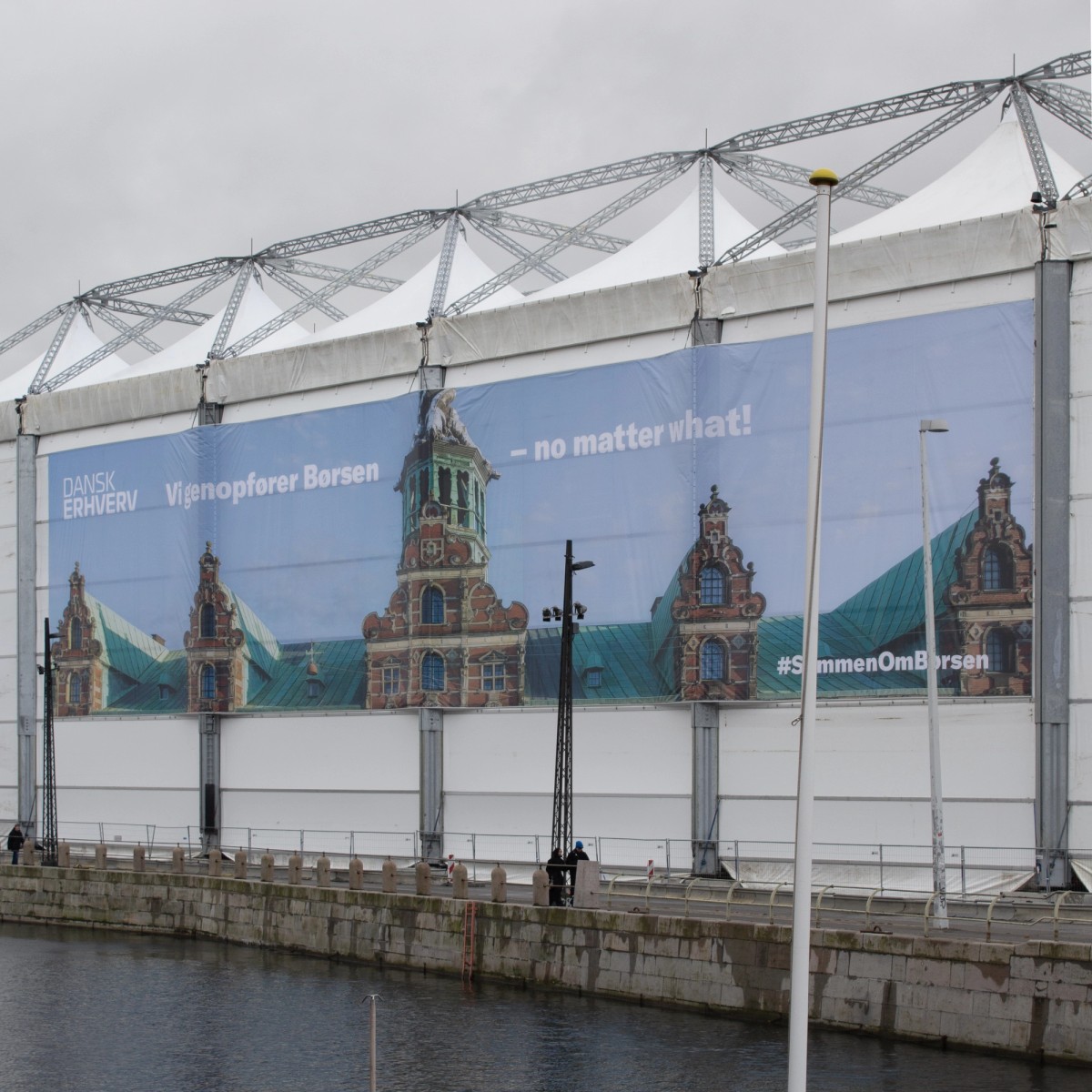
The destruction of Børsen on the 16th of April, caused by a fire, led to a subsequent public discussion on how to restore it, as its reconstruction was deemed inevitable. A discourse quickly centered around the question of originality regarding how and what to preserve. This embedded itself in the notion of value: how we (de)value the physical matter surrounding us and what we consider valuable factors.
Despite living in a world characterized by progress and mutability, this event made it clear that we, as humans, tend to long for the past—that we, with Walter Benjamin, wish to “awaken the dead and make whole what has been smashed” in our pursuit of an authentic world.
We cannot neglect the importance of authenticity in the cultural molding of space, although the authentic is disputed territory. It extends its hands from the rubble of our past into future spaces through the present. It acts as a judgment of ephemeral decisions about where we travel, it plays a role in considerations about our qualities as individuals, and the treatment of physical material reflected in our buildings. By approaching the term itself, we notice a small crack, revealing that authenticity has become blurred at the edges.
CORELESS CORE, REAL REALITY
When examining the authentic, we encounter the notion of a core, an essentialist aspect, where the diffuse character of the authentic actualizes itself with a constant movement toward a center.
The core, sometimes termed substance, identifies the innermost quality of an actual thing, object, or phenomenon. By being true to this center, things fulfill themselves. Conversely, every act or circumstance that is not in line with the real or the core is considered an imitation, a copy, as it falls back on a substance-based conception of immutability. If we change a feature that exceeds the qualities defined by the core, a dissonance between core and being emerges, and authenticity is lost.
When discussing what to preserve, we tend to look at the object through a lens, trying to define the core of the building, leading us to the catalyst of preservation. How this core is defined and how everything acts accordingly is what, in some cases, becomes the authenticity of the building.
In an official document issued by The Agency for Culture and Palaces, “Vejledning: Vurdering af Fredningsværdier”, an example of the “bærende fredningsværdier” (essential preservation values) is as follows:
In the building's exterior, the principal preservation values are associated with the traditional use of materials and all original details, particularly the half-timbered construction and the hipped roof.
In this case example, a certain building is worth preserving due to its traditional materials and original details, essential values defining the core. We determine whether the building is worth preserving by looking at its essential values.
The principles of assessing authenticity from the Agency for Culture and Palaces seep into the independent municipalities in Denmark where judging whether a building is worth preserving or not is based on a ‘SAVE registration’ (Survey of Architectural Values in the Environment), which differs from one municipality to another.
Values are assessed on a scale between 1-10. Originally, the scale reflected a holistic and all-encompassing approach, but today the evaluations are often associated with strong architectural values that correspond with the originality of the building. These assessments happen rarely, and in most municipalities the last one is often more than 30 years old. Yet their influence on whether buildings are to be preserved or not is indisputable.
The Agency’s official guide for how to assess preservation values emphasizes the perceived materiality relative to the building’s original state, a state that refers to the time it was created, i.e. when the building was most true to itself. This state can be termed the genesis of the building. The official assessments neglect the possibility that a building can go through several states of genesis, for example, if a building undergoes comprehensive changes where larger parts of the building, interior as well as exterior, are rearranged, subtracted, or transformed. If we accept that a building can in fact go through several stages of genesis, we can claim that authenticity cannot be narrowed down to one single state at a certain time—rather, several authenticities can co-exist simultaneously.
This aspect of time, its multiplicity, becomes relevant when scratching the surface of Børsen. Archeological investigations of the ruined building revealed a tiled floor dating back to the Renaissance. Hidden underneath the wooden floors, first assumed as the authentic floors and therefore worthy of restoring, another time revealed its face. This raises new questions about which time is the most authentic and what we choose to bring back. The same applies to the walls. After the wallpapers were bunt away, the inner walls were exposed, revealing everything other than fine craftsmanship. Mortar smeared on aerated concrete might not be the first thing that comes to mind when thinking of what this precious building really consists of. These were the walls standing when the fire raged but is it these walls, raised with efficiency rather than fine technique, that we choose to bring back?
AUTHENTICITIES
In 1993, the UNESCO Nara Document of Authenticity rejected the essentialist view. Drafted by 35 participants at the Nara Conference on Authenticity in Relation to the World Heritage Convention, it states that: “It is thus not possible to base judgments of values and authenticity within fixed criteria.” And it continues:
Authenticity judgements may be linked to the worth of a great variety of sources of information. Aspects of the sources may include form and design, materials and substance, use and function, traditions and techniques, location and setting, and spirit and feeling, and other internal and external factors.
This attempt to define and capture authenticity suggests that it is not anchored to a core: a single material, a specific roof, a time period, or an original technique. Authenticity has as much to do with the ephemeral and non-material as with the material.
The dynamics of the social connections to a building is difficult to assess. Aldo Rossi described how the development of a city and its artifacts, such as buildings, landscapes, and urban spaces, have individual character with their own agency: “In every city there are individual personalities; every city possesses a personal soul formed of old traditions and living feelings as well as unresolved aspirations.” This view leaves room for buildings to develop beyond their original techniques, functions, and programs — also buildings with a seemingly inauthentic conception.
With the current discussion of whether we should preserve instead of building anew, the concept of authenticity plays a key role. Simply through the act of indicating that some buildings are more authentic than others, the issue of hierarchy and differentiation arises, and we are deemed to devalue the buildings that are not authentic. Rooted in the authentic is the problem of distinction: making distinctions between the authentic and the inauthentic. In a future where we choose renovation and restoration instead of demolition, this distinction seems more crucial than ever. How will our future built environment look if we were to put half-timbered houses over postmodern concrete structures?
THE RETURN OF THE NEW?
The strategy of rebuilding Børsen, reusing almost 40% of the original bricks and all the sandstone figures put into their original place, in line with the original style, reflects an idea of repurposing the existing material which is in line with a contemporary movement in architecture: to avoid unnecessary depletion of our resources. Utilizing the existing to bring the new building in line with the original style, however, expresses the desire to reinstate what once was. However, should we not question whether this decision is premature?
Do we possess sufficient knowledge about the building itself, its history, and its material to determine this? Within the findings of the renaissance floor and the cladded walls, do we not find it necessary to further assess the building before we deem parts as authentic and others as inauthentic? Are we thoroughly aware of the exact notion of authenticity that we now embed into the rebuilding?
–
Anne Silberg Thomsen is a practicing architect educated at the Royal Danish Academy. Her practice is concerned with the critical comprehension and examination of underexposed and unexplored potentials of space.