Stop building? The question isn’t exactly comfortable to answer for a scholar working at a large research centre, developing and transferring digital fabrication technologies into the building industry, to contribute to a more sustainable future for the architecture, engineering, and construction (AEC) sector. While my work focuses on human factors, for my peace of mind, maintaining a certain belief in the potential of digital technologies to transform the building industry seems wise. So, do I think we should continue building, but instead with sustainable technologies?
Departing from a conference on the future of construction in Munich last fall, I describe and discuss various narratives in the contemporary discourse on sustainable building, including the different definitions of – and attitudes towards – building. This endeavour is motivated by the assumption that the different narratives may each provide puzzle pieces in the storyline of future sustainable building, and the article contributes to the discourse by providing an analytical device – a category system – to help discern the narratives and discuss their potential interrelation.
First, I lay the theoretical basis for the discussion, arguing that approaches to sustainable building can be analytically distinguished in what I term system-upgrading and system-transforming approaches. System-upgrading approaches cover the manifold research that develops new technologies and methods for the building industry, aiming for the uptake and transformation of conventional ways of building. System-upgrading approaches are methodological in their scope, changing how we do things. System-transforming approaches, on the other hand, cover the range of literature on sustainability, which have in common a consideration of the subject matter as an epistemological changing what we consider to be knowledge. These approaches question perceptions of truth, and what might be sustainable ways of knowing. Second, I connect the approaches in a category system which I then adopt to present, analyse, and discuss the various narratives presented during the conference.
SYSTEM-TRANSFORMING APPROACHES
Climate change is a time-sensitive issue. We have already witnessed the early stages of its catastrophic potential on our bodies. Unfortunately – one might say – we no longer need to rely on the works of artists like Lara Almarcegui, Pierre Huyghe, and Olafur Eliasson to help us connect phenomenologically with the changes occurring in deep time. These occur on our summer holiday, where the campsite is flooded, and the cars damaged by hail the size of tennis balls. With the AEC-industry counting for 39% of global energy-related carbon emissions, is there still time to think? Should we stop building if not today, then tomorrow?
A building stop would confront us with new questions: How to convince the world to close an industry with a global market value of 10.6 trillion dollars in 2023? How to organize housing for a growing and urbanizing world population? The need for housing is almost as urgent as the need for a building stop, confronting us with a paralyzing dilemma – at least in the short term. On a longer timescale, however, things look a little different. Time provides an opportunity to think anew and provide answers from the bottom up. It’s on the longer timescale that influential sustainability thinkers like Donna Haraway and Bruno Latour enter the discussion, arguing for a transformation of the very system, with which we have come to think: one that Haraway has termed the Capitaelocene to emphasize that neither Man nor technology is responsible for climate change, which results from more complex, systemic couplings that date back at least to “the great market and commodity reworldings of the long sixteenth and seventeenth centuries of the current era.” Unwinding these connections, and establishing more sustainable ways of habitation, demands us to take a dig deeper than simply reconsidering how we build. Such approaches are epistemological in their scope.
The epistemology of modernity – which Haraway directs her criticism towards – has been coined by Alfred North Whitehead as the “bifurcation of reality.” The notion provides not only an explanation for “the historical–systematic origin of the categorical–binary distinctions that characterize the philosophical tradition of modernity, but also for the modern bifurcation of modes of knowing, that is, the division of territory between the natural sciences, dealing with the objective world, and philosophy, dealing with the subjective conditions of knowing this objective world.”” Bruno Latour has connected this notion to the current sustainability crises, arguing for a Metaphysical speculation as a tool to move beyond the bifurcation of nature “through the construction of abstractions with which to interpret the pluralism of experience. (…) Latour develops a notion of a common world out of the messiness of experience and, as such, hopes to transform us into beings who would be moved to actively pursue and care for such a notion.”
In an associated stream of literature that has influenced the discourse on sustainable building, Haraway speaks of the Chthulucene, characterized by a tentacular thinking that follows a non-linear, intricate logic; Tim Ingold of “practices of locality” and of the “life of lines”; David Turnbull of the “transmodern”; Kate Soper of post-growth living as an “alternative hedonism” and Anna Tsing of “entanglements” and “contaminations.” These notions have in common a system-transforming approach to the issue of climate change, arguing that our sustainable future depends on our ability as humans together to unwind the constructions of modernity, and this requires an acceptance of science as a local knowledge resulting in the disidentification of Western epistemology with universal truth, and of human-centeredness altogether. To this pool of literature, I want to draw attention to the notion of ecological-sensemaking as well. The concept is interesting, as it hasn’t been coined directly as part of a critique of the discourse of modernity, but in the context of management and described as a leadership skill. Like Ingold’s practices of locality it refers to a practice-based form of knowledge of environmental conditions, continuity, and change, but is described as a skill that an individual can learn to possess. Building on Donald Schön’s concept of the reflective practitioner, the authors connect literature on practice-based knowledge in architectural design, to a comparative case study of two situations of rapid changes in the immediate environment, leading to one life-threatening and one fatal event. In both cases, the chances of survival relied on individuals’ ability and disability to make sense of the environment.
SYSTEM-UPGRADING APPROACHES
In difference to these system-transforming narratives, new building technologies and methods are developed, changing the system on a methodological level – that is how we do things. I term these system-upgrading approaches, as they are narrower in their scope focusing on the transformation of a specific task or a series of tasks, and their organization operating within and upgrading the existing system, but not on changing the system overall. If successfully implemented into the building industry, these technologies are set to disrupt the AEC-sector by pulling the building phases together towards circularity. Yet, like the “Coal and the steam engine did not determine the story,” reused material and assembly robots themselves won’t determine our future. They create a possibility space for sustainable building, but they do not determine the purpose of their use. In this research stream on sustainable building, I count research that develops technologies associated with the so-called industry 4.0, transforming tasks previously performed by humans – from augmentation to automation – such as those often described as dull, dirty, and dangerous. While robots are only slowly beginning to enter the construction sites, additive manufacturing/3D-printing as well as Augmented Reality (AR)/Virtual Reality (VR)/Mixed Reality (MR) are in use.
However, to this research stream, I also count robotics and 3D printing for care and repair processes, which don’t target the construction phase. The promises of augmentation and automation of tasks of often-marginalized workers in maintaining buildings are one of the incentives driving research into the care and repair of buildings by new technologies. Another incentive is a promise of improved safety for workers; a more optimal accuracy in task completion and delivery, as well as longer and more uninterrupted hours of repetitive delivery of tasks and higher flexibility.
NARRATIVES IN SUSTAINABLE BUILDING: A CATEGORY SYSTEM
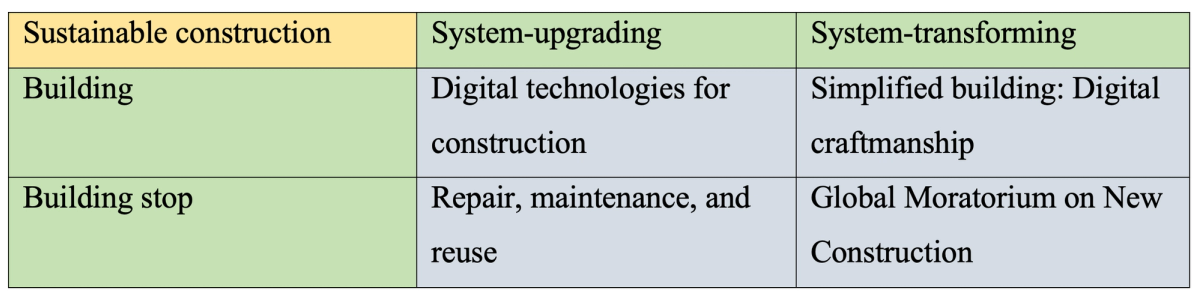
While system-transforming approaches tend to speculate and either not focus on building or speaking for a building stop (such as a A Global Moratorium on New Construction) it is possible to think of system-transforming research that builds. Brandon Clifford is a digital fabrication researcher at the Massachusetts Institute of Technology (MIT), challenging the values of industrialization. To him, the core (transformative) potential of digital fabrication lies within its capacity to re-link design and making, thereby arguing that it has more in common with pre-historic ways of building, than post-industrial ones. Thus, while system-transforming approaches might be intuitive to relate to a building-stop narrative, they can also be part of building narratives. Vice versa, building maintenance, repair, and re-use present narratives on circular construction (cradle-to-grave or cradle-to-cradle), but often orientate towards the industrial application without focusing on building anew. Thus, they can be categorized as system upgrading.
Below is a tentative outline of a category system for narratives in sustainable building, arguing that various but often overlapping narratives translate into analytical categories according to their scope (as system upgrading vs. system transforming) and attitude towards building. The aim of the system is solely to focus on a discussion of sustainable building narratives, and the borders of the categories are rather grey zones than strictly defined. In addition, the table assists placement and comparison of narratives (to be introduced in the following paragraph). [Ill.1]
NARRATIVES IN THE FUTURE OF CONSTRUCTION
On a rainy September day in Munich in 2023, I attended a conference on the Future of Construction, placing sustainable construction on the top of the agenda. While most presenters were part of a roughly central European community, surrounding digital fabrication (i.e., researchers in technology- and software development, Life Cycle Assessment (LCA), construction management, and building materials), some external voices diversified the discourse. I here focus on these different voices as I present two narratives that are transforming in their scope, and finally, a third one that addresses the narrative itself, through a reflection on the practice and importance of storytelling.
The first story to be told is one of A Global Moratorium on New Construction. As both “an initiative and a provocation that argues a drastic change to construction protocols is necessary” this narrative is particular in the discourse, since its story plays out around a speculation. System-transforming in its ambition, the initiative reacts to the fact that the construction industry didn’t take the chance offered by the pandemic to pause, think, and “question our societal model,” and thus considers the implications that a momentary building stop might have. In this way, the initiative goes well beyond a provocation; it presents an alternative path of perceiving building – one which departs from a complete building stop as a common denominator from which we can then start to think anew together. At first, the building stop is an experiment and a construct that could become reality, if we find that a ban is feasible. However, for the building-stop to be(come) feasible, a radical transformation of at least the real estate market is needed: The initiative asks questions like, “How many of the thousands of new units built every year, everywhere, are accessible to those who need it most—while office and retail space lay vacant?” This question targets resource re-allocation and a global reformation of housing policies, implied in the rhetoric of the initiative that “the suspension of new building activity must be enforced.” Thus, I wasn’t surprised that Barthes’ talk stimulated a rather heated debate among conference participants during the coffee break, as it is politically explicit as well as questioning the research agenda of several other conference participants. If a building moratorium is too hasty and causes emotional tensions, can we think of an alternative route?
A PROJECTIVE ARCHEOLOGY WITH DIGITAL FABRICATION
At the conference, a range of new technologies were presented, each offering new potentials for building and – to varying extends – shifting conventional processes towards sustainability. The goal of these technologies (i.e., software, robotics, augmented-, virtual-, and mixed reality) in the first line, however, was their uptake into the industry whereby they could become practically relevant, further tested, and developed with a range of sustainability indicators in mind (across the social, environmental, and economic pillars). While these endeavours upgrade conventional ways of building, they largely don’t question – on a more profound level – the production system. They do so, however, when coupled with system-transforming thinking, which I would argue was the case in one of the presentations on the second day of the conference.
As part of a panel session on how to simplify building, Brandon Clifford presented his research. Describing himself as a time traveler, Clifford’s research presents a projective archeology – a way to experiment with the potentials of pre-historic, abandoned methods of making. Searching for archaeological evidence, that disrupts contemporary ideas on building and employing digital fabrication to reconnect with those abandoned methods, Clifford does things differently. This is not only in terms of the research design, but in the communication of the findings as well. In his book, The Cannibal’s Cookbook, he blends oral histories and myths of ancient building construction in the writing of his findings, presenting them as recipes addressing the hunger of the individual builder, and foregrounding the DIY spirit in digital building. The book is a “manual for the hungry, for those who are not satiated by the careless building practices of the present.” It’s both a cookbook for future building, and a manifesto for cannibalistic architecture that speaks for the reuse of existing but abandoned building material and how to (re)-assemble it. The cookbook is based on data and stone material from field visits to ancient ruins, such as the stone structures of the Inca Empire, and presents studies of the techniques of masonry of megalithic sculptures which he then brings into life back in the laboratory back in Boston, employing the sculptures to perform tasks with the assistance of digital technologies. In Clifford’s own words, his research is “focused on re-directing architectural research through spectacle and mysticism, by re-posting a series of ancient, but hauntingly relevant questions. For instance, could walking massive statues help us design for transportation and assembly? Is the key to recycling our building materials locked inside the cryptic walls, suspected of being built by primordial giants? These ancient ways of thinking, compound cultural significance, ceremony, and mythology with technical and methodological procedures, that have the potential to resolve our contemporary problems.”
To Clifford, we need to not only take seriously the oral histories and myths, which cannot be validated scientifically, but we need to re-consider them in light of today’s technologically advanced resources, to bring the myths to life in new ways and give them new credit as knowledge. Thus, if we follow David Turnbull’s argument that science is local knowledge, Clifford simply makes connections between various sources of local knowledge on building. While his research doesn’t explicitly speak for a building stop, it speaks against post-industrialized ways, and thus potentially offers a way towards thinking system-transforming with building.
GLOBAL IMAGINARIES OF BUILDING
Less about building technologies and more about storytelling, architect Marija Maric presented an ongoing work on what she terms Real Estate Fictions, looking at the Construction of Global Urban Imaginaries. Examining the role of communication strategists in the mediation, design, and globalization of the built environment, she argues that we cannot create a future, we cannot imagine, depict, and visualize. The importance of this argument in the face of climate change, is that we need to carefully consider which story we want to tell about the future, and how we want to tell it. While science is constrained by its commitment to objective description and basic research, design can be prescriptive and make use of new technologies (i.e. VR, AR, and MR and artificial intelligence for reality-capture- and production). Within construction management, Jennifer Whyte and Alice Comi have described various ways of future-making by architecture design. One of these ways of strategizing and organizing a design project, they termed future perfect thinking. Accepting that we cannot have objective knowledge of the future, future perfect thinking “argues for reducing its open-endedness by imagining the future as a past event.” This strategy shapes a design process that starts with a complete vision for a future design with everything (including the strategy itself) following from this vision.
While Maric’s talk didn’t directly address the debate on building vs. building stop, and doesn’t fit into the theoretical framework I previously outlined, it presents an important morality for the subject matter. Against the background of climate change, science, and social science disciplines, are studying the interface between imagination on the one side and material reality on the other. Following a future perfect thinking approach, realizing a future vision, involves drawing a strategic roadmap of one (or several) routes of how to get where we want to be. This brings into question what the various narratives of sustainable building can learn from each other. How should a roadmap look and read?
SIMPLIFYING BUILDING: DIGITAL CRAFTSMANSHIP AS BOUNDARY-CROSSING SUSTAINABLE PRACTICE?
At the conference’s closing apero, I found myself using Clifford’s example to compare the various narratives I had encountered, creating my own story that aimed for diplomacy in conversations with attendees which largely favored the talks that spoke for building. Awkwardly maneuvering this space of epistemic tension with a glass of white wine and a plate of canapés, I found myself drawing on arguments I had previously presented elsewhere. In my doctoral dissertation, I argued that an increasing specialization is underway in architectural education as sub-cultures of knowledge to the discipline “curl up upon themselves” making the internal epistemic boundaries clearer. I suggested that these tendencies of siloing occur against the background of a phenomenon depicted as the academization of architecture which threatens a much-needed inter- and transdisciplinarity inherent in the discipline. This academization has accelerated over recent decades and taken a specific form, but certain elements in its logic date back longer in time.
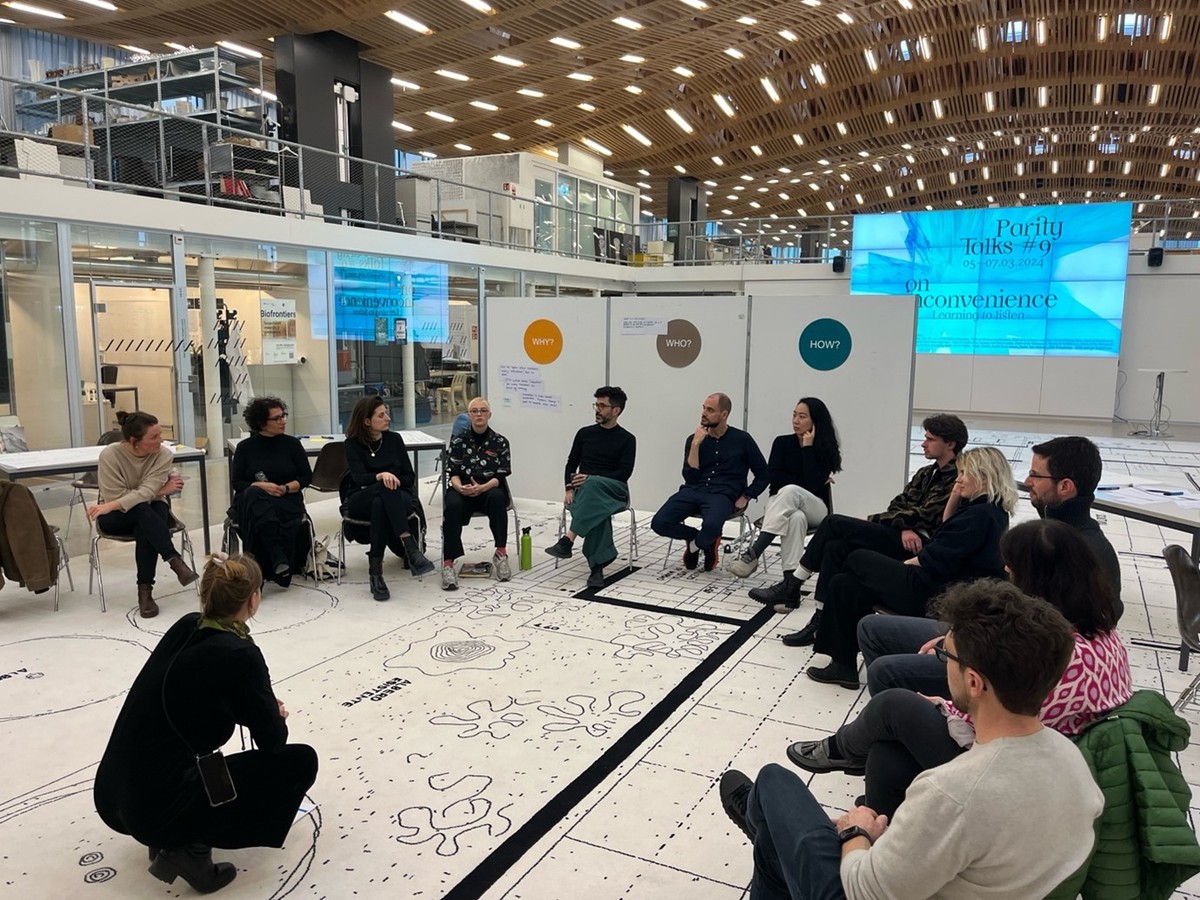
Johnathan Hill has argued that Vasari’s art academy in Florence (founded in 1563), acted as a model for architecture schools ever since. In this school, a perception and self-understanding of the architect were established, according to which architects claim and achieve “their intellectual status by making drawings with just a few delicate lines.” “Whether in the studio or on-site, they tended to see not matter and mass but proportion and line.” It was the idea, not the craftsmanship, which gave the architect their privileged position, thereby creating a disciplinary culture where the architect asserted their status in distance to the building site, pulling apart the design and the making which – according to Clifford’s narrative – can now be brought back together. The dualism between mind and matter, traced in the cartesian-platonic logic, pulled the building practices apart in domains of knowledge. Against the background of climate change, it has become less meaningful to maintain the boundaries of these domains. Materials are back in focus, their scarcity and agency more respected, notions of craftsmanship and vernacular heritage trending, individual authorship and starchitecture put into question. Related to these trends, inter- and transdisciplinarity (ITD) are now hot topics of research and teaching in architecture, but the question remains if we are open to ITD? Not only do we need to share power and knowledge in decision-making processes with stakeholders from other disciplines, but we also need to share a bit of power with the technologies themselves. When Latour speaks of how we shouldn’t reduce things to objects, he means it literally. Building ideally should be a collaboration of human and non-human actors in sync, a dance if you want, and this is the imagery Clifford used in his talk to describe the potential of employing digital fabricationin experiments with pre-historic methods of building. [Fig 2]
When Whitehead speaks about the division of territory, it relates to a fundamental distinction in epistemology between “matters of facts” and “matters of value,” with the first assigned to the objective sciences and the latter to the humanities, dealing with the subjective conditions of knowing. The problem with this distinction is that it misrepresents the condition of reality which is always a mix of these domains. Haraway emphasizes the significance of telling the right story about life on Earth (part of an ever-evolving, now acceleratingly overheating, planetary system). It matters for our understanding and making of reality which story we tell about reality; and how we tell it. It matters if we speak of the Anthropocene, the Capitaelocene, or the Chthulucene. Describing the Anthropocene as a tool, story, or epoch to think with, she underlines this contingency and value bias of the perception of reality. So, if reality is constructed, we should be able to construct a new one and may ask ourselves pragmatically if the story of Anthropos is useful to us.
CLOSING REMARKS
Let me end with a story about progress and regress. We are in New York City, 1948, and the Americans are war heroes. There is a great belief in future progress, in Man and science. Warren Weaver – a scientist widely regarded as a pioneer of machine translation – is working for the Rockefeller Foundation where he grants approvals to major science projects. Of great power and influence, Weaver doesn’t simply reflect on and forecast the future, he also co-creates it, by allocating Dollars to be transformed into knowledge. At this point, he writes an article called Science and Complexity, in which he asks: “How can we get a view of the function that science should have in the developing future of Man?” Today, we ask ourselves the same question, but the tone is as different as the answers would be – or should be.
Weaver was inspired by two new developments that came out of the second world war: First, the new type of electronic computing devices (i.e. the computer), and second the mixed-team approach of operational analysis (i.e., interdisciplinarity or “team science”). In this way, he (correctly) predicted digital interdisciplinary collaboration to be the future of science. What Weaver didn’t forecast, however, was that the great progress he imagined, would turn out to be challenged by a series of discoveries of a transformation of the planetary system known as climate change. His view of nature was that of an indefinite resource to be excavated, and something that humans should distance themselves from. He said, “Science is capable of tremendous further contributions to human welfare. It can continue to go forward in its triumphant march against physical nature, learning new laws, acquiring new power of forecast and control, making new material things for man to use and enjoy.” This triumphant march against physical nature of science, was at the same time a march against humanity. Today we know this. The question is rather how to stop the march? Is building inherently part of the marching logic, or can we simplify it towards a more locally rooted and ecologically respectful practice?
I don’t see building as inherently part of Weaver’s marching logic. I think it has become part of it, but this is a historical development which – at least theoretically speaking – can be altered. To reach this end, I see promises in Clifford’s work. This is not only because of its efforts to relink design and making through digital fabrication, but as an example of how a pluralist epistemology can inform a new building methodology. The strength of the research lies in its capacity to think with various narratives at the same time, and connect knowledge conceived to be antagonistic.
We might ask if sustainable building is about (re)thinking habitation in the broadest sense, or about developing and applying digital building technologies – or about both. Maybe it’s about drawing connections between such diverse narratives, understanding their unique qualities, and when to apply them to increase complementarity. If we think our problem is the bifurcation of nature, we might be inclined to investigate system-transforming approaches, and if we think our problem is a conservative building industry, we might be inclined to study system-upgrading approaches. Combining such investigations, however, seems particularly compelling.
I’ll round up by collecting some keynotes for our net bag (here paraphrasing Haraway): Sustainable building is about inter- and transdisciplinarity, (re)connecting design and making, but it’s also about acknowledging non-human agency, not getting lost in romantic ideas of craftmanship as individual and material. Digital technologies can help tell different material stories and shouldn’t be employed, only in narratives of how to increase efficiency and effectiveness in the building industry. Combining these keywords, we find a new keyword – digital craftsmanship – which we can add to the bag along with collaboration which is also a natural outcome of ITD-processes, which also assume a pluralist epistemology overcoming the bifurcation of reality. This helps us connect various sources in a non-hierarchical manner, to shape epistemologically boundary-crossing narratives that mirror the value claims underlying our inherent assumptions of knowledge.
–
Kim Nørgaard Helmersen holds a research position at ETH Zurich and NCCR Digital Fabrication. He has an interdisciplinary background in sociology, architectural theory and urban planning. He obtained his PhD from ETH Zurich, and his BSc and Msc from the University of Copenhagen. Before starting his PhD, Kim worked at the ETH-Singapore centre and in a consultancy in Copenhagen, focusing on the built environment.