




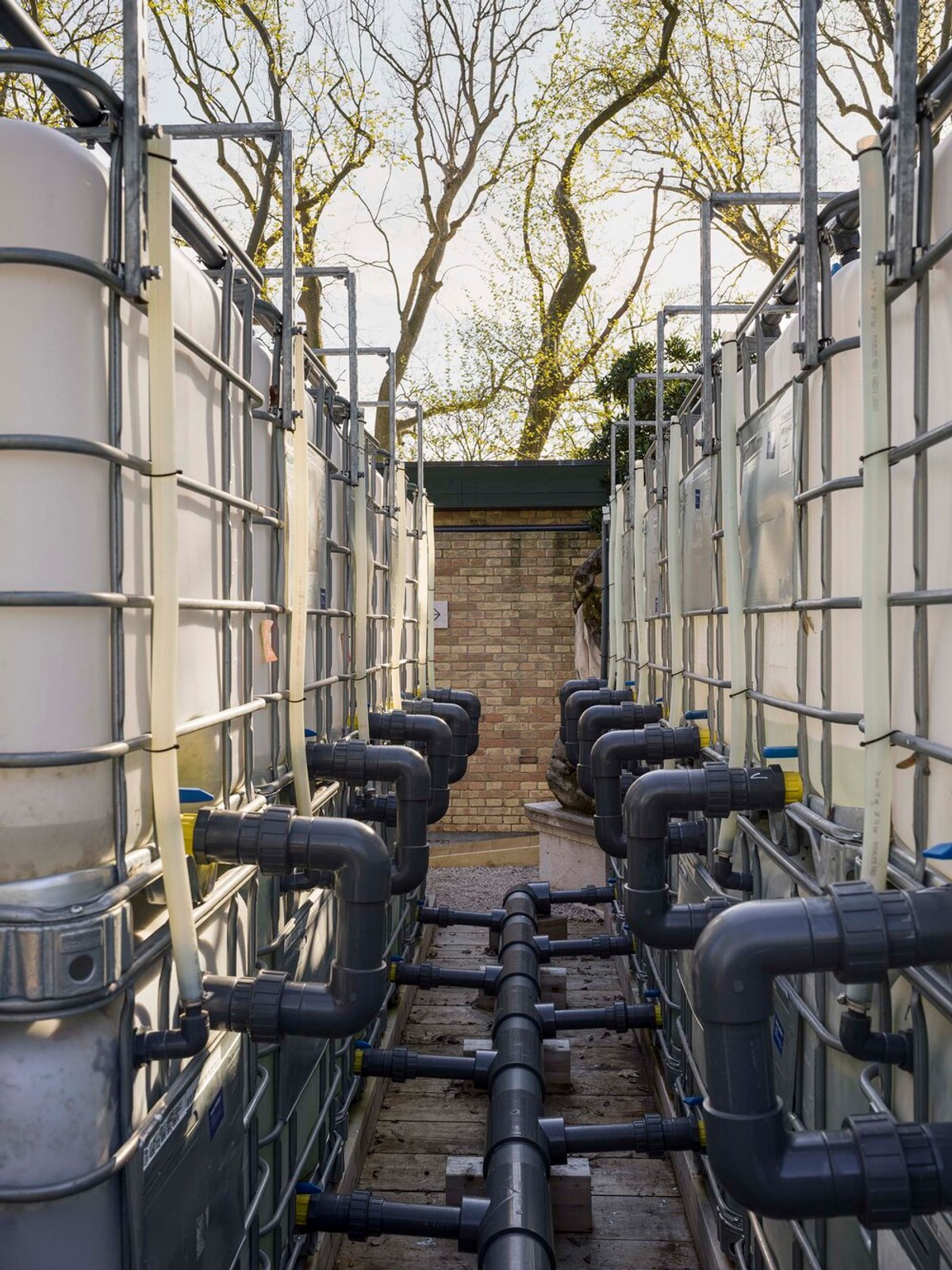
Ill. 1. Con-nect-ed-ness, The Danish Pavilion at the Venice Architecture Biennale 2021 curated by Marianne Krog in collaboration with Lundgaard & Tranberg Arkitekter. Photo: Hampus Berndtson.
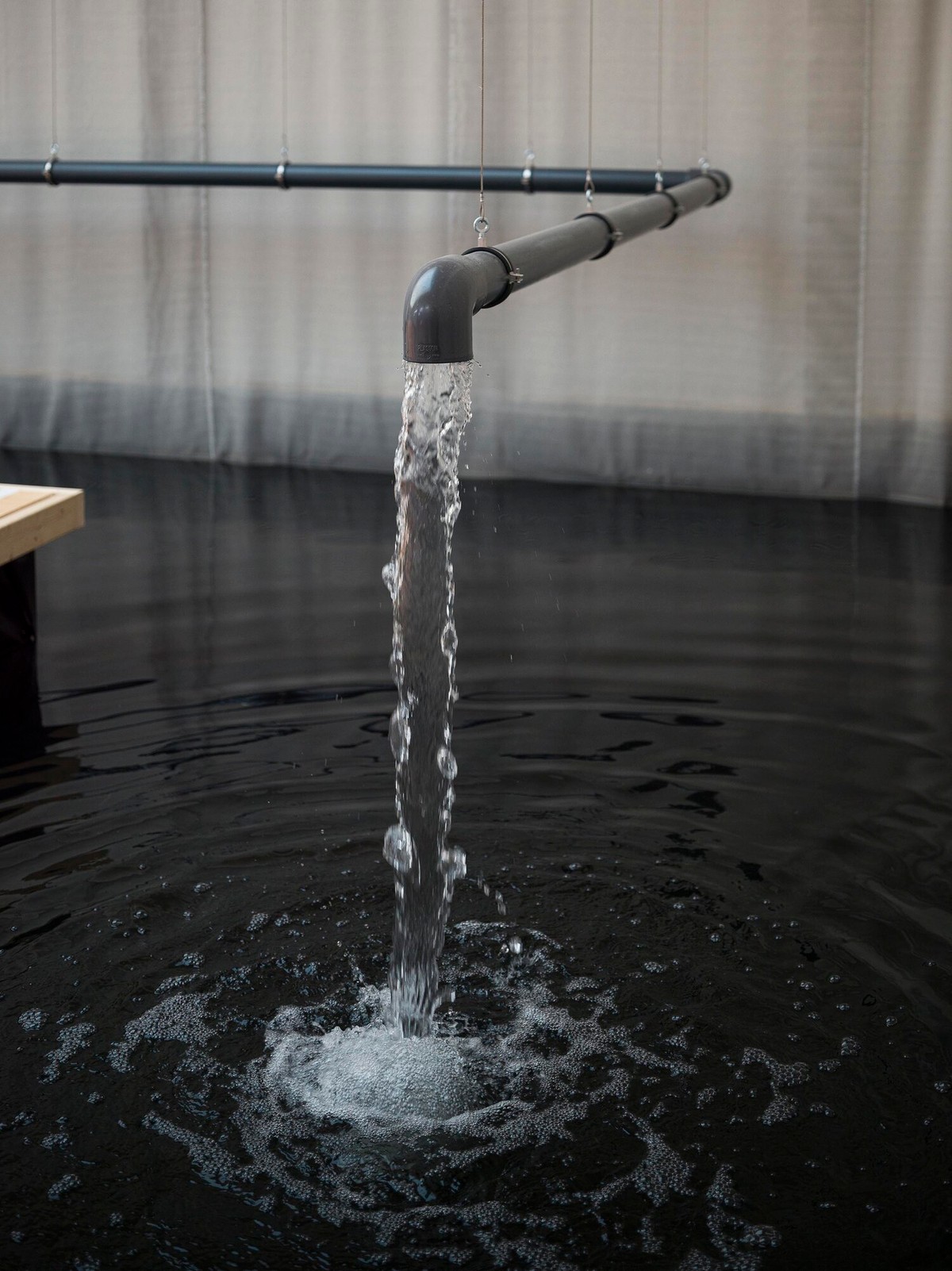
Ill. 2. Con-nect-ed-ness, The Danish Pavilion at the Venice Architecture Biennale 2021 curated by Marianne Krog in collaboration with Lundgaard & Tranberg Arkitekter. Photo: Hampus Berndtson.
Last week, when the sun was out and the summer seemed to extend itself into the first days of autumn, I went to eat my lunch on the terrace just out there, behind the Seaplane Hangar. A wasp attempted to join me at the table, which prompted me to eat somewhat faster than I normally would have. I had left the glass door open, but the wind had caused it to move and shut. I had no choice but to walk around the building and use the main entrance. On my way, I got caught in a gigantic spider’s web, suspended between the hangar and some of the mock-ups on the lawn. The strings must have been several metres long. When I had returned to my desk to read, a large fly made its entrance through the open window, only to disappear again within seconds.
Such events are commonplace, some would say banal. I’m not suggesting that I suddenly experienced the mightiness of Nature with a capital N, or even a heartfelt sense of interspecies entanglement. Nevertheless, sun, wind, wasp, spider, and fly, that is, climatic conditions as well as other life forms had an impact, however diminutive, on my actions and sensations inthe world. Nature isn’t somewhere else.
These tiny events and their minor consequences are, of course, insignificant compared to what is happening in the world on a larger scale as regards the relationship between climate, human beings, and other organisms. The global pandemic has certainly demonstrated the fragility of our societies and ways of life which, ironically, seem to have caused the pandemic in the first place. A simple consequence of human exploitation of natural resources, of deforestation and urbanisation. This human hubris has various reasons. The lure of power and economic gain has resulted in the abuse of our surroundings, only supported by the rationalist idea of a split between nature and culturewhich has allowed for the subjugation of the former by the latter. However, climate change and global pandemics urge us to think differently and, accordingly, to act differently. To leave the old dichotomy of nature versus culture behind and explore what Donna Haraway, American science scholar and prominent feminist, has described in a single, compounded word as NatureCulture, a morass of species and matter.
It is time for us to follow Haraway’s advice and stay with the trouble, to engage in what British philosopher Timothy Morton has termed the ecological thought, and to relate such thinking and its difficult and perhaps frightening consequences to our field of architecture. In fact, taking the etymology of the word ecology into consideration, it seems rather appropriate to relate it to the word architecture. After all, some sort of architecture is already implied since eco comes from the Greek oikos meaning house or household, while logos means wordor study from the Greek logia.
Of course, ecology does not mean the study of houses, only in the sense of the house as an environment, the surroundings. Ecology is the study of the relationship between organisms and their environments, but today the term is also being applied in a broader and sometimes even metaphorical sense to describe a relational attitude to the study of various aspects of our world. People study political ecologies, social ecologies, psychological ecologies, technological ecologies, and even the ecologies of architecture. Perhaps the ecologies of architecture then suggest a study of the relationships between architecture and the life forms which inhabit its built structures, in the broadest possible sense? It may also imply a particular interpretation of the very name of our institute, of architecture and culture, an interpretation which would move beyond the nature versus culture dichotomy.
The production of architecture, the building industry, is responsible for a vast amount of the global CO2 emission. Such a responsibility reflects other forces and desires, economic as well as psychological. Indeed, we should remind ourselvesthat the Greek word oikos is also at the root of the word economy. Steering the production of architecture in a more sustainable direction should be a common concern, an endeavour to which architects can contribute through practice, research, and artistic exploration. Climate change, the mass extinction of species, and the spread of pandemics are all extremely frightening matters which can cause anxiety, feelings of guilt, and mental flagellation for our sins as humans. Some would counter this with techno optimism or even techno fetishism, trusting in the capacities of human rationality, technology, and technocracy.
Understanding and transforming the ecologies of architecture in order to take them in more sustainable and inclusive directions, however, also requires making those ecologiessensable, which architecture can contribute to. A question for the students – and the teachers – who are present here today: how can we create architecture which respects and enhances ecological thinking, and makes the ecologies of architecture present to our senses?
One might begin by looking for inspiration in the works of others. A first example: In her current exhibition titled Insecare – an amalgamation of the two words insect and care – at Kunstforeningen Gl Strand, Danish artist Astrid Myntekær artistically investigates insects and the mass extinction of species within the world’s ecosystems in her captivating, precise, and highly sensorial sculptural work. Would an architectural Insecare be equally possible? A second example: As you may know, this year’s Danish pavilion at the Venice Architecture Biennale, curated by architectural historian Marianne Krogh, is called Connectedness. It points to a relational attitude, a sensitivityto interdependencies between human beings, natural phenomena, technologies, and architecture. It points to consideration of and respect for what American philosopher Jane Bennett callsvibrant matter, a term which describes our world as process rather than dead matter, and which associates things and organisms with agency.
In his text, “An Attempt at a Compositionist Manifesto” written in 2010, the French anthropologist and philosopher Bruno Latour states: “Everything happens as if the human race were on the move again, expelled from one utopia, that of economics, and in search of another, that of ecology. Two different interpretations of one precious little root, eikos, the first being a dystopia and the second a promise that as yet no one knows how to fulfil. How can a liveable and breathable ‘home’ be built for those errant masses?” It is exactly such liveable and breathable homes, such environments – not just for humans, but as well for our neighbouring species, the wasp, the spider, and the fly – that I would like to encourage all of you to consider, to explore, to discuss, and to create.
Næste: Mure af hække med svævende tage
Ill. 1. Con-nect-ed-ness, The Danish Pavilion at the Venice Architecture Biennale 2021 curated by Marianne Krog in collaboration with Lundgaard & Tranberg Arkitekter. Photo: Hampus Berndtson.
Ill. 2. Con-nect-ed-ness, The Danish Pavilion at the Venice Architecture Biennale 2021 curated by Marianne Krog in collaboration with Lundgaard & Tranberg Arkitekter. Photo: Hampus Berndtson.