





Ill. 1. Kubus stacking containers, set of ten by Wright20, 2013
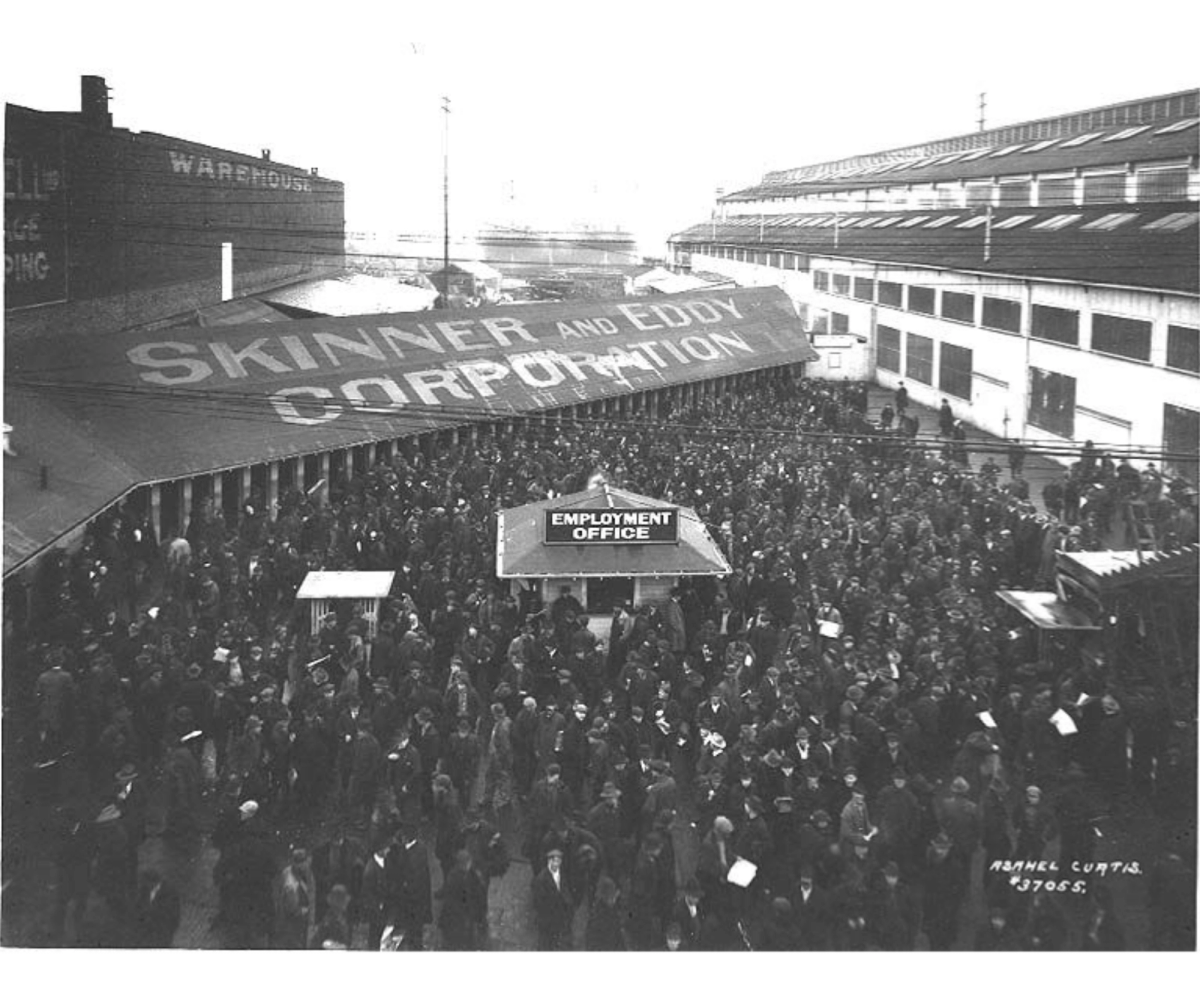
Ill. 2. Photograph of Skinner and Eddy shipyard workers leaving on strike by Asahel Curtis, 1919
Imagine for a moment that the act of building, the act of designing buildings, is halted overnight. That by tomorrow close to 620.000 architects and 13 million construction workers that constitute over 9% of Europe’s GDP are displaced, without work. Such scale poses a critical question when faced with the construction moratorium of Byggestop: Is such a halt realistic, let alone even justifiable?
Despite a multiplicity of vocal and public commitments from individuals and organisations alike, to safeguard and care for our planet, our actions betray us, with a considerable amount of construction continuing unabated. This contradiction extends beyond the profession into our personal lives: Many of us continue to travel by plane, eat meat, and purchase new clothing despite the clear and pressing implications of doing so. The climate crisis we face today requires dynamic, scalable solutions across industries: It demands a multifaceted approach, one where we interrogate the value of the work of the architect and accept that the status quo is no longer feasible.
As architects, we must accept that we stand at a crossroads: We face growing regulations to reduce the environmental footprint of our work, as we should, and yet the system within which we operate demands that we continue building. The single-family home, despite being widely accepted to be a contemporary symbol of wealth and the most environmentally impactful dwelling type, accounts for 56% of turnover for architects in Europe in 2022. The relationship between architecture, capital, and societal value we aspire to create requires investigation, as does the societal impact of the commodification of architecture.
THE COMMODIFICATION OF HOUSING AND ITS IMPLICATIONS
At its core, the value of architecture has been one of security, to provide shelter from the elements. With the earliest houses thought to have been conceived anywhere from between 1.8 million – 400,000 years ago, the typology of the house has since then transformed radically. Architectural styles have likewise evolved, with the journey to ornamentation and its antithesis, reflecting societal change and its contextual influences. The industrial revolution was a turning point for architecture, enabling the buildings of the early 1900s to effectively transform from crafted object to living machine — or Wohmachinen, as originally coined by Gropius — the focus of which was the industrialisation of the home into a series of reproducible types.
[Ill. 1]
During and following the World Wars of the early 20th century, the modernist principles birthed from the Bauhaus movement influenced not only the considerable amount of architecture that arose throughout this period of time but also the objects, such as Wilhelm Wagenfeld’s Glas Kubus [Ill. 1]. This emphasis on function and manufacturing efficiency penetrated into a considerable amount of social and affordable housing that emerged from this period, not only across Europe, but also the US. Social and affordable housing projects of the time, such as Le Corbusier’s Unité D’habitation, Ernö Goldfinger's Trellick Tower, and Tim Tinker’s Heygate Estate, were typically spurred by governments and trade unions alike, that were relying upon these large scale developments to address public housing shortages. These projects were intended to accommodate sprawling numbers of industrial workers, typified by those in the American shipyards of WW1, as well as for migrant populations displaced across Europe following the two World Wars.
[Ill. 2]
Inaugurated after The United States declared war against Germany, The United States Housing Corporation (USHC) was charged with housing the many thousands of workers required to build US navy vessels. As this modernist dream become a reality via the many notable social housing projects of the early to mid 20th century, such as the Williamsburg Houses and Dawson’s Heights, we see the mass-production of housing eventually lead to its commodification, not only through federal policies but also thanks to a newfound reduction in manufacturing costs:
“In 1949, for instance, the labour and material or ‘shell costs’ of an American single-family house amounted to 69 percent of the total. By 1974 it had declined to around 48 percent (U.S. Department of Commerce 1976).”
The mass-production of housing witnessed during this period, eventually led to its commodification, with policies such as the UK's Right to Buy scheme all but guaranteeing this: “The introduction of Right to Buy reduced the number of homes the housing association could offer to the community, and also ushered in the concept of buy-to-let, which undermined one of the original goals of the development.”
Introduced in 1980, the Right to Buy scheme allowed tenants of such mass housing to purchase their homes considerably below market price, resulting in the ability to trade upwards, or even to buy a second home, known as “trading up”. If the right to buy housing was to be considered universal, then this would not be problematic. But is it not housing itself—particularly access to such—which should be considered universal? This post-war commodification transformed housing into a tradable commodity, diluting its intended egalitarian objective of affordable housing.
Towards the later half of the 20th century, structural changes in the economy, like the creation of the Mortgage-backed Security, all but guaranteed the commodification of housing. Such structural change “... distances housing from being fixed capital and transforms it into fluid Money”, in turn severing its connection to social utility. As the structure, complexity and pervasiveness of capitalism enabled it to become paramount to our contemporary lives, a reflection towards the architecture we create today, and for whom we create it, is most apt. In Post, Past, or Post-Past: The Commodification of Architecture, Hamid Shirvani assesses the influence of capital-hungry actors on architecture’s recent aesthetic evolution: “Architecture, which depends on money and power for its bread and butter like no other artistic realm, has been intoxicated by the influence of that money and power”.
Whilst we may regard pension funds as the guarantors of our future financial security, they are also the key financiers of many large building projects of today: PFA Pension, for example, is behind the recent Nordø in Nordhavn. Projects like these may provide hundreds, in some cases thousands of homes, but ultimately serve as an instrument through which to allocate and manage capital, further entrenching the notion of housing as a commodity. Despite this, they simultaneously provide our industry with a considerable amount of sustained employment, underscoring the necessity with which we must re-assess the status quo of building for the sake of building. The architect-developer relationship is one that demands scrutiny, as we continue to be of service to such actors, failing to question whether our output is one that meets a genuine social need.
RE-EVALUATING THE SOCIETAL ROLE OF ARCHITECTURE
A critical examination of the building industry might currently be underway, yet the questions being asked are missing the point. To question the materials with which we build together with the environmental footprint of a building is a critical start, but irrespective of how low the carbon footprint is, a negative planetary impact persists. Continuing to build does however enable us to enrich our collective stock of knowledge, as does investigating how we build. A paper by R.N. Hansen et al. for example recently shed some light on construction methods and associated materials, identifying that when considering aspects of consequential LCA, indirect Land Use Change (iLUC) and forest modelling, conventional construction obtained a lower Global Warming Potential (GWP) than timber-based construction for single-family homes and office buildings. Replacing the primary building materials plays a large part in current decarbonization efforts, and certainly has a role to play, but fails to truly challenge us: The fundamental question of for whom and why we build remains unaddressed.
The ability to question why, and to be empowered to go against the social inertia that we find ourselves amongst today, is perhaps the most powerful tool we have. By questioning existing prevailing economic practices and exploring the contribution of alternative value, we might begin to imagine an industry that contributes to our greater wellbeing as opposed to one that contributes to more than 40% of global GHG emissions. The potential for de-growth and Universal Basic Income (UBI) in fostering such a transformation in architectural value cannot be understated.
Economic activities are directly linked to carbon emissions, but it is not growth itself which should be questioned, but the kind of growth that we are manufacturing. Jean-Marie Monnier and Carlo Vercellone in Le Revenu De Base Comme Revenu Primaire (Basic Income as Primary Income) argue for the need to establish a form of social contract, where the social and cultural value created—alongside that which creates financial value—is recognised.
“Workers must fight not for a better distribution of value, but for the production of an alternative value. They must replace capitalist institutions (profit-seeking ownership, credit, labour market) by institutions inspired by social welfare and the civil service.”
The establishment of a secondary income stream where the productive output of the individual or organisation would be that of social value, as opposed to the generation of capital value, might just enable such agency: Outputs that contribute to the common good beyond traditional employment.
For the individual to gradually shift their time, effort and attention towards social value as opposed to one that generates social capital, requires structural change not only politically and economically, but also a fundamental shift in the way we live our lives. Charles Eisenstein provides a particularly relevant point about how social currency can contribute towards a shrinking economy, one where individuals are no longer forced to dedicate their entire working lives towards the generation of capital. Eisenstein explores the case of OpenOffice, a Microsoft Word alternative created mostly by unpaid developers, highlighting the wider benefit and impact their contribution had as a result of focusing on the generation of social value:
“I prefer to see their productivity as a gift economy, which naturally generates respect and gratitude among community members. … We could easily have a shrinking “economy” that offers more and more, better and better, products like these. And the more there are, the less we need money; the less we need money, the more leisure time we have; the more leisure time we have, the more we can afford to make our own offerings to the gift economy.”
Eisenstein
Despite the impending generational wealth exchange that is about to occur,17 many of us still require and depend upon our salaries: Not only those with an income, but those running businesses dependent upon its expenditure. This dependency limits our ability to exert agency, whilst simultaneously locking the individual within the existing system. To stop building requires considerable industrial and cultural adjustment: without a considered gradual shift or with adequate safeguards in place, such an act would likely result in adverse economic and social consequences. What the act of building requires is a significant reorientation of our collective mindset, to challenge ourselves to question what value we provide when we do build: is it social, or is it financial? As Lara Schrijver states, “Some problems have no technical solution, but require an assessment of their moral context”.
–
Jacques Chevrant is an Architect MAA and UX Lead currently focused on advancing the integration of biogenic and low-carbon materials into mainstream architectural practice, while advocating for sustainable and renewable practices.
The Architect’s Council of Europe, The Architectural Profession in Europe 2022 Sector Study, (Belgium: The Architect’s Council of Europe, 2023), 3.
“EU for Fair Construction”, European Labour Authority, accessed February 24, 2024, https://www.ela.europa.eu/en/campaigns/eu-fair-construction.
The Architect’s Council of Europe, The Architectural Profession in Europe 2022 Sector Study, (Belgium: The Architect’s Council of Europe, 2023), 3.
“EU for Fair Construction”, European Labour Authority, accessed February 24, 2024, https://www.ela.europa.eu/en/campaigns/eu-fair-construction.
Lavagna, Monica, Catia Baldassarri, Andrea Campioli, Serena Giorgi, Anna Dalla Valle, Valentina Castellani, and Serenella Sala, “Benchmarks for Environmental Impact of Housing in Europe: Definition of Archetypes and LCA of the Residential Building Stock.” Building and Environment 145 (November 2018): 260–275. https://doi.org/10.1016/j.buildenv.2018.09.008.
“ACE Observatory/Observatoire Du CAE”, Ace Observatory, n.d., https://aceobservatory.com/M_Sectors.aspx?Y=2022&c=Europe&l=EN.
- H. E. Riley, “Evolution in the Worker’s Housing Since 1900.” Monthly Labor Review 81, no. 8 (1958): 854–61.
http://www.jstor.org/stable/41833974.
Peter G. , Modernity and Housing. (Cambridge, Mass: Mit Press, 1995), 219.
Alex Whitwell, “The Dream and Decline of Post-War Modernist Social Housing in South London.”, Medium, Accessed February 26, 2024. https://medium.com/@alex.whitwell/the-dream-and-decline-of-post-war-modernist-social-housing-in-south-london-ee525f353ef6#:~:text=The%20introduction%20of%20Right%20to.
Rowe,“Modernity and Housing”, 218.
Melissa Ozer, “There’s no place like home: The commodification of housing in London and its effects on the right to housing and to the city”: 7. https://ssrn.com/abstract=3627526
Hamid Shirvani, “Post, Past, or Post-Past: The Commodification of Architecture”, Differentia: Review of Italian Thought: Vol. 8 , Article 9 (1999): 76. https://commons.library.stonybrook.edu/differentia/vol8/iss1/9
Rasmus Nøddegaard Hansen, Jonas Lassen Eliassen, Jannick Schmidt, Camilla Ernst Andersen, Bo Pedersen Weidema, Harpa Birgisdóttir and Endrit Hoxha, “Environmental consequences of shifting to timber construction: The case of Denmark,” Sustainable Production and Consumption 46 (2024): 65. https://doi.org/10.1016/j.spc.2024.02.014
World Green Building council and Ramboll. Bringing embodied carbon upfront. London: UK Green Building Council, 2019.
“50 years of Greenpeace: Q&A with Rex Weyler”, Greenpeace, accessed February 25, 2024, https://www.greenpeace.org/international/story/48457/greenpeace-50-years-rex-weyler-mailbag/
Jean-Marie Monnier and Carlo Vercellone, “Le Revenu De Base Comme Revenu Primaire” In Revenu Universel L'état Du Débat, ed. By Guillaume Allègre et Henri Sterdyniak (Observatoire français des conjonctures économiques - OFCE, 2017), 86– 100. https://sciencespo.hal.science/hal-03222424v2
Monnier and Vercellone, “Le Revenu De Base Comme Revenu Primaire”, 88.
Charles Eisenstein, Sacred Economics. (Evolver Editions, 2011), 181–182.
Jack Kelly, “The Great Wealth Transfer From Baby Boomers To Millennials Will Impact The Job Market And Economy”, Forbes, accessed February 26, 2024. https://www.forbes.com/sites/jackkelly/2023/08/09/the-great-wealth-transfer-from-baby-boomers-to-millennials-will-impact-the-job-market-and-economy/
Næste: Stop Painting, Stop Building
Ill. 1. Kubus stacking containers, set of ten by Wright20, 2013
Ill. 2. Photograph of Skinner and Eddy shipyard workers leaving on strike by Asahel Curtis, 1919