




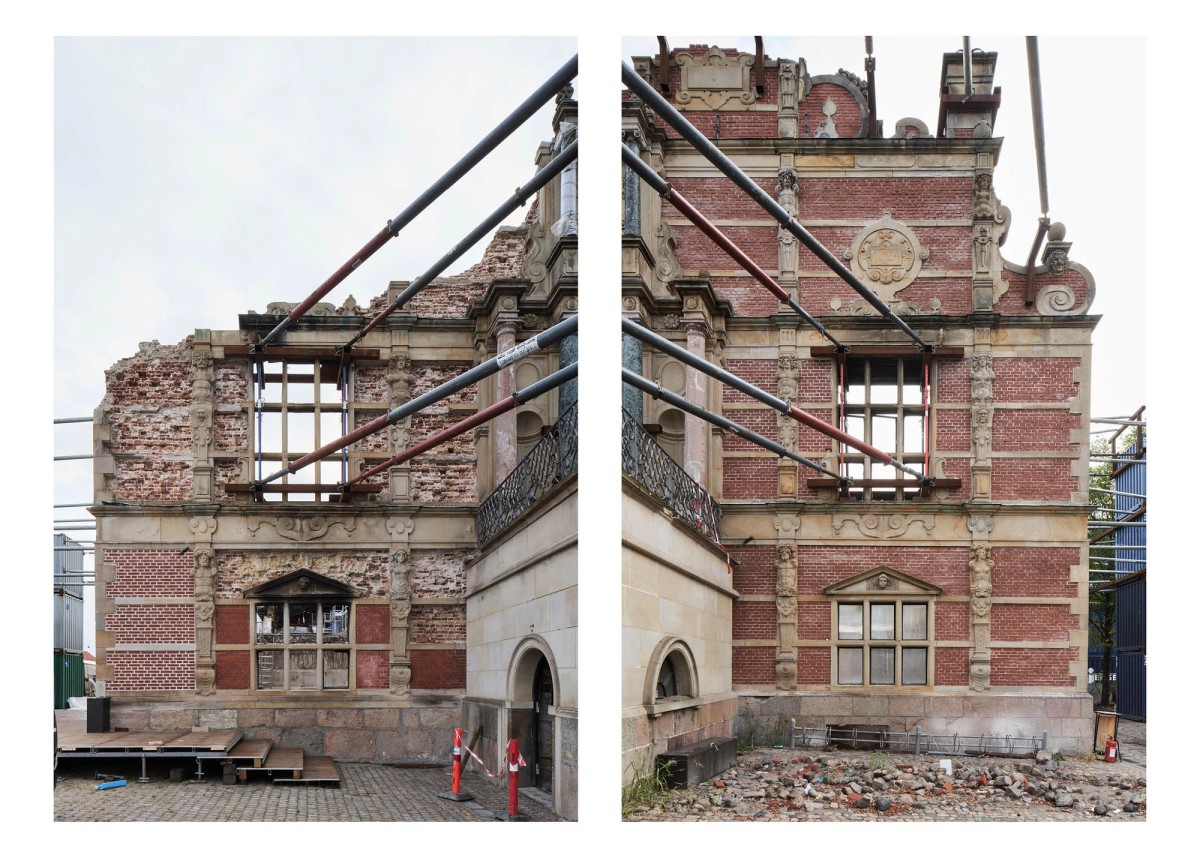
Western wall, Børsen. Dipytch, 2024. Foto: Lars Rolfsted Mortensen.
BØRSEN, APROPOS
Den ikoniske barokbygning med sit unikke dragespir styrtede sammen i flammer den 16. april, 2024.
Under efteråret har studerende ved Kandidatprogrammet for Transformation og Restaurering på IBK studeret resterne i minutiøs detalje ved opmåling, bygningsarkæologisk registrering og værdisætning direkte på stedet. Adjunkt Lars Rolfsted Mortensen med kollegaer beskriver arbejdet og viser et lille udsnit af materialet.
Christoffer Thorborg, lektor ved Aarhus Arkitektskole, begynder sit essay med at lade kollapset foranledige en problematisering af rekonstruktion som arkitektonisk værktøj. Således motiveret opridser han rekonstruktionens idéhistorie, dvs. historien om de mange skiftende forestillinger om det meningsfulde ved at rekonstruere mistet kulturarv.
Filip Ivarsson, arkitekt med ekspertise i historisk byggeteknik, dvæler heller ikke længe ved Børsen, men bruger lejligheden til at spørge retorisk om Danmark uddanner tilstrækkelig mange nye fagkyndige indenfor traditionelt byggehåndværk. Ikke for at der mangler kompetencer til rekonstruktionen, men for at der er fordele ved at bygge med lokalt tilgængelige materialer som både kan binde CO2 og egner sig til genbrug. Hvis bare industrien er med på omstillingen, og håndværkere og arkitekter ved hvordan man gør.
Afslutningsvis løfter Anne Silberg Thomsen diskussionen om Børsen til et begrebskritisk niveau. Autenticitet og originalitet repræsenterer en idétradition som ikke forsvandt med postmodernismen men som styrer såvel forvaltningspraksis som arkitektonisk værdisætning i sager om fredning og rekonstruktion. Eksempler på overraskende fund i ruinen som komplicerer begreberne understøtter også Thorborgs ræsonnement og fremtræder i det afsluttende kapitel som klare tegn på genopbygningsproblematikkens kompleksitet og nuværende relevans.
__________________________________________________________________________
BØRSEN, APROPOS
The iconic baroque building with its unique dragon spire collapsed in flames on April 16, 2024.
During the fall semester, all students at the Master's Program for Transformation and Restoration at IBK have studied the remnants in minute detail, taking measurements, conducting registrations, and making valuation assessments directly on site. Associate Professor Lars Rolfsted Mortensen plus colleagues describe the work and shows a small selection of the visual material.
Christoffer Thorborg, associate professor at the Aarhus School of Architecture, begins his essay by letting the collapse prompt a problematization of reconstruction as an architectural practie. Thus motivated, he outlines the intellectual history of reconstruction, i.e., the history of the many changing ideas about why reconstructing bygone cultural heritage is meaningful.
Filip Ivarsson, an architect with expertise in historical building techniques, does not dwell long on the Stock Exchange, but uses the opportunity to rhetorically ask whether Denmark educates enough students in the field of traditional craftsmanship. Not because there is a lack of skills for the reconstruction, but much rather because there are advantages to building with locally available materials that can both bind CO2 and are suitable for reuse—if only the industry is committed to the transition and craftsmen and architects have the requisite know-how.
Finally, Anne Silberg Thomsen elevates the discussion about Børsen to a concept-critical level. Authenticity and originality represent an intellectual tradition that did not disappear with postmodernism but which governs both administrative practices and architectural valuation in preservation and reconstruction cases. Examples of surprising findings in the Børsen ruin complicate these concepts and appear in the concluding chapter as a testiment to the complexity and current relevance of reconstruction issues.
Næste: Fugl Føniks – hvordan skal Børsen genopstå?
Western wall, Børsen. Dipytch, 2024. Foto: Lars Rolfsted Mortensen.